
MARCH 31, 1889:What Hath Iron Wrought

On March 31, 1889, the structure that would forever change the Paris skyline opened to the public.  The French were understandably proud of the Tour Eiffel,La dame de fer” (“Iron Lady”).  They enthused:

“We, writers, painters, sculptors, architects and passionate devotees of the hitherto untouched beauty of Paris, protest with all our strength, with all our indignation in the name of slighted French taste, against the erection … of this useless and monstrous Eiffel Tower … To bring our arguments home, imagine for a moment a giddy, ridiculous tower dominating Paris like a gigantic black smokestack, crushing under its barbaric bulk Notre Dame, the Tour Saint-Jacques, the Louvre, the Dome of les Invalides, the Arc de Triomphe, all of our humiliated monuments will disappear in this ghastly dream. And for twenty years … we shall see stretching like a blot of ink the hateful shadow of the hateful column of bolted sheet metal.”

Well, maybe not everyone.

The Tower was the centerpiece of the 1889 World’s Fair, celebrating the 100th anniversary of the French Revolution.  At a height of 1,083 feet, it surpassed the Washington Monument as the tallest freestanding structure in the world.  Continuing the game of one-upmanship, Americans struck back with the Chrysler Building in 1930.  In 1957, the French regained the title by adding an aerial to the top of the tower.

The tower has three levels open to the public.  The top level, 906 feet above the ground, has an observation deck and a private pied à terre built for Gustave Eiffel.  Some six million people make the climb every year.  As far as we know, none have ever been invited into the pied à terre.

Fooling Around with Father Time

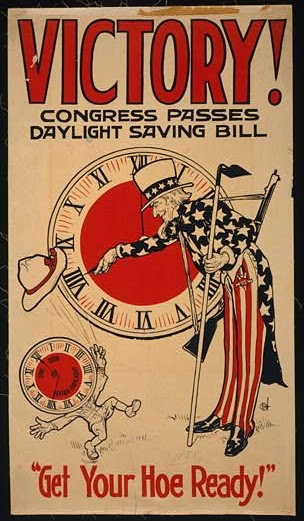
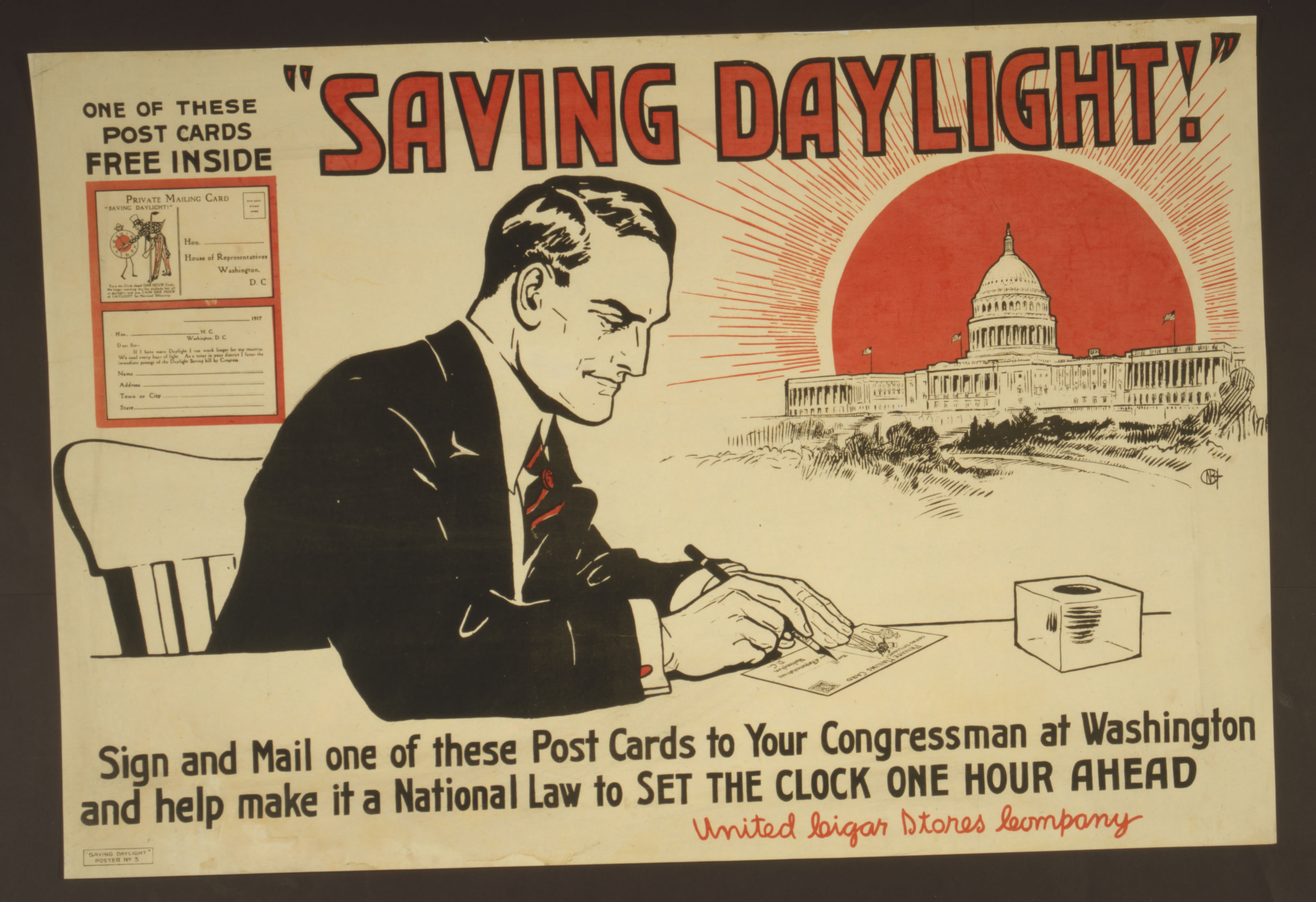
We’ve been enjoying the benefits of daylight saving time for a couple of weeks now – something most of us have always known. But it wasn’t always so. We saved no daylight before March 31 in 1918, when daylight saving time went into effect in the United States for the first time. It was abandoned after World War I and had an off an on again existence for the next half-century.

Strangely enough, the concept was fairly controversial. In a government hearing on daylight saving time back in the late 40s, Senators brought up several unusual points.
The Senator from Louisiana wondered what effect the change would have on his milk supply since “the flow of milk is not governed by any act of Congress.” The Senator from Rhode Island answered: “I am not an authority on milk – I use it once in a while – but I am sure there will not be any trouble with the delivery of milk to the Senator’s door merely because of the variation of one hour in time.”

But the Senator from Louisiana was just getting started: “Daylight savings time or no daylight savings time, the birds are going to their nests according to standard time, and the squirrels will go to their rest in the same way; and the cows will want to go to the barns and get their food at that time, and they are entitled to do so. But the Senate bids the sun and the moon to stand still – why? To accommodate some of these ambitious people who like to get to work early and like to get away from work early and get out in the sun and play golf, and, after a few rounds of golf, retire for proper refreshments.
“Even love would be affected. A boy calls a young lady up and . . . they make a date for the evening and fix an hour. She has standard time and he has daylight savings time and they do not get together at all. It merely makes for confusion all around.”

Nevertheless, fifty-six senators voted for the daylight saving time bill. Calculations indicate that since that time we’ve saved 8,402 hours of daylight per person.


March 30, 1921: On the Corner of Sodom and Gomorrah

The town of Zion, Illinois, banned all jazz performances on this musicless day, labeling them sinful, right up there with tobacco and alcohol and sexting as things its citizens could well do without. The very word jazz was thought (correctly) to have a sexual connotation. The decadent rhythms and wild dancing it elicited were feared (correctly) to be leading young people down the road to sexual abandon (remember Footloose, barely a degree of Kevin Bacon from Satan himself), degeneracy, and bad manners. “Oh, you got trouble right here in Zion city.”

Zion, Illinois is a bunch of degrees from New Orleans, the birthplace of jazz with its Bourbon Street, bordellos and sin, sin, sin. Zion was founded in 1901 by John Alexander Dowie as a place where people of faith could come together and live in a moral environment, reading the Good Book from  Fri ’til Monday. The population was 24,655 as of the 2020 census. Zion is one of only a few cities in the world to have been completely planned out before building. And Dowie thought of just about everything. The north-south roads in the original plan were all named from the Bible –Ezekiel Place; Gabriel, Galilee, and Gideon Avenues; Matthew, Mark, and Luke, but no John. And no Duke Ellington Circle or Thelonious Monk Boulevard.

During the same year that Zion proscribed jazz, the town nixed evil alcohol,  In what can only be described as a binge, the citizens poured 80,000 pints of beer into Zion sewers.  Did they actually have 80,000 pints on hand?  Or did they have to borrow from nearby towns?  Perhaps Gabriel and Galilee Avenues harbored a lot of closet imbibers.  And maybe even a Louis Armstrong record or two.


Pencil Me In

Hymen J. Lipman one of the Philadelphia’s leading stationers, founded the first ever envelope company in the United States. Lipman didn’t just content himself with envelopes. His vision took him to pencils as well. And on March 30, 1858, the forward-looking Lipman earned himself a patent for a pencil with an eraser built right into one end of it. This was a giant step for the pencil industry.

Joseph Reckendorfer looked at Lipman’s pencil and saw dollar signs. He also saw himself as a titan of the pencil industry. He would be to pencils what Rockefeller was to oil, what Vanderbilt was to railroads. He bought the pencil patent from Lipman for $100,000 (the equivalent of a couple million today).

But alas it wasn’t to be. Pencil manufacturer A. W. Faber began producing eraser-tipped pencils without paying a penny in royalties to Reckendorfer. Reckendorfer sued Faber.  In 1875, the lawsuit made its way to the Supreme Court which declared the patent invalid, reasoning that Lipman’s design combined a known technology, the pencil, with another known technology, the eraser, not creating a new use. Bad news for Reckendorfer.

March 29, 1974: Can’t Someone Give Us an At Ease

One can imagine the look on the faces of Chinese peasants digging a well on their rural farm when, on March 29, 1974, they discovered not water but a huge subterranean chamber in which an 8,000-man army of fully-armed soldiers with horses and chariots stood ready for battle.  The life-sized figures were all individually crafted from terra cotta and they had stood at attention for more than 2,000 years.

The great chamber was the final resting place of Qin Shi Huang Di (“first emperor of Qin”), who unified various warring states to create a Chinese empire in 221 B.C.

Along with the terra cotta G.I. Joes, were enough bronze and iron farm implements, spears, swords, jade, and silk to keep grins on archaeologists’ faces for years to come.

Dash It All

This day in 1990 marked the beginning of the Hyphen War in Czechoslovakia. Although the USSR had fallen a year earlier, the official name of the country was still the Czechoslovak Socialist Republic. President Václav Havel proposed merely dropping the word Socialist from the name, but Slovak politicians wanted another change – the spelling of the name with a hyphen (i.e., Republic or Federation of Czecho-Slovakia ), as it was spelled from Czechoslovak independence in 1918 until 1920, and again in 1938 and 1939. President Havel agreed to the change, but the Czechoslovak parliament in typical political fashion resolved that the country’s long name was to be spelled without a hyphen in Czech and with a hyphen in Slovak.

This solution was found to be not only dumb but unsatisfactory, and less than a month later, the parliament reversed itself. Problem not solved. Although the Slovaks were demanding a hyphen, the Czechs called it a dash. The Czechs usually use the same term for both; Slovaks use different terms. Thus the Hyphen War began. Oddly enough, the Czechs did not call it the Dash War.

While the Hyphen War was not really a hot war (nor a cold war), it demonstrated differences between Czechs and Slovaks about their identity, that perhaps they really weren’t meant for each other. The slippery slope: the frequent bickering over minor issues, the trial separation, and in 1992, both sides said yes to splitsville. The country was split into two states – the Czech Republic and Slovakia – in what is called the Velvet Divorce (or for some, the Vel-vet Divorce).

MARCH 28, 1910: Not with the Mouse Again

Jimmie Dodd, who was born on March 28, 1910, was an American actor who had small parts in movies during the early 50s. His specialty seemed to be playing taxi drivers (You can check him out in Easter Parade.) His big break came in 1955 when he became the fearless leader of a gang of young teenagers who all performed on TV five times weekly sporting mouse ears.

Dodd was, of course, the head mouseketeer on the Mickey Mouse Club. Dodd also penned the infamous “Mickey Mouse Club March” as well as other songs which he performed on the program accompanying himself on his “mouse-guitar.” It must have been embarrassing enough for teenagers, wearing those mouse ears, but for a guy in his forties — well, chances are he drank heavily.

Kingdoms Can Be Magic or They Can Be Wild

Herding teenagers in mouse ears is one thing, but being chased by wild animals week after week was quite another. It was, however bread and butter for Marlin Perkins, born on this date in 1905. For 35 years beginning in 1950, Perkins was insulted, chased, bitten and stung, first on Zoo Parade and then on Wild Kingdom. Perkins eventually got smart and let his sidekick Jim Fowler interact with the animals while he narrated from a safe distance.

The Nays of Texas

On March 28, 1845, Mexico had a diplomatic temper tantrum over the territory of Texas and broke off relations with the United States. (Either both countries wanted Texas or neither country wanted Texas.)  Said the Mexican president: “We’re going to build a big, beautiful wall, and the United States is going to pay for it.”


March 27, 1958: They Say Goofy Is a Fellow Traveler

     Nikita Khrushchev was elevated to top commie in the Soviet Union on March 27, 1958. His Cold War relationship with President Eisenhower and the United States was a complex one, certainly more so than the Ego War between the current Russian leader and his previous U.S. bro-hug counterpart.

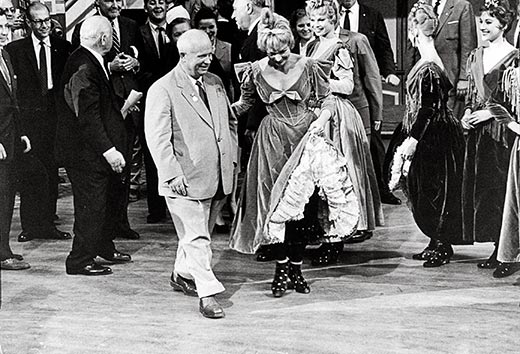
     The following year Khrushchev was in the U.S. for a summit meeting with Eisenhower.   At the Soviet leader’s request, a visit to Hollywood was arranged.  Khrushchev and his wife arrived in Los Angeles, where the day started with a tour of the Twentieth Century Fox Studios in Hollywood and a visit to the sound stage of  Can-Can. Meeting stars Shirley MacLaine and Juliet Prowse pleased the roly-poly dictator even though he had to nyet a chance to dance with MacLaine (probably something to do with the Siberian stare coming from Mrs. K)   A lunch hosted by Frank Sinatra was also a big success even though Sinatra didn’t sing “That Old Bolshevik Magic,” as Nikita requested.

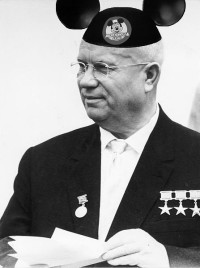
     The day headed downhill when Twentieth Century Fox President Spyros P. Skouras, who wore his anticommunism on his sleeve, got into a bit of a who-will-bury-whom brouhaha with the Russian leader who was known for his temper tantrums.  Shortly afterward, it began to look as though a nuclear exchange were imminent. Meeting Frank Sinatra was nice, but who Nikita really wanted to meet was Mickey Mouse.  His American hosts told him it couldn’t happen.  Security concerns.   Perhaps he’d like to see Cape Canaveral, the White House War Room, the Strategic Air Command. But no Disneyland.  Nicky exploded. “And I say, I would very much like to go and see Disneyland. But then, we cannot guarantee your security, they say. Then what must I do? Commit suicide? What is it? Is there an epidemic of cholera there or something? Or have gangsters taken hold of the place that can destroy me?”

Khrushchev left Los Angeles the next morning, and the Cold War returned to deep freeze.

Put a Cork in It

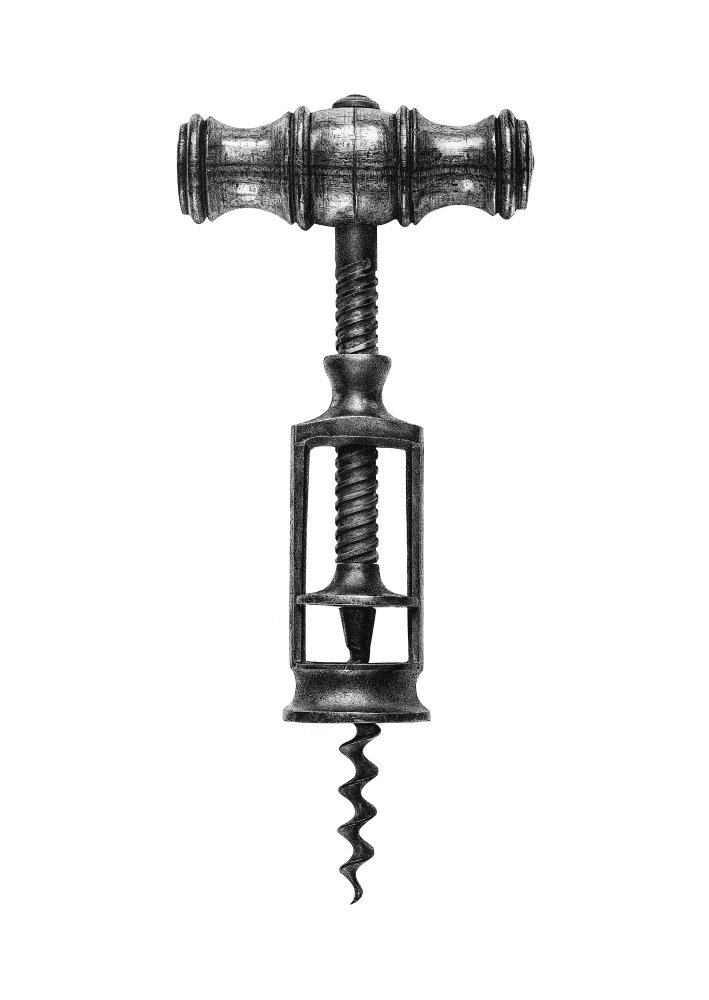
Back through the centuries wine lovers never aged their wines; they consumed it quickly before it went bad.  Then in the 18th century, British glassblowers began to make bottles with narrow necks for wine that made airtight storage possible. Corks were used to seal the bottles. This quickly led to the invention of one of the dandiest little gizmos ever devised — the corkscrew. The design was based on a similar device used to clean muskets. The first corkscrews were T-shaped devices that twisted into the cork and after a certain amount of pulling extracted the cork. Corkscrews were first patented in England and France, then on March 27, 1860, M. L. Byrn of New York City received an American patent.

Since then, hundreds of corkscrews have been designed of every shape, size and mechanics you can imagine — single-lever, double-winged, air pump, electric, mounted. Naturally there are corkscrew books, corkscrew clubs, and corkscrew collectors, helixophiles.

MARCH 26, 47 BC: WITH A LITTLE BIT OF LUCK

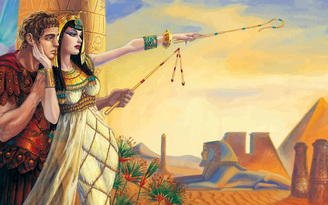
Ptolemy XIII was Pharaoh of Egypt from 51 to 47 BC (remember we’re counting backwards here), his reign pretty much demonstrating the bad luck associated with the number thirteen (in fact he could have been nicknamed Ptolemy the Unlucky or Friday the XIII).

Ptolemy XIII succeeded his father Ptolemy XII, becoming co-ruler by marrying Cleopatra who was his older sister at the time. She was Cleopatra VII, but she was the Cleopatra we all know about — the one of Antony and Caesar and the asp and all that. Since XIII was only 11 at the time, he had a regent — and should you be thinking about the regent’s duties vis-à-vis Cleopatra, we’ll point out that the regent’s name was Pothinus the Eunuch.

Still with us?

Cleopatra, it turns out, was a bit of a grandstander, strutting about as Queen, putting her image on coins, and generally hogging the Egyptian spotlight. Thus in 48 BC, XIII and his eunuch tried to depose her, but she ran off to Syria and raised herself an army.

Enter Roman general Pompey, seeking sanctuary from Julius Caesar.  XIII pretended to welcome Pompey but had him murdered instead.  When Caesar arrived, XIII gave him Pompey’s head as a little welcoming gift. Caesar was unimpressed and took Cleopatra as his welcoming gift instead, giving XIII a cold Roman shoulder and killing his eunuch for good measure.

While Caesar and Cleopatra kept busy trysting the night away, XIII in cahoots with another sister (it’s great to be able to toss in another sibling when things are beginning to slow down) tried again to dump Cleopatra.

XIII and his other sister were no match for Caesar and Cleopatra and in the ensuing Battle of the Nile, XIII was forced to flee. Unfortunately, Ptolemy the Unlucky was drowned as he attempted to cross the Nile.


MARCH 25, 2024: WAITER, THERE’S A LOBSTER ON MY WAFFLE

Today is International Waffle Day, a tradition that is celebrated worldwide but mostly in Sweden. It’s a day to enjoy – guess what? – eating waffles. The day may have arisen out of confusion. Waffle Day in Swedish, Våffeldagen, sounds a lot like Our Lady’s Day,Vårfrudagen, (you really have to be on a street in Stockholm to get the full effect), a Christian holiday also known as Annunciation (the third Thursday after Pronunciation), when the Archangel Gabriel told the Virgin Mary she was pregnant. Mary was understandably upset and did what any virgin would do upon being told she was pregnant – stuffed herself with waffles. Waffle Day also coincides with the beginning of Spring, another traditional day for eating waffles in Sweden. Therefore, if you see a Swede eating waffles today, you don’t know if it’s religious or secular or just hunger.

More interesting facts:

Waffles were made with cheese and herbs in ancient Greece.

The familiar grid pattern of today’s waffles originated in the Middle Ages. Some waffles had fancier designs such as coats of arms,  landscapes and portraits of Middle Age people.

Waffles were so popular that they were even sold from street carts (by strange looking men who eventually switched to selling chestnuts and large pretzels).

In the late 1800’s, Thomas Jefferson returned from France with a waffle iron.  It’s unclear how he got it through security.

Many folks in Britain celebrate International Waffle Day by eating rutabagas which are known there as Swedes.  There is no International Rutabaga Day.

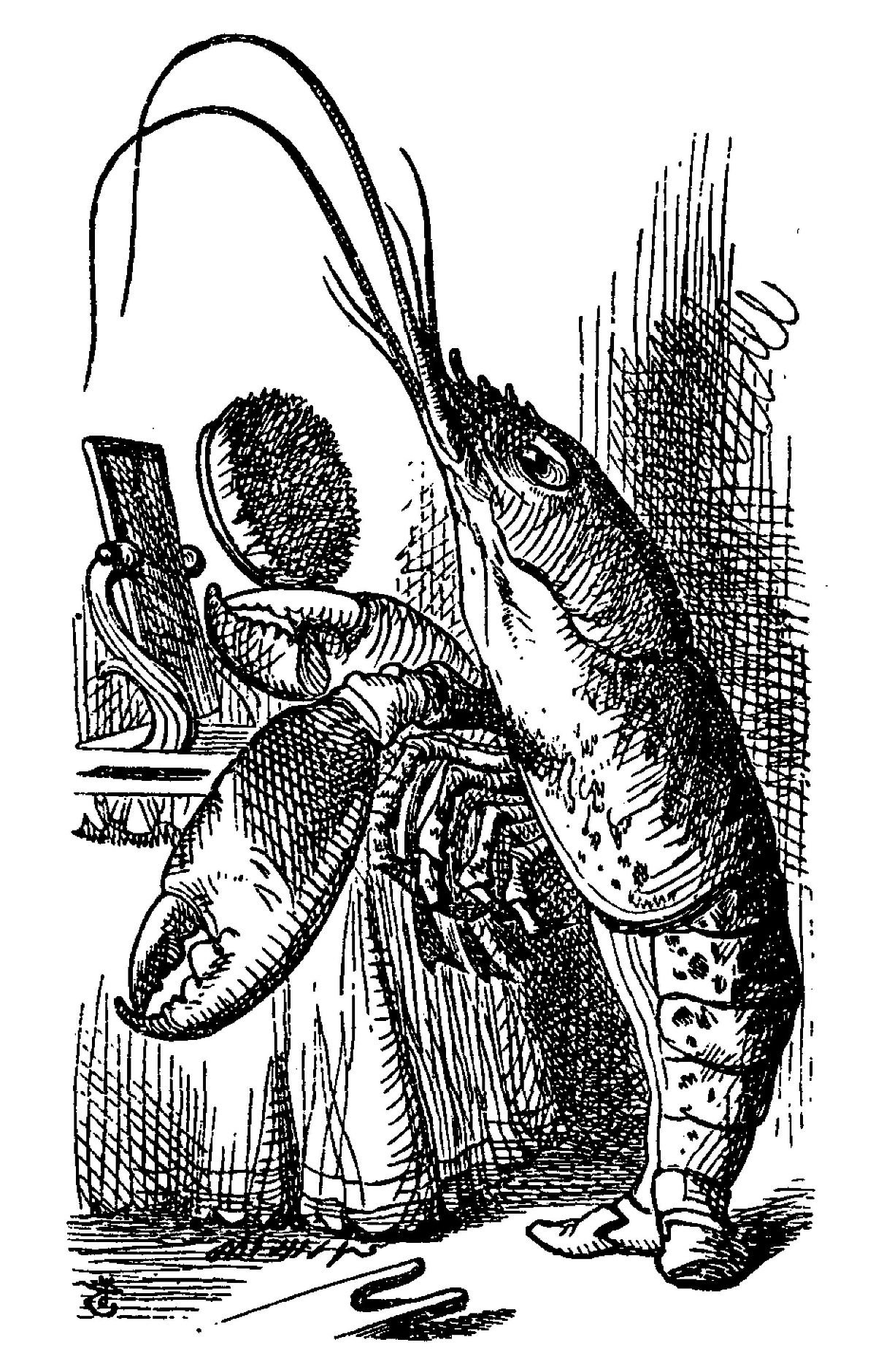
There is, however, a Lobster Newburg Day – and it’s today!

Lobster Newburg, lobster with a sherry and cognac infused, egg-thickened cream sauce, was first served at New York’s Delmonico’s in the 1870s. Delmonico’s was not only the first formal dining restaurant in the United States, it was the first to serve hamburger, the creator of Baked Alaska, the creator of Eggs Benedict, and of course the creator of Lobster Newburg.  A waffle topped with Lobster Newburg, anyone?

The Lobster Quadrille (from Alice in Wonderland)

“Will you walk a little faster?”
Said a whiting to a snail,
“There’s a porpoise close behind us,
Treading on my tail. ”
See how eagerly the lobsters
And the turtles all advance!
They are waiting on the shingle –
Will you come and join the dance?
So, will you, won’t you, won’t you,
Will you, won’t you join the dance?
Will you, won’t you, will you,
Won’t you, won’t you join the dance?

“You can really have no notion
How delightful it will be
When they take us up and throw us,
With the lobsters, out to sea! ”
But the snail replied, “Too far, too far!”
And gave a look askance –
Said he thanked the whiting kindly,
But he would not join the dance.
So, would not, could not, would not,
Could not, would not join the dance.
Would not, could not, would not,
Could not, could not join the dance.

“What matters it how far we go?”
His scaly friend replied,
“There is another shore, you know,
Upon the other side.
The further off from England
The nearer is to France –
Then turn not pale, beloved snail,
But come and join the dance.

Will you, won’t you, will you,
Won’t you, will you join the dance?
Will you, won’t you, won’t you,
Will you, won’t you join the dance?

Will you, won’t you, will you,
Won’t you, won’t you join the dance?
Will you, won’t you, will you,
Won’t you, won’t you join the dance?

MARCH 24, 1152: Oh My God, Not the Third Degree of Consanguinity

Eleanor of Aquitaine was a teenager, a bit of a handful, beautiful and wild and, when her father died in 1137 leaving her the entire duchy of Aquitaine, the richest 15-year-old in France.  She was immediately placed under the “protection” of the crown and pledged in marriage to the newly-crowned King Louis VII.

Louis had been raised to be a monk but when his older brother died, he ended up king.  And as the saying goes “you can take the boy out of the monastery, but you can’t take the monastery out of the boy” (except the saying went in French).  As a result, Eleanor was rather disappointed in the consummation department.  She is  quoted as saying “I thought I was wed to a king, now I find I am wed to a monk.”  To show her pique, she gave Louis no son and heir.

Fifteen years passed, and Louis became convinced that God was punishing him for marrying a third cousin once removed.  A  church court consulted a dusty rule book and found a convenient grounds for annulment — a third degree of consanguinity, marrying a third cousin once removed.  (In case you were wondering, there were seven degrees.)  The court granted an annulment on March 24, 1152.

Bye bye Eleanor and bye bye duchy of Aquitaine, making it the most expensive divorce ever.  Louis remarried and eventually got a son.  Eleanor quickly got herself another monarch, Henry II of England.

Oh My God II: Not the Six Levels of Kevin Bacon

For anyone who’s unfamiliar with this most trivial pursuit created back in the ’90’s for folks who had absolutely nothing to do,  its premise is that actor Kevin Bacon is pretty much everywhere in the movie world and, starting with any other actor, you can work your way co-star by co-star to him in a series of joint appearances.  For example: Eleanor of Aquitaine was portrayed by Katherine Hepburn in The Lion in Winter.  Katherine Hepburn co-starred with Humphrey Bogart in The African Queen.  Humphrey Bogart starred in The Caine Mutiny with Fred MacMurray.  Fred MacMurray appeared with Shirley Maclaine in The Apartment.  Shirley Maclaine and John Lithgow appeared together in Terms of Endearment.  And John Lithgow played the anti-dancing daddy in Footloose starring (applause) Kevin Bacon.  Your turn.

MARCH 23, 1857: Mr. Otis Has No Regrets

 American inventor Elisha Otis had planned to join the California gold rush to find his fortune. As it turned out, he found his fortune closer to home, in the ups and downs of the business world — literally. Otis had devised a “hoist machine,” a fairly simple affair that would prevent a rising platform from falling if the ropes that held it broke.

Otis opened his small business in Yonkers, New York, which barely sputtered along until he came up with a plan to have P. T. Barnum publicly demonstrate his device at America’s first world’s fair in New York City in 1854.  An open elevator platform was installed at the center of the Crystal Palace exposition hall upon which Otis hoisted himself to the ceiling by means of a rope.  There to the oohs and aahs of the crowd below, he produced a sword and cut the rope. The platform plummeted downward, but Otis’ safety brake engaged and brought the elevator to a dramatic stop. “All safe, gentlemen, all safe,” Otis declared triumphantly.

On March 23, 1857, he installed the first commercial elevator, in a department store in New York City, and the elevator industry was launched. Then came passenger elevators which in turn allowed buildings to rise higher and higher, from five or six stories max to a hundred or more.

The ten-story Home Insurance Company Building in Chicago, serviced by four passenger elevators, was followed in 1913 by the Woolworth Building with 26 elevators and the Empire State Building in 1931 with 58.  Automatic self-service elevators came to Dallas, Texas, in 1950. Twenty years later, elevators in Chicago’s John Hancock Center barreled between floors at 1,800 feet per minute. Before its destruction in 2001, New York’s 110-story World Trade Center operated 252 elevators and 71 escalators, all manufactured by Otis.

My Kingdom for a Bic

Pedro I a 14th century king of Castile was one of the first monarchs who could write, and he had very nice penmanship. That didn’t prevent him from being stuck with the moniker Pedro the Cruel for various transgressions, real and imagined. His greatest sin seems to have been his hatred for the monks, a hatred which was returned in kind. When Pedro died by the dagger of his illegitimate brother on March 23, 1369, his place in history was left to be determined by — Guess who?  His sworn enemies, the monks.  It seems they too could write. And they went right to work proving that their pens were mightier than his scepter. Good penmanship can only take one so far.

The Game Show That Wouldn’t Die

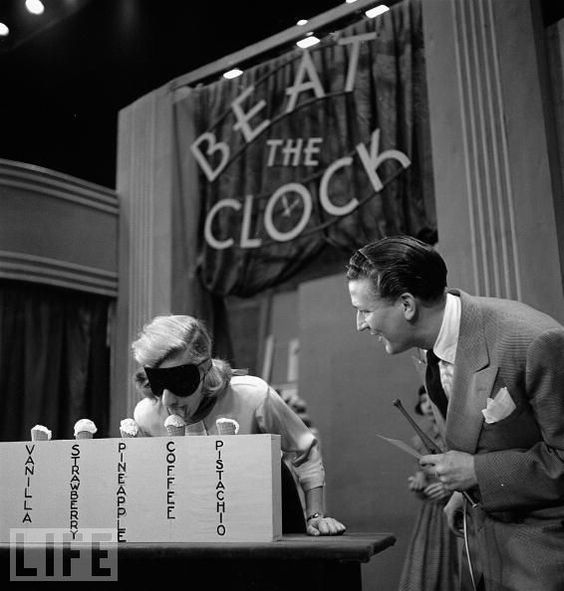
Beat the Clock made its CBS debut on March 23, 1950, hosted by Bud Collyer. It ran until 1961. It rose from the dead in 1969 as The New Beat the Clock, running until 1974. It reappeared in 1979 as The All-New Beat the Clock, and later as All-New All-Star Beat the Clock.

To win, contestants had to “solve problems” within a certain time limit which was counted down on a madly-ticking giant clock. If they succeeded, they “beat the clock”; if they didn’t, “the clock beat them.” And they died.

MARCH 22, 238: GORDIAN ANGELS

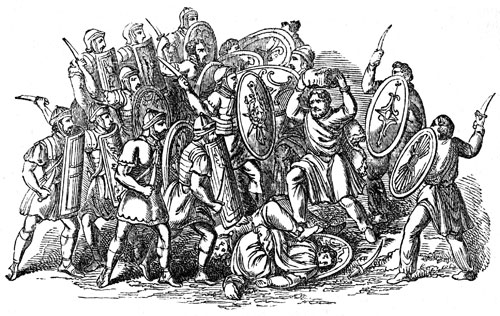
Romans got two emperors for the price of one, when in 238, Gordian I and II became father-and-son tag-team Caesars after an insurrection against Maximinus Thrax, a rather unpopular emperor who had come to the position by the popular tradition of assassinating his predecessor.  Gordian I was a bit long in the tooth so the younger Gordian was attached to the imperial throne and acclaimed Augustus too – sort of like if Poppa Bush and W had been presidents together, mano e mano so to speak.

Some supporters of Maximinus Thrax who were not happy with this turn of events staged a rebellion in Africa. Gordian II fought against them in the Battle of Carthage but lost and was killed for good measure. Hearing the bad news, Gordian I took his own life.  All of this happened within a month. Fortunately, there was no dearth of Gordians in Rome, and Gordian II’s 13-year-old nephew Gordian III soon became emperor. During his six-year reign, the teenage ruler endured pimples, the fickleness of teenage girls, and Persians until he was done in by the latter in yet another battle. He was succeeded by Philip the Arab (son of Ahab) sometimes referred to as the Gordian Not.

Slow and steady wins the race

Back in 1767, Lord Robert Clive of the East India Company was given a gift of four Aldabra tortoises from the Seychelle Islands. Three soon died, but the fourth, a gent named Addwaita “the one and only,” prospered.  He was transferred to a Calcutta zoo in 1875.

Addwaita was a bit of a loner, content to pass the decades in his zoo cubicle, munching on carrots, lettuce, chick peas, bran, bread and grass, growing to a stately 550 pounds and living  to the ripe old age of 250, give or take a year or two.

Alas, Addwaita bought the reptilian ranch on March 22, 2006. Foul play was not suspected.