APRIL 28, 2004: IT WAS SHEAR PLEASURE

Some folks will go to great lengths to avoid sitting in a barber’s chair. So it seems will some animals. A New Zealand Merino sheep named Shrek — not to be confused with the bald green guy of the same name — really didn’t want to be shorn. So he went on the lam in the late 90’s, living as a fugitive, hiding in caves, always looking back over his shoulder.  He avoided capture for six years but alas someone finally fingered him and he was apprehended in April 2004. And on April 28, the now incredibly woolly Shrek went under the shears. It took a mere 20 minutes to denude him, and the entire indignity was nationally televised. The suddenly svelte Shrek gave up 60 pounds of wool, enough to suit 20 New Zealanders.

Now famous, he took tea with the Prime Minister on his tenth birthday and was allowed to spurn the shears for another 30 months before being shorn on an iceberg off the New Zealand coast (certainly a jumping the shark event). Shrek bought the sheep farm in 2011.

This Was No Toy

The world’s first car race took place on April 28, 1887.  It was organized by the editor-in-chief of the Parisian magazine Le Vélocipè. The winner of the race was Georges Bouton, an engineer and toymaker driving an 1884 La Marquise, a steam-powered automobile he had constructed with his partner Albert, the Count of Dion.  The race from Paris to Versailles wasn’t particularly exciting; Bouton’s La Marquise was the only car taking part.
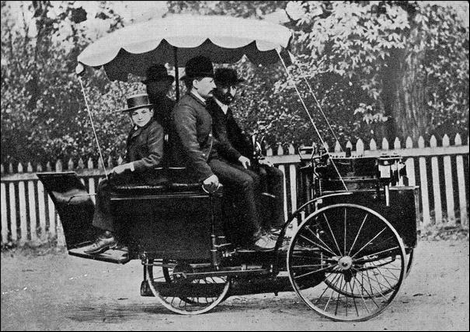
Named for the Count’s mother, La Marquise is a four-seater powered by twin steam engines.  A 40-gallon steel tank underneath the passengers gives the car a range of 20 miles with speeds up to 38 mph.  Once it gets going , that is.  Fueled by coal, wood and bits of paper, it takes 40 minutes  to create enough steam to move.  The car was still running when it was sold in 2011 for a record $4.6 million, making it the world’s longest running automobile.

Sardine in Honorable Tin Can

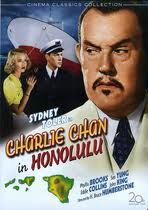
Following the death of Warner Oland, who had successfully brought the character of Charlie Chan to the screen in 16 films, Twentieth Century Fox began the search for a new Chan. Sidney Toler, who was born in Warrensburg, Missouri, on April 28, 1874, was chosen to play the detective, and filming began less then a week later on Charlie Chan in Honolulu. Through four years and eleven films, Toler played Charlie Chan for Twentieth Century Fox. Fox terminated the series in 1942, following the completion of Castle in the Desert. Sidney Toler went on to star in eleven more Charlie Chan films for Monogram Pictures. Very ill during the filming of his last two Chan pictures in 1946, Toler died in 1947.
The character of Charlie Chan was created for the novel The House Without a Key in 1925 by Earl Derr Biggers. Biggers loosely based Chan on a real-life Honolulu detective named Chang Apana. He conceived of the heroic Chan as an alternative to the many stereotypical villains such as Fu Manchu that typified the so-called Yellow Peril, a prevailing vision of the menace of Asia. Sounding like a turn-of-the-century Donald Trump, Horace Greeley, editor of the New York Tribune intoned: “The Chinese are uncivilized, unclean, and filthy beyond all conception without any of the higher domestic or social relations; lustful and sensual in their dispositions; every female is a prostitute of the basest order.”

Over four dozen films featuring Charlie Chan were made, beginning in 1926. Movie-goers took to Chan, but in later years critics found that in spite of his good qualities he too was an Asian stereotype. Many also objected to the fact that he was played by Caucasian actors in  (although Keye Luke who played Chan’s number one son in 7 films was a Chinese-American actor).

In addition to his great detection, Charlie Chan was noted for the aphorisms sprinkled liberally throughout the films. A handful of the very many: Action speak louder than French, Bad alibi like dead fish – cannot stand test of time Detective without curiosity is like glass eye at keyhole, Dead as sardine in honorable tin can.


APRIL 27, 1899: I COULDA BEEN A TENOR

Walter Lantz, who was born in 1899 to Italian immigrant parents,  actually had the surname Lanza until an immigration official anglicized it. Had he not, Walter could have grown up to be an opera singer rather than the creator of Woody Woodpecker and many other cartoon characters.

The first of these characters was Oswald the Lucky Rabbit, star of a 1928 cartoon series for Lantz_OswaldUniversal Studios. The character, who bears more than a passing resemblance to Mickey Mouse, had once belonged to Disney. Lantz won it in a game of poker.

Other less memorable characters followed: a trio of chimps, Meany, Miny and Moe; Baby-Face Mouse; Snuffy Skunk; Doxie (a dachshund); and monkeys Jock and Jill. One character stood out from the crowd – Andy Panda became the comic star for 1939.

A year later, Lantz married actress Grace Stafford. While on their honeymoon, Walter and Grace were pestered by an insistent woodywoodpecker02woodpecker pecking on their roof, and Grace suggested that Walter use the bird as a cartoon character. Woody Woodpecker appeared for the first time in an Andy Panda cartoon and soon became a leading character.

Mel Blanc was originally the voice of Woody Woodpecker, but after only three cartoons, he left to join Warner Brothers. Lantz held anonymous auditions for a new Woody. Lantz’s wife Grace made a secret audition tape and was chosen to be the new voice. She continued in the part until production ceased in 1972.

Woody Woodpecker is the only comic character to have his own hit song. Kay Kyser recorded “The Woody Woodpecker Song,” a top hit and Academy Award nominee in 1948.

Ho-ho-ho ho ho! Ho-ho-ho ho ho! Oh, that’s the Woody Woodpecker song.  They don’t write lyrics like that anymore.

APRIL 26, 1970: FLAUNT YOUR INTELLECTUAL PROPERTY

Shine up your sneakers, grab your party hats and noisemakers. It’s a day to cast off your inhibitions and get wild and crazy. Yes, today is World Intellectual Property Day, the day set aside to “raise awareness of how patents, copyright, trademarks and designs impact on daily life” and “to celebrate creativity, and the contribution made by creators and innovators to the development of societies across the globe.” And get pleasantly pickled of course.

It’s not quite as over the top as say Fat Tuesday but it’s close. Celebrating the contributions of creators and innovators with two guys in clown suits and a person of unknown gender wearing nothing but a rubber chicken puts a fair amount of zest into a gray day in late April. And coming as it does on the heels of World Book and Copyright Day – well, it’s not for the faint of heart.

Why April 26 you ask? Because it’s the date on which the Convention Establishing the World Intellectual Property Organization was established in 1970.  Perhaps you missed it.  What is intellectual property you ask? That’s the beautiful part. It’s anything you want it to be. What you are reading here at this moment by very elastic definition could be considered intellectual property – especially after three Harvey Wallbangers. So live it up; National Defense Transportation Day is nearly a month away.

These Aren’t Your Ordinary Old Bottle Rockets

An announcement in a London newspaper on April 26, 1792, described an upcoming special event in breathless anticipation: fireworks to celebrate the birthday of her royal highness the Duchess of York.

The fireworks display would depict the eruption and lava flow of Mount Etna on a scale never before seen. Under the mountain would be shown the cavern of Vulcan with the Cyclops at work forging the armor of Mars as portrayed in Virgil’s Aeneid. Music courtesy of Gluck, Haydn, Giardini and Handel.

As the work progresses, Venus and Cupid arrive to request armor for Aeneas. Mars arrives for his armor and is amorously distracted by Venus, annoying Vulcan. But at this moment the smoke thickens above, the crater on top of Etna vomits forth flames, and lava flows dreadfully down the side of the mountain. This continues with increasing violence until there is a prodigious eruption, punctuated by a tremendous explosion.

Coffee and tea are included.

APRIL 25, 1926: HERE THE MAESTRO DIED

The world premier of Giacomo Puccini’s last opera “Turandot” was held at Milan’s La Scala on April 25, 1926, two years after his death. Arturo Toscanini conducted. Toward the end of the third act, Toscanini laid down his baton, turned to the audience and announced: “Here the Maestro died.”  Puccini had died before finishing the opera. Subsequent performances at La Scala and elsewhere included the last few minutes of music composed by Franco Alfano using Puccini’s notes.  A highlight of the opera is “Nessun Dorma,” probably the most famous aria in all of opera.

Down at the End of Lonely Street

Elvis Presley scored his first number one hit on the Billboard Pop 100 on this date in 1956.  Recorded and released as a single in January, “Heartbreak Hotel” marked Presley’s debut on the RCA Victor record label . It spent seven weeks at number one, became his first million-seller, and was the best-selling single of 1956. The song was based on a newspaper article about a lonely man who committed suicide by jumping from a hotel window.

APRIL 24, 1819: WHERE’S THE SODA, JERK?

Samuel Fahnestock was given a patent for the first soda fountain in 1819. Carbonated mineral water was all the rage at the time.  Joseph Priestley had created the first man-made carbonated water back in 1767, and Jacob Schweppes had developed a method of mass producing it, quickly leading to the production of different brands of soda and different flavors. Fahnestock’s soda fountain allowed these drinks to be sold by the glass. Oddly enough, it took more than fifty years for someone to create the first ice cream soda, even though ice cream had been around since at least the 10th century.

At the peak of their popularity in the 1940s and 1950s, soda fountains were everywhere – in pharmacies, ice cream parlors, candy stores, department stores, and five-and-dimes. They were public meeting places (or hangouts, when occupied by teenagers).

Soda fountains required the services of a soda jerk. The name referred not to the personality of the person serving sodas but to the jerking action used to swing the soda fountain handle back and forth when dispensing soda. The position of jerk was actually quite sought after and usually came only after an extended period of service in less desirable positions. The soda jerk was the star of the soda fountain show.

The decline of the soda fountain began in the early 1950s when the Walgreens chain introduced full self-service drug stores. Hello Dairy Queen and McDonalds and supersizing; goodbye chocolate soda with two straws and two cents plain.

Wouldn’t Bet on This Horse to Show

Back in 1184 BC, there were no soda fountains.  There were jerks, however, the most infamous of them being the Trojan guy who on April 24 said:  “Look at that cool wooden horse.  Let’s bring it in and have a party.”  The Trojan Horse figures mightily in the war between the Trojans and the Greeks. The Greeks who had been trying for the longest time to sack Troy pretended to sail away, leaving the large wooden beast as a going away gift. But weren’t there a gaggle of Greeks hiding inside. Laocoon, a Trojan priest warned the others that he feared the Greeks bearing gifts. Perhaps if he had been more precise, counseling the Trojans to beware a gift bearing Greeks or not to look a gift horse in the mouth or you might see a Greek looking back at you, the outcome may have been different. But it wasn’t.

The Trojan Horse became a symbol of Greek might and was revered through the ages, resting at its home in the Trojan Horse National Park. Inexplicably, the Greeks tired of it and it was eventually converted to a condo. The horse which had once been filled with ancient Greek warriors came to house only five Greeks, the Thermopolis brothers — Dmitri, Ergo, Aristotle, Zorba and Smitty.

APRIL 23, 1982: Birth of a Republic

Some two hundred years ago on a day meant for history books, Americans declared that they had had enough of the indignities — taxation without representation and such — heaped upon them by their British overloads. That declaration said they were ending their association with the empire, seceding.  Of course, in this case the British didn’t go along with the plan; it would take years of a nasty war for independence to become a fait accompli.

April 23, 1982, deja vu all over again: Residents of the skinny archipelago curving off the southern coast of Florida — Key Largo, Key West and all the baby keys — declared that they had had enough of the indignities heaped upon them by their American overlords.  Their declaration said they were ending their association with Florida and the United States.  For good measure, they declared war on the United States.

The tensions had been simmering for some time.  The Florida Keys had always been something of an outlier.  After all, they’re closer to Havana than Tallahassee or Washington.  And they got no respect from the mainland.  The last straw came when the U.S. Border Patrol set up a blockade on the only highway to and from the mainland, forcing Keys residents to go through customs to reach the mainland.  Key West Mayor Dennis Wardlow said that if they were to be treated like foreigners, they might just as well be foreigners.  The Conch Republic was born. With that he fired the first shot in the war for independence by attacking a naval officer with a piece of stale bread.

The war didn’t last long.  Less than a minute actually.  Wardlow surrendered, and the Keys immediately filed for foreign aid.  But the spirit of the Conch Republic remains in the hearts and minds of Key residents and the many visitors who flock to the annual Independence Day celebration.

A Virtual Visit to Key West (a Sneaky Segue)

This was Key West – noisy, funky and alive with an in-your-face reality, a grittiness in the last light of dusk, that stripped away the cardboard memories of morning and the Magic Kingdom. Mallory Square, looking out on the Gulf of Mexico, was tamer now than before the cruise ships came to call yet still a Felliniesque carnival. Sidewalk entrepreneurs who had staked out their few feet of retail space wherever they could find it hawked popcorn, soda, beer, artwork, trinkets and T-shirts. Acrobats, jugglers, ventriloquists and even a knife swallower soared, twirled, threw voices into unlikely objects and chewed on cutlery. Rugged and ragged individualists, they were bonded only by the one tool of all their trades, the holy collection plate – be it hat, cup, tambourine or cardboard box – lying patiently on the ground, awaiting a pious offering – the price of admission and gratuity wrapped into one monetary hip, hip, Hallelujah, coin or preferably paper, denomination optional.  (Voodoo Love Song)

The holy collection plate

Don’t Try This at Home

According to the National Rifle Association, guns don’t kill people, people kill people.  On the other hand, if you were to make a fist with your index finger pointing at your intended victim, and shout Bang, bang, you’re dead, chances are the only injury inflicted would be to your pride as you endured the derisive laughter all around you.

On yet another hand, take the case of William Lawlis Pace. Nine-year-old Billy was accidently shot in the head by his older brother. Pace died on April 23, 2012.  In his sleep.  At a California nursing home – 94 and a half years after the incident. The bullet was still in his head.

Doctors in Texas where the shooting took place left the .22 caliber bullet in his head because – well, because that’s what they do in Texas.

In 2006, Pace was crowned the Guinness world record holder in the category of “unwanted cranial ammunition acquisition.” A proud moment indeed, and Wayne LaPierre did not attend the ceremony.

Thank God, the Second Amendment still protects a citizen’s right to walk around for 94 years with a bullet in his head.

APRIL 22, 1886: BUT WILL YOU RESPECT ME IN THE MORNING?

In a blow to lounge lechers everywhere, the state of Ohio passed a law making seduction unlawful. Covering any man seduction1over 18, it prohibited sex, consensual or not, with a woman of any age if the woman were being taught or instructed by the man. It covered all subject matter, leaving a lot of room for interpretation.  Other states jumped on the anti-seduction bandwagon. In Virginia, he’d better not try to engineer an “illicit connexion with any unmarried female of previous chaste character” using the promise of marriage. In Georgia, he couldn’t “seduce a virtuous unmarried female and induce her to yield to his lustful embraces.” In some jurisdictions, however, a woman could not press charges on her own behalf; only the father could do so based on his property interests in his daughters’ chastity.

Naturally, such laws were enforced with varying degrees of fervor. An unfortunate man trapped by the law in New York was headed for certain conviction until he proposed to his victim during the trial. Just to make certain, he didn’t back out, the judge brought in a minister and had the ceremony performed then and there.

A court in Michigan, on the other hand, went out of its way to favor the accused male. On three charges of seduction, two were thrown out because the woman was no longer virtuous after the first seduction. The other was tossed when the court ruled that her claim that they had sex in a buggy was physically impossible.

There’s an Awful Lof of Coffee . . .

Pedro Alvares Cabral sailed out of Lisbon in early 1500 with a fleet of 13 ships, following the route taken earlier by Vasco da Gama.  He strayed from the route, however, sailing far into the western Atlantic Ocean making landfall on April 22, 1500, on an island he named the Island of the True Cross.  Turns out it wasn’t an island at all but a big mother of a continent.  He claimed a big chunk of it for Portugal and dispatched a ship to notify King Manuel I of his discovery.  Manuel renamed the territory Holy Cross.  It later became known as Brazil, the fifth largest country in the world, home to the Amazon River, the world’s second longest, the Amazon Rainforest, an awful lot of coffee, and the samba.

APRIL 21, 753BC: ROMULUS AND REMUS REDUX

Astute almanackers will recall that we touched upon those lovable Roman twins, Romulus and Uncle Remus, back on January 1. (Many others tried their best to forget on January 2 and were largely successful.)  The next few sentences contain a lot of funny names which you do not need to remember.  Romulus and Remus were born in Alba Longa to Rhea Silvia, a Vestal Virgin and daughter of King Numitor who had been overthrown by his brother Amulius.  Rhea conceived them when their daddy, Mars (yes, the god), came to her in a sacred grove.  He got her in the garden, folks.

King Amulius thought the twins might prove a threat to his throne, so naturally he ordered them killed.  They were left to die on the banks of the Tiber (not a  particularly effective homicide technique) but were saved by Tiberinus, another god, suckled by a she-wolf (hear that, Mowgli?) and adopted by a shepherd, Faustulus.  They grew up among the sheep, unaware of their royal demigod identities (and evidently not knowing that wolves eat sheep).

This all took place in the locale that would become known as Rome.  As the years passed quickly backwards, the boys grew up, killed Amulius, and reinstated Numitor as king.  They got to thinking that Europe could use another major metropolis, something of the Alexandria or Carthage sort.  Unfortunately, they couldn’t agree on which of the seven hills to build their city.  They quibbled, they argued, they battled and Romulus slew Remus. (This is something we can’t be absolutely sure of, given the fact they were twins. “I’m Romulus and I just killed my twin brother Remus.”  “No I’m Romulus and my brother just killed me.”

In any event, Romulus is credited with being the true founder of Rome.  Had it been his brother, it would now be called Reme.

Hustle and Bustle

Among the many advances of the 19th century, the idea that Alexander Douglas patented on this day in 1857 hardly stands out.  At first glance the bustle seems to have no useful function beyond making a woman’s butt seem larger.  But on closer inspection this item of apparel has some noteworthy attributes.  The bustle replaced the infamous crinoline, a contraption that was like a large metal bird cage strapped to the unfortunate female wearer.  Not only was it difficult to navigate in, it was also impossible to exit in a hurry should the flammable fabric covering it catch fire which it frequently did (killing some 3,000 women in England during the 1860s.

The bustle also had a utilitarian function, keeping milady’s dress from dragging through the mud.  And there was plenty of mud around during the 19th century.  The bustle pretty much disappeared during the latter part of the century, allowing women to occasionally sit down.


April 20, 1935: Splish Splash, Snooky Was Taking a Bath

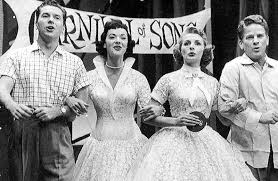
A music staple of the 40s and 50s, Your Hit Parade, made its radio debut on April 20, 1935. It lasted for nearly 25 years before being done in by rock and roll music – and perhaps Snooky Lanson. It began as a 60-minute program with 15 songs played in a random format, and eventually moved to television where the seven top-rated songs of the week were presented each week in elaborate production numbers requiring constant set and costume changes.  The list of top songs was compiled through a closely guarded top secret algorithm that involved record sales, quarters plunked into jukeboxes, shoplifted sheet music and the divination of an unidentified mystic in Memphis, Tennessee.

Dorothy Collins , Russell Arms, Snooky Lanson and Gisèle MacKenzie were top-billed during the show’s peak years. And Lucky Strike cigarettes starred throughout its run.

As the rock and roll era took over, the program’s chief fascination became seeing a singer like Snooky Lanson struggle with songs like Splish Splash and Hound Dog.

Would Snooky Make a Good Macbeth

Although Shakespeare’s Macbeth was written in 1606, the first record of a performance was at the Globe Theater on April 20, 1611, although chances are there were  a few out-of-town tryouts earlier.  Shakespeare’s tragedy is one of the most performed and one of the shortest.  It has in its 413-year history made a lot of contributions to the English culture and picked up some interesting baggage.  One of the most noted of the latter is the Macbeth curse: speaking the name of the play in the theater is inviting a grim reckoning.  It is always referred to as “the Scottish play.”  No one knows exactly why there is a curse, but it has been suggested that the witches’ spells used in the play were real. They were taken from a book on demonology written by King James I, either to suck up to the king or to poke fun at his belief in witchcraft. Were some unfortunate to slip up and utter the word Macbeth, he or she must immediately leave the room, turn around three times, spit, say Donald Trump, then beg to be re-admitted.

“Double, double, toil and trouble, fire burn and cauldron bubble.”  No, Snooky would make a better witch.

APRIL 19, 1935: THE AWARD FOR BEST FEMALE CREATED BY A MAD SCIENTIST GOES TO . . .

The embers from the burning windmill were still glowing when Universal Pictures honchos  began planning a sequel to the 1931 Frankenstein.  Boris Karloff would return as the Monster, Clive Colin as the beleaguered Dr. Henry Frankenstein, and James Whale would once again direct.  Joining the cast as the mate that fate had the Monster created for was British actress Elsa Lanchester — the titular Bride of Frankenstein.  The film premiered on April 19, 1935.

The film also featured a despicable evil scientist, Frankenstein’s former mentor, Dr. Septimus Pretorius, played by Ernest Thesiger and an old blind hermit, Oliver Peter Heggie, who with Karloff perform one of the movie’s most enduring scenes.

A scene which was brilliantly parodied in Mel Brooks’ Young Frankenstein.

Where Are the Angry Villagers When You Need Them

The Vagabond King a 1925 operetta by Rudolf Frimi was already an American success when it opened in London on April 19, 1927.  It’s success in England was probably assured given its theme of foibles of the French.  Its hero is a braggart, thief and rabble-rouser who attempts to steal an aristocratic lady from the king himself.  Not only that, he openly mocks the king, boasting about what he would do if he were king.  The angry king gives him royal powers for 24 hours — king for a day — during which he must solve all France’s problems or go to the gallows (the guillotine had not yet been invented).  He succeeds, wins the lady’s hand and lives happily ever after in exile — probably in England.  The operetta was the inspiration for a couple of movies and, of course, the popular radio and television program “Queen for a Day.”