MAY 7, 1885: COMIN’ THROUGH THE SCREEN, SHOOTIN’ UP THE LAND

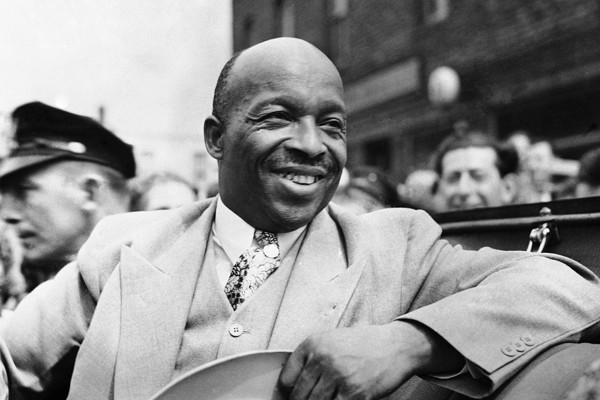
An essential player in Hollywood westerns was the leadinggabby man’s sidekick, and many sidekicks became just as famous as their starring partners: Andy Devine was Jingles to Wild Bill Hickock, Pat Buttram and Smiley Burnette were both sidekicks to Gene Autry, Jay Silverheels was Tonto to the Lone Ranger, Leo Carillo was Pancho to the Cisco Kid. The top sidekick was, of course, Gabby Hayes, born May 7, 1885. Through the 1930s and 1940s, he was sidekick to Hopalong Cassidy in 18 films and to Roy Rogers in 41.

The third of seven children, George Francis Hayes was born in an upstate New York hotel owned by his father. As a young man, he worked in a circus and played semi-pro baseball while a teenager. He ran away from home at 17, and joined a touring stock company.  He married and with his wife enjoyed a successful vaudeville career. Although he had retired in his 40s, he lost money in the 1929 stock market crash, and he felt the need to work again.  He and his wife moved to California, and he began his movie career, taking various roles until finally settling into a Western career.

Hayes first gained fame as Hopalong Cassidy’s sidekick Windy Halliday in many films between 1936-39. He left the Cassidy films in a salary dispute and was legally prevented from using the name “Windy.”   So “Gabby” Hayes was born.  He rode alongside  stars such as John Wayne, Randolph Scott, and, of course, Roy Rogers.

Offstage Hayes was the complete opposite of his screen persona – an elegant bon vivant, man-about-town and connoisseur.  He died in 1969.  On the subject of his movies: “I hate ’em. Really can’t stand ’em. They always are the same. You have so few plots – the stagecoach holdup, the rustlers, the mortgage gag, the mine setting and the retired gunslinger.”

“You’re a good-looking boy: you’ve big, broad shoulders. But he’s a man. And it takes more than big, broad shoulders to make a man.” — High Noon

“There are only two things that are better than a gun: a Swiss watch and a woman from anywhere. Ever had a good… Swiss watch?” — Red River

“A gun is a tool, Marian; no better or no worse than any other tool: an ax, a shovel or anything. A gun is as good or as bad as the man using it. Remember that.” –Shane

“You don’t look like the noble defender of poor defenseless widows. But then again, I don’t look like a poor defenseless widow.” –Once Upon a Time in the West

MAY 6, 1782: YOU’VE GOT THAT MIDAS TOUCH

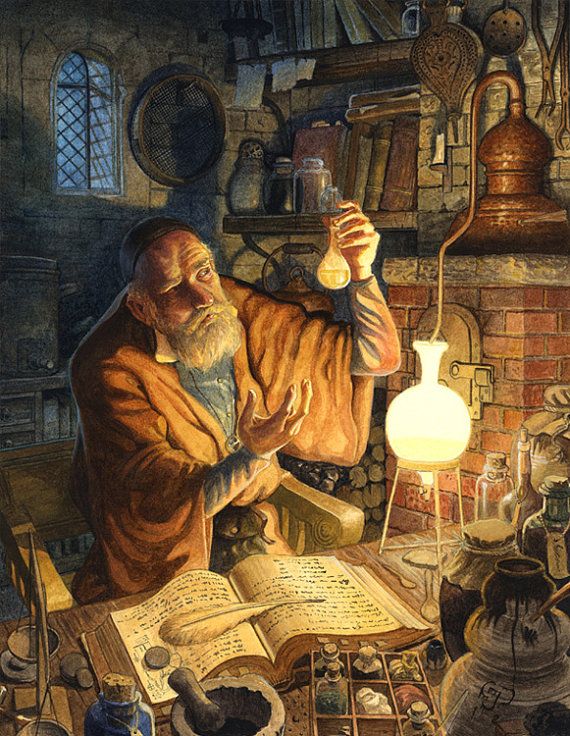
     On this day, one James Price, a distinguished amateur chemist and a Fellow of England’s Royal Society began a series of remarkable experiments. The seven experiments were witnessed by peers, baronets, clergymen. lawyers and chemists – men of unimpeachable public character. In these experiments, mercury was apparently transmuted into various quantities of gold and silver. Some of the gold was presented to His Majesty George III.

     Price became a celebrated figure, and many saw in his work the dawning of an era of unparalleled prosperity for England. Naysayers claimed that Price was merely a clever juggler or that he had deceived himself. In his favor were the facts that he was already a wealthy man and no needy adventurer and that he had already distinguished himself in chemistry.

     A fierce paper battle ensued over the veracity of the experiments, and eventually the Royal Society stepped in, calling upon Price as a Fellow of the society to prove to the satisfaction of his fellow Fellows the truth of his transmutations by repeating his experiments in their presence.

     Price dithered, making various excuses for not repeating the experiments (one of which was that it cost more to produce gold than the gold was worth).  Finally, however, he yielded to their exhortations and announced that he would leave London for his laboratory in the country to prepare for the experiment. He pledged to return in a month, but the month passed, and a second and a third. Six months passed, and even his friends had given up on him.  Just when everyone was convinced he had fled to France or some other criminal haven, he  reappeared, inviting members of the Royal Society to meet him at his laboratory for the experiment.

     Although only a year earlier they were contending for the honor of witnessing the experiments, only three society Fellows accepted his invitation. Stepping before them, Price hastily produced a flask and swallowed its contents. Noting a sudden change in his appearance, the visitors called for medical assistance, but in a few moments Price was dead.

     One thing was sure.  Price had not transmuted himself to gold.  It is speculated that in the beginning he had probably deceived himself, then in the usual slippery slope of skullduggery  attempted to deceive others, and finally,  lacking the moral courage to confess his mistake, checked himself out. In any event, the last belief in the possibility of alchemy among England’s scientific community came to an end in 1782 with Price’s death.

MAY 5, 1795: Keep Your (Hair) Powder Dry

Unlike today, a nice head of hair made an important fashion statement in the 17th century.  Hair loss and baldness were accompanied by a loss of status and style and, even worse, might indicate the heartbreak of syphilis.  Wigs were often used to cover up such shameful appearance.  Their use became widespread after two monarchs, Louis XIV of France and Charles II of England, victims of premature hair loss, donned wigs.  Courtiers, always quick to jump on a convenient bandwagon, started wearing wigs as well, and a fashion was born.

The first wigs were fashioned from horse and goat hair and, even though they identified the wearer as an elite member of society, they smelled bad and attracted lice and other unwanted critters.  To combat this inconvenience, wig wearers would powder their faux tresses.  Hair powder usually consisted of wheat starch and perfume.  Cheaper powders might be made of flour, ground rice or chalk.

The more popular wigs became, the more elaborate and  bigger they got, hence the term bigwig.  Then in the 18th century, wigs fell out of fashion just as quickly as they had risen.  Late in the century, the clever British, needing revenue to finance another of their endless wars with France, hit upon the idea of taxing hair powder. On May 5, 1795, the government introduced the Hair Powder Act, requiring citizens to purchase a certificate to purchase hair powder.  Well didn’t that put a dent in the use of wigs.  All  of a sudden, in England folks began to wonder what else those wigs might be hiding.  In France, they saw how often wig-wearing dandies ended up with their wigged heads at the wrong end of a guillotine.

Longhair became a word of derision.  Short hair or be square.  But nothing is forever.  Long hair made a comeback in the 20th century.  And you can buy hair powder on Amazon.  Tax-free.

Vamos A Celebrar

In Mexico, Cinco de Mayo is celebrated primarily in the state of Puebla where it is called El Día de la Batalla de Puebla (The Day of the Battle of Puebla) observed to commemorate the Mexican army’s unlikely victory over French forces at the Battle of Puebla on May 5, 1862. France, under the leadership of Napoleon Number Three, sought to establish a Gallic empire in Mexico (possibly because things had gone so well for Napoleon Number One in Russia back in 1812). In 1861, a large French force landed at Veracruz sending the Mexican government into retreat. Moving toward Mexico City, the French army encountered heavy resistance near Puebla from a poorly equipped Mexican army of 4,500 men. The Mexicans were able to soundly defeat the 8,000-strong French army, considered the best in the world.


MAY 4, 1904: When Henry Met Charles

Many historic meetings have taken place over the years — when Caesar met Cleopatra, when Stanley met Livingston, when Harry met Sally.  Such a meeting took place on May 4, 1904.  Henry Royce had operated an electrical and mechanical business in Manchester, England,. since 1884. His real interest, however, was automobiles.  He built his first in 1904, the two-cylinder Royce 10.  Charles Rolls had a motor car dealership selling  imported luxury automobiles.  The two were introduced, and before the end of the year they had struck a bargain: Rolls would take all the cars Royce could build.  They would be sold exclusively by Rolls and would bear the name Rolls-Royce.  The 10-hp automobile had its coming out party at the Paris Salon in December, and quickly became one of the world’s most prestigious brands.

Rolls-Royce Limited was formed in 1906. Throughout the 20th century and into the 21st, it manufactured some of the most  luxurious and exclusive automobiles in the world, synonymous with royalty, celebrity and wealth.  The iconic Rolls-Royce hood ornament, the Spirit of Ecstasy, was commissioned in 1911 by a Baron Scott-Montagu, its figure looking a lot like his secretary/mistress, her finger pressed to her lips, suggesting the secrecy of their affair.  She has endured through the years, evolving with the current fashion.  A redesign in 2022 made her more aerodynamic.  “Previously she had stood with her feet together,  legs straight and tilting at the waist,” said the company. “Now she is a true goddess of speed, braced for the wind, one leg forward, body tucked low, her eyes focused eagerly ahead.” Looking for a gas station.

  • Now That’s a Hood Ornament

 The first Grammy Awards (or Gramophone Awards as they were originally called) honoring achievement in the recording industry were held in 1959. And it was a banner year to start passing out those little gold gramophones.

     In contention for Record of the Year was Perry Como with one of his three Top 10 singles for the previous year, “Catch a Falling Star,” Peggy Lee with her biggest hit of the rock era, “Fever,” Frank Sinatra crooning “Witchcraft,” and the are-you-kidding entry, “The Chipmunk Song” by David Seville. Taking home the statuette (to Italy) was Domenico Mondugno and the only foreign language recording to ever win the top prize, “Nel Blu Dipinto Di Blu.” The recording also won Song of the Year.

Other winners included Van Cliburn, Henry Mancini, Louis Prima and Keely Smith, Count Basie, Andre Previn, the Champs and the Kingston Trio.

 And Ella Fitzgerald of course. She placed one of her several songbook albums in the ring, this one dedicated to Irving Berlin. This was her first of 13 Grammy Awards.  She also has 9 recordings in the Grammy Hall of Fame, the most of any female artist.  The first to be inducted was her first hit, A-Tisket, A-Tasket.

MAY 3, 1840: JIMMY’S LITTLE LETTUCE PILLS

James Morison was a British merchant turned physician who died on May 3, 1840, at the ripe old age of 70 after suffering through a mid-life crisis of intolerable pain which he cured by magic little pills of his own devising. Thanks to his little pills created from flora and their miracle cure, he became throughout his later life a notorious advocate of “vegetable medicines.”

Although many of his peers considered him a bit of a quack, he came to his calling in a fairly honorable way; having tried every known cure for his maladies in vain, he devised the vegetable pills and found them to be “the only rational purifiers of the blood.”

He became, at age 50, a new man. He regained his youthfulness; his pains were gone; he enjoyed sound sleep and high spirits. In short, he was healthy, fearing neither heat nor cold, dryness nor humidity.  And all because of his dear little pills and a morning glass of lemonade.  Would it have been fair for him to keep this medical miracle to himself? Wasn’t he morally bound to spread this blessing among his fellow creatures? Of courses he was. And what if he profited handsomely from his doing so? One can grow wealthy arcimboldowith a much clearer conscience peddling carrots and turnip pills than peddling many other things.

He established a vegetable pill emporium with the rather lofty title of  British College of Health, retired to the south of France where he remained healthy, wealthy and wise until his 1840 death.  His work led to the later discovery of the powers of penicillin taken with a glass of lemonade.

arcimboldo

“The Vegetable Gardener” by Giuseppe Arcimbaldo

Vegetables are interesting but lack a sense of purpose when unaccompanied by a good cut of meat. — Fran Lebowitz

MAY 3, 1840: JIMMY’S LITTLE LETTUCE PILLS

James Morison was a British merchant turned physician who died on May 3, 1840, at the ripe old age of 70 after suffering through a mid-life crisis of intolerable pain which he cured by magic little pills of his own devising. Thanks to his little pills created from flora and their miracle cure, he became throughout his later life a notorious advocate of “vegetable medicines.”

Although many of his peers considered him a bit of a quack, he came to his calling in a fairly honorable way; having tried every known cure for his maladies in vain, he devised the vegetable pills and found them to be “the only rational purifiers of the blood.”

He became, at age 50, a new man. He regained his youthfulness; his pains were gone; he enjoyed sound sleep and high spirits. In short, he was healthy, fearing neither heat nor cold, dryness nor humidity.  And all because of his dear little pills and a morning glass of lemonade.  Would it have been fair for him to keep this medical miracle to himself? Wasn’t he morally bound to spread this blessing among his fellow creatures? Of courses he was. And what if he profited handsomely from his doing so? One can grow wealthy arcimboldowith a much clearer conscience peddling carrots and turnip pills than peddling many other things.

He established a vegetable pill emporium with the rather lofty title of  British College of Health, retired to the south of France where he remained healthy, wealthy and wise until his 1840 death.  His work led to the later discovery of the powers of penicillin taken with a glass of lemonade.

arcimboldo

“The Vegetable Gardener” by Giuseppe Arcimbaldo

Vegetables are interesting but lack a sense of purpose when unaccompanied by a good cut of meat. — Fran Lebowitz

MAY 2, 1843: THE LITTLE TOWN THAT CRIED WOLF

     Chances are you’ve never heard of Champoeg — unless maybe you’re from Oregon which is where it is, or was. Champoeg had the historical significance of being the first American government on the West Coast, having been established by representatives of Willamette Valley settlers on May 2, 1843, by a vote of 52-50. These representatives had held a series of meetings starting back in February to entertain measures to deal with the threat of wolves. During these so-called “Wolf Meetings,” the conferees established a series of civil codes (although its doubtful the wolves paid much attention to them).

     When the Oregon Territory was created in 1848, Champoeg was cold-shouldered as upstart Oregon City became its capital. This despite the fact that Champoeg had become rather a bustling little metropolis with a steamboat landing, a ferry across the Willamette River, a stagecoach office, a granary and a warehouse. Ten streets ran north to south, crossed by six east-west thoroughfares.

     Champoeg chugged along through the years as Oregon grew and gained statehood. Then in 1861, the Willamette River reared its ugly head, rising 55 feet above its normal stage, flooding the town and destroying every structure in it with the exception of two saloons (there’s a lesson here somewhere). Champoeg was never rebuilt after the flood; all that remains is a small monument describing its place in history and a stake marking a street corner (probably the one where a saloon stood).

“Well!”

     Although he was first heard on radio as a guest of Ed Sullivan, Jack Benny debuted his own radio show for NBC on May 2, 1932. After six months he moved to CBS and then in 1933 back to NBC. Although he continued to jump back and forth on networks, his radio program lasted until 1955, some five years after his television program appeared.

     Benny was a fixture on radio and TV for three decades, and is still considered one of the best. He was a master of comic timing, creating laughter with pregnant pauses or a single expression, such as his signature “Well!

     Appearing with him over the years were Eddie “Rochester” Anderson, Don Wilson, Dennis Day, Mary Livingston, Phil Harris, Mel Blanc and Sheldon Leonard. Leonard helped Benny produce what was said to be the longest laugh in radio history. Leonard as a holdup man approached Benny and demanded “your money or your life.” Benny remained silent. Finally, Leonard said “Well!?” and Benny answered “I’m thinking it over!”

MAY 1, 1931: TALL BUILDING WITH APE

     US President Herbert Hoover pushed a button in Washingtonempire D .C. turning on the lights of a building in New York City. On May 1, 1931, the world’s tallest building (102 stories with a total height of 1,454 feet), one of the seven wonders of the modern world, and soon to become an American icon, the Empire State Building, was open for business.

     Commanding the intersection of Fifth Avenue and West 34th Street, the Art Deco masterpiece had taken just over a year to complete. It remained the tallest building in the world for 40 years, and is still a celebrated symbol of American culture. It has been a featured star in over 250 movies and many other forms of entertainment for its entire existence – An Affair to Remember, Sleepless in Seattle, Elf and, probably the most famous, the one with that giant ape clinging to its spire, battling modern technology.

     Although jumping (or attempting to) from the Empire State Building is a much depicted form of suicide, just 30 people have pulled it off. The most noted is the 1947 death of a young woman who landed on a United Nations limousine parked at the curb. A photo taken minutes after her death was featured in Life magazine as “The Most Beautiful Suicide” and was later used by Andy Warhol in his print Suicide (Fallen Body).

     Notable failures included a woman who jumped from the 86th floor observation deck, only to be blown back onto the 85th floor by a gust of wind and left with a broken hip, and a man who jumped or fell from the 86th floor but landed alive on an 85th floor ledge from which he was rescued suffering only minor injuries.

APRIL 30, 1803: AND FOR ONE TULIP MORE, GALVESTON

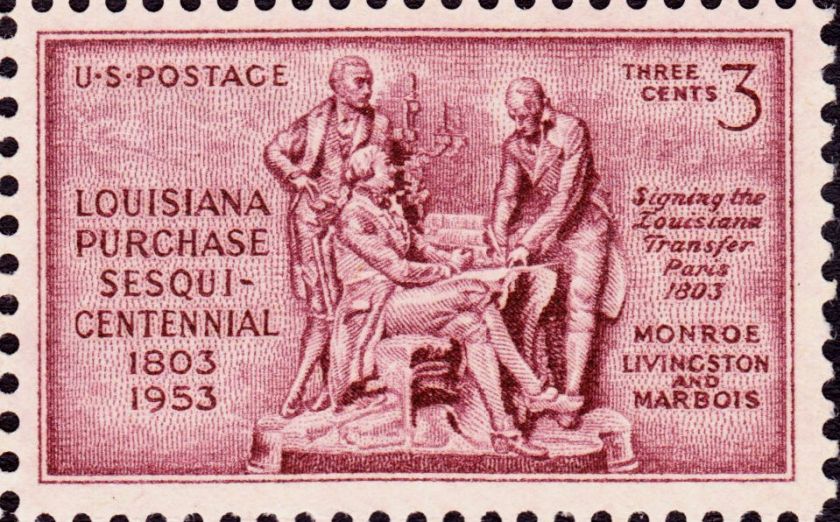
The United States purchased the Louisiana Territory from France in 1803, more than doubling the size of the nation. In addition to the city of New Orleans and western Louisiana, the purchase included Arkansas, Missouri, Iowa, Oklahoma, Kansas, and Nebraska; most of North and South Dakota; parts of Minnesota, New Mexico Montana, Wyoming, and Colorado (portions of Texas were included for ordering before 1804).

The price paid was 50 million francs (55 million without Texas). With the Dutch purchase of Manhattan in mind, President Jefferson had hoped to pay for the acquisition using beads. The frontierspeople would have none of it (“We may die without our boots on, but we won’t wear no sissy beads.”) and the people of New Orleans already had so many beads they held a party each year to give them away.

The purchase was pricey compared to the Dutch purchase of Manhattan ($15 million versus $24 in American currency; but since there was no American currency when the Dutch bought Manhattan, the comparison is like comparing guilders and tulips – and guilders and tulips went a lot farther back in 1626).  In another comparison, the United States paid 223 million rubles for Alaska. That’s 7.2 million dollars, 32 million francs, 18 million guilders, or 41 million tulips.

And Maybe a Few Brownies

In the 1968 movie I Love You Alice B. Toklas, Peter Sellers places an uptight lawyer who gets lost in the San Francisco counter-culture.  Featured prominently in the story is a notorious marijuana-laced brownie first introduced in a book by Alice Babette Toklas, an American writer born on April 30, 1877 in San Francisco.

Shortly after the 1906 earthquake, Toklas moved to Paris where she and her life-long companion, Gertrude Stein, immersed themselves in an earlier counterculture, the Parisian avant-garde of the early 20th century. They hosted a steady parade of American expats including such writers as F. Scott Fitzgerald, Thornton Wilder and Ernest Hemingway.

Toklas’ 1954 book, The Alice B. Toklas Cookbook, was a curious mix of recipes and reminiscences, most notably featuring the recipe for Haschich Fudge, the brownie that became a film star.

APRIL 29, 1946: Are You Looking for a Smiting?

God was married on this day in 1946. For the second time. He was 70 at the time; she was 21 and, he claimed, a reincarnation of his first wife.

Unlike many other religious leaders who claimed to have God’s ear, Reverend Major Jealous Divine, (1876 – 1965) claimed to be God. Some contemporaries – jealous’ themselves perhaps – claimed he was more charlatan than god. Earlier in his life, before he became God, he was simply the Messenger. He founded what some have called a cult and oversaw its growth into a multiracial and international church.

Father Divine preached extensively in the south where, in 1913, he ran afoul of local ministers and was sentenced to 60 days jail time. While he was serving his sentence, several prison inspectors were injured in an auto accident, which, Father Divine pointed out, was the direct result of their disbelief.

Upon his release, he attracted a following of mostly women in Georgia. In 1914, several of his followers’ husbands and local preachers had Divine arrested for lunacy. This did not have the desired effect; it actually expanded his ministry. Father Divine was found mentally sound in spite of “maniacal” beliefs. When arrested, he had refused to give his name and was tried as John Doe (aka God).

After moving north and attracting a New York following — just as you were saying with a smirk, it could only happen in Georgia — Father Divine was arrested again, this time for disturbing the peace. At his 1932 trial, the jury found him guilty but asked for leniency. Ignoring this request, the judge called him a menace to society and sentenced him to one year in prison and a $500 fine. The 55-year-old judge died of a heart attack a few days later. Father Divine told-you-soed thusly: “I hated to do it. I did not desire Judge Smith to die . . . I did desire that my spirit would touch his heart and change his mind that he might repent and believe and be saved from the grave.”

In 1944, singer/songwriter Johnny Mercer attended one of his sermons – the subject, “You got to accentuate the positive and eliminate the negative.” Mercer was impressed. He returned to Hollywood and, with songwriter Harold Arlen, wrote “Ac-cent-tchu-ate The Positive”, which was recorded by Mercer himself and the Pied Pipers in 1945. It was also recorded by Bing Crosby with the Andrews Sisters.  And probably sung a year later at God’s wedding.