Harrison Ford cracked a mean bullwhip as the title character in the Indiana Jones series of films. Ford wasn’t born brandishing a bullwhip; he had to learn it for the films. And he was taught by bullwhip master, Lash LaRue born on June 16, 1917.
Like many actors in the 40s and 50s, LaRue spent most of his career making B-Westerns. Originally hired because he looked enough like Humphrey Bogart that producers thought this would draw in more viewers, he used his real last name as the name for most of his film characters. He was given the name Lash because, although he carried a gun, he was noted for preferring to use an 18-foot-long bullwhip to take on bad guys. Lash not only disarmed bad guys, he performed many stunts such as saving people about to fall to their doom by wrapping his whip around them — often while at full gallop on Black Diamond, his trusty horse — and pulling them to safety. Lash, like a guy named Cash, was also known for always wearing black.
After starting out as a sidekick to singing cowboy Eddie Dean, he earned his own series of Western films and his own sidekick, Fuzzy Q. Jones (Al St. John), inherited from Buster Crabbe. He also got his very own villain — an evil, cigar-smoking twin brother, The Frontier Phantom.
His films ran from 1947 to 1951. The comic book series that was named after his screen character lasted even longer, appearing in 1949 and running for 12 years as one of the most popular western comics published.
In 1937, Congress passed the Marihuana Tax Act which levied a tax of one dollar on anyone who dealt commercially in marijuana. The bill had been written using the slang term “marihuana” throughout, obscuring the fact that it covered the plant’s legitimate uses in medicine, where it was broadly known as cannabis and in the fiber industry as hemp. The Act did not itself criminalize their possession, but regulations and restrictions on the sale of cannabis as a drug had been around since the previous century. In effect, the bill made it impossible for anyone to deal with call it what you will in any form.
Conspiracy theorists maintained that business tycoons Andrew Mellon, Randolph Hearst, and the Du Pont family were behind passage of the Act as a way to reduce the size of the hemp industry. Hemp had became a very cheap substitute for the paper pulp that was used in the newspaper industry and as such was a threat to Hearst’s extensive timber holdings. Mellon had invested heavily in the Du Pont family’s new synthetic fiber nylon that was competing with hemp. The campaign that Hearst’s newspapers had been staging against the dangers of the recreational use of the”powerful narcotic in which lurks MURDER! INSANITY! DEATH!” was therefore disingenuous. (‘Beware the evils of hemp’ didn’t quite cut it. “Reading newspapers printed on hemp will lead to degradation and reading the New York Post.”)
The legislation effectively killed the hemp industry and the medical use of cannabis, and the ensuing years of “reefer madness” completed its evolution to the abominable recreational drug it became through the rest of the century.
When little Billy Bligh joined the British Royal Navy at the tender age of seven, he certainly never thought he’d grow up to haul breadfruit around the world. At sixteen, he became an able seaman, then a year later a midshipman. And in 1787, Bligh became Captain of the Bounty.
The Royal Society was offering special prizes to those who would travel to Tahiti, pick up a bunch of breadfruit trees and haul them back to the Caribbean as a source of cheap high-energy food for slaves. It sounded simple enough on paper, but getting there was far from half the fun. First, there was Cape Horn. The Bounty tried to get round it for a month before giving up and taking a longer route. Then Bligh and his crew had to sit around in the tropical sunshine for five months waiting for the little breadfruit babies to get big enough to travel. And when finally they set off for the Caribbean, didn’t Fletcher Christian and his cohorts, having grown fond of the Tahitian ambiance, up and mutiny.
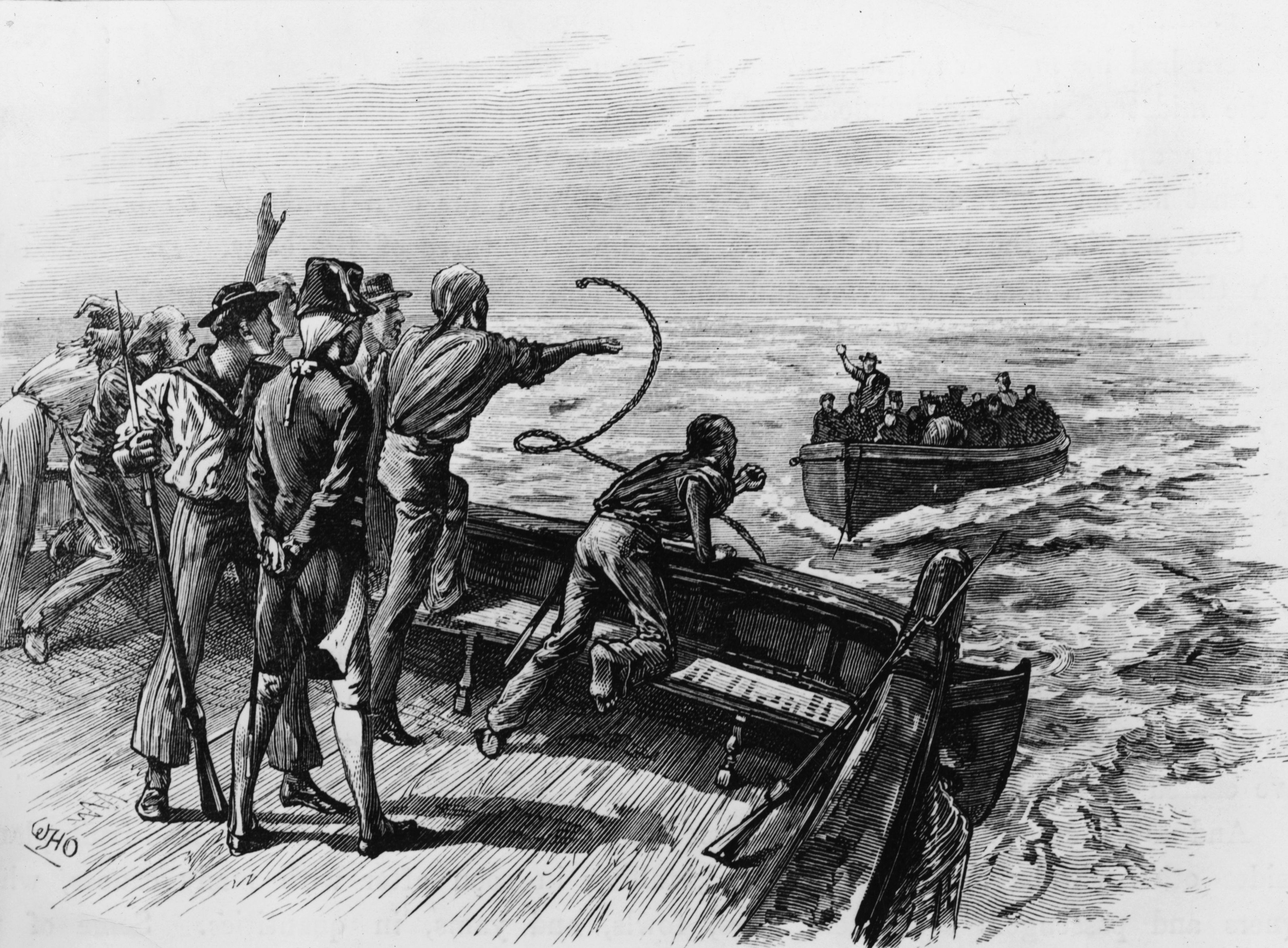
Bligh and his loyalists were loaded into a launch with nary a breadfruit tree and set adrift. Amazingly, they survived and sailed over 4,000 miles, arriving in Timor on June 14, 1789, from where they returned to England. And two years later Bligh headed another expedition and this time successfully carried a load of trees to the Caribbean. However, the slaves refused to eat the breadfruit, wanting no part of a fruit that tasted like day-old bread.
Et Tu, Ku
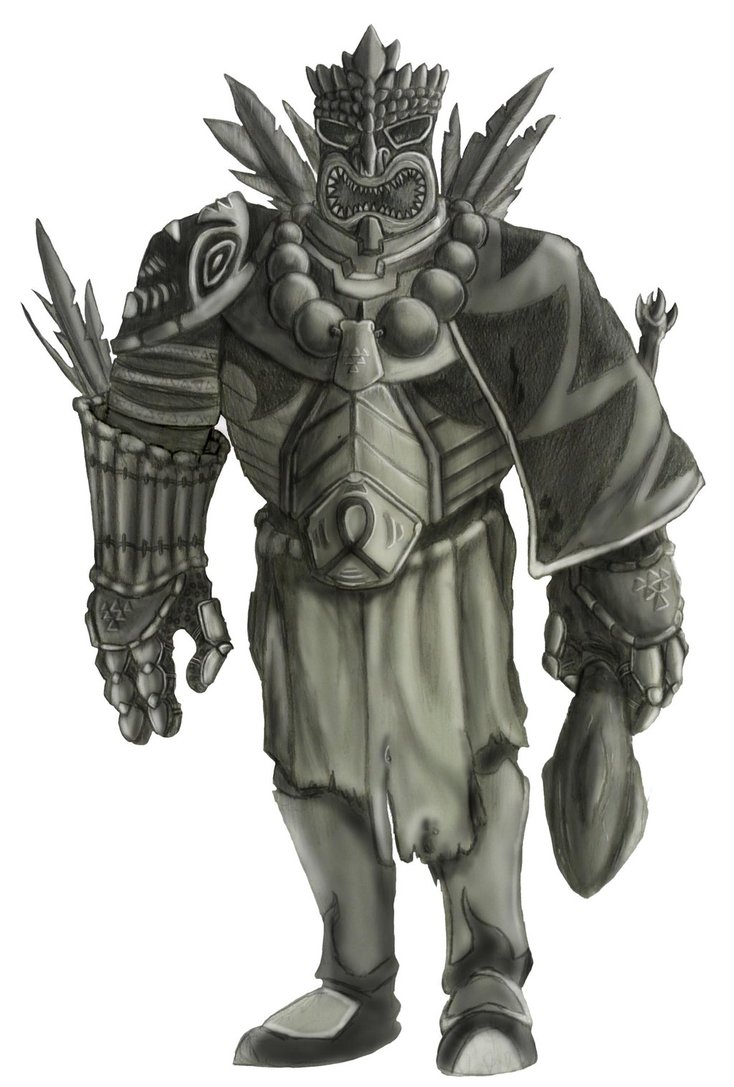
Once upon a time, according to Hawaiian legend, the war god Kū, for reasons known only to Kū, decided to live secretly among the common folk and pass himself off as a mortal. He posed as a farmer and even went so far as to marry and have a family. Kū and his family lived quite happily, but being a war god Kū wasn’t such a hot farmer, and famine struck (as famine will).
Ku posing as a farmer
When everybody got pretty darn hungry, Kū realized it was time to shed his disguise and do some god thing. One would think his action would involve a battle of some kind, his being the god of war and all. Instead he disappeared into the ground right before his astonished family’s eyes. They were quite distressed by this, so they stood around where he had last been seen and cried day and night, thus watering the ground until a tiny green sprout emerged. The tiny sprout grew into a magnificent tree heavy with fruits that looked like big ugly green footballs. After tossing one around for a bit, they wondered if they might eat it since they were starving. They tried it, and it tasted awful. But they ate it anyway, saving themselves from starvation, and always remembering that this tree was their beloved Kū, finally providing for his family.
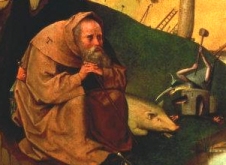
St. Anthony of Padua was a medieval saint who gained great fame in Italy for his zealous rooting out of heretics. As a preaching friar he might be heard to shout: “There are 27 known heretics in the State Department.” But he didn’t just discover heretics; he employed miracles to cure them of their heresy. Most of these miracles involved the use of animals, for he seemed to get along quite well with critters.
On one occasion, having discovered a person harboring heretical opinions, Friar Anthony, to convince the heretic of his errant ways, caused the fishes in a nearby lake to lift up their heads and listen to him. Now unlike Doctor Doolittle who talked to the animals, Friar Anthony preached to them. And he preached one fine sermon to those attentive fishes. And when those fishes all shouted “Amen!” at the conclusion of the sermon, that heretic was converted and stayed converted.
Another day, another heretic (there was no shortage of heretics – still isn’t). Anthony caused the heretic’s mule, after three days of no food, to kneel down and pray instead of rushing to eat a bundle of hay that was set before it. Another conversion.
St. Anthony was also known as a protector of animals (although starving a mule for three days might be considered counter-intuitive) particularly of pigs. A contemporary described him as the universally accepted patron of hogs, frequently having a pig for a companion – possibly because, as a hermit living in a hole in the earth and eating roots, he and the hogs had in common both their diet and their lodging.
What with his lifestyle and zealousness, he cut short his days, departing on June 13, 1231, at the age of 35, leaving pigs and heretics alike to their own devices.
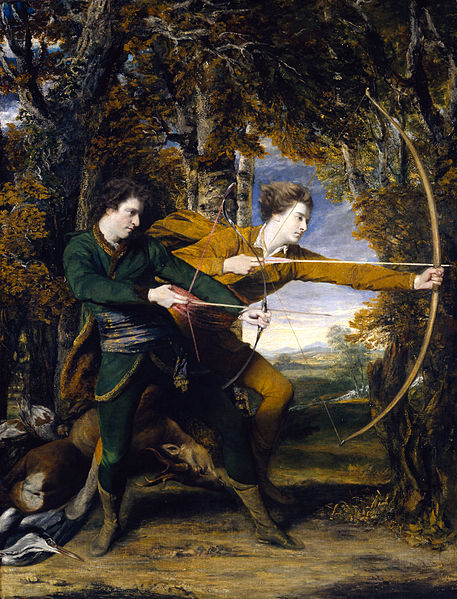
. . . only knaves will have bows and arrows. In a letter dated June 12, 1349, England’s King Edward III wrote how the people of his realm, both rich and poor, had in previous times exercised their skill at shooting arrows and how that practice had brought honor and profit to the kingdom. But, he continued, that skill had been laid aside in favor of other pursuits. Therefore he commanded sheriffs throughout the realm to proclaim that every able citizen in their leisure time use their bows and arrows, and learn and exercise the art of archery. And furthermore, they should not in “any manner apply themselves to the throwing of stones, wood, or iron, handball, football, bandyball, cambuck, or cockfighting” or any other such trivial pursuits (that includes golf).
A hundred years later, Edward IV continued the tradition, decreeing that all Englishmen, other than clergymen or judges, should own bows their own height, keeping them always ready for use and providing practice for sons age seven or older. Fines were levied for failing to shoot every Sunday.
Sir Wayne of LaPierre complained that the law did not go far enough, that it lacked a provision that citizens should carry concealed bows and arrows and quivers with more than a ten-arrow capacity. And a ban on background checks for potential archers, of course.
‘On behalf of the United States of America, may we offer you this tubular delight of meat, meat byproducts, curing agents and spices?’”
On June 11, 1939, on a royal visit to the United States, King George VI and Queen Elizabeth (II’s mum) joined President Roosevelt and others at his Hyde Park residence for a picnic. There, the British monarch experienced his first ever hot dog — and his second ever hot dog, along with a beer. It was a far cry from a typical state dinner. No reporters, no photgraphers, no politicos. The guest list included relatives, friends and neighbors of the Roosevelts, as well as employees and their children.
“King Tries Hot Dog and Asks For More” read the headline in The New York Times the following day, including that imagined dinner proclamation.
Werewolf? There Wolf
Actor, comedian, director, screenwriter, author and activist Gene Wilder was born on June 11, 1933. After his first film role playing a hostage in Bonnie and Clyde, he went on to star in such memorable films as Willy Wonka & the Chocolate Factory, The Producers, Young Frankenstein and Blazing Saddles.
“Invention, my dear friends, is 93% perspiration, 6% electricity, 4% evaporation, and 2% butterscotch ripple.” — Willy Wonka in Willy Wonka & the Chocolate Factory
“The clue obviously lies in the word “cheddar.” Let’s see now. Seven letters. Rearranged, they come to, let me see: “Rachedd.” “Dechdar.” “Drechad.” “Chaderd” – hello, chaderd! Unless I’m very much mistaken, chaderd is the Egyptian word meaning “to eat fat.” Now we’re getting somewhere!” – Sigerson Holmes in The Adventures of Sherlock Holmes Smarter Brother
“You’ve got to remember that these are just simple farmers. They’re people of the land. The common clay of the New West. You know – morons.” – The Waco Kid in Blazing Saddles
“This is a nice boy. This is a good boy. This is a mother’s angel. And I want the world to know once and for all, and without any shame, that we love him. I’m going to teach you. I’m going to show you how to walk, how to speak, how to move, how to think. Together, you and I are going to make the greatest single contribution to science since the creation of fire.” – Dr. Frankenstein in Young Frankenstein
I’m in pain and I’m wet and I’m still hysterical! – Leo Bloom in The Producers
An air of excitement certainly gripped London on June 10, 2000, as 90,000 people queued up to cross the first new bridge to span the Thames River in over a hundred years, a bridge for pedestrians only, stretching from the Globe Theatre to St. Paul’s Cathedral, aptly named the London Millennium Footbridge. It didn’t take long for the bridge to become more known by its nickname, the Wobbly Bridge. Seems the designers had not given enough attention to a phenomenon with the catchy title, synchronous lateral excitation. Even if you’ve never heard of it, it doesn’t sound like anything you’d want to be on a bridge with. People, according to engineers, sway when they walk. People walking and swaying cause sideways oscillations in lightweight bridges. These, in turn, cause the people (some two thousand on the bridge at any given time) to sway even more to keep from falling over. And they all sway at the same time. It’s as if two thousand Londoners were doing the tango above the Thames. Result? Wobbly. Access to the bridge was limited later in the day, and two days after it opened, the bridge closed for modifications. It reopened in 2002 (with tango forbidden). It was again closed in 2007 because of strong winds and a worry that pedestrians foolish enough to cross might be blown off the bridge. The footbridge was not the only British millennial faux pas: a little number called the Millennium Dome elicited this derision from MP Bob Marshall-Andrews: “At worst it is a millennial metaphor for the twentieth century. An age in which all things, like the Dome itself, became disposable. A century in which forest and cities, marriages, animal species, races, religions and even the Earth itself, became ephemeral. What more cynical monument can there be for this totalitarian cocksure fragile age than a vast temporary plastic bowl, erected from the aggregate contribution of the poor through the National Lottery. Despite the spin, it remains a massive pantheon to the human ego . . .”
At the Zoo
Originally created as a royal herb garden in the 1600s, the Jardin des Plantes opened in 1793. During the following year a ménagerie was added, the world’s first and, still in existence, today the world’s oldest. The 58-acre botanical garden and zoo is located in the center of Paris, next to the Seine.
The zoo was founded during the height of the French Revolution and the Reign of Terror. The National Assembly decreed that exotic animals in private hands – rare antelopes, tigers, Louis XIV, and the like — were to be donated to the menagerie or guillotined, stuffed and donated to the natural scientists of the Jardin des Plantes . The Jardin was free for all visitors and tourists right from its inception.
While the menagerie at first was just provisional, it grew in the first three decades of the 19th century to be the largest exotic animal collection in Europe – as they describe it in France (or somewhere): monkey honnete, girafe pas sincere, elephant plein mais stupide, orang-outang sceptical, zebre reactionaire, antilope missionaire.
A well-run place, but this being France the menagerie gardiens are usually quite fond of their aperitifs.
Someone told me it’s all happening at the zoo. — Paul Simon
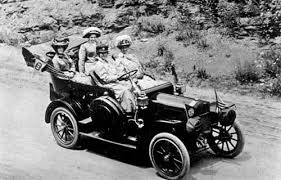
In 1909, a diminutive 22-year-old housewife from Hackensack, New Jersey, hopped into her dark green, four-cylinder, 30-horsepower Maxwell touring car and headed west. Alice Huyler Ramsey and her companions, two older sisters-in-law and a 16-year-old friend, were beginning a 59-day, 3,600-mile transcontinental odyssey that would end on August 9 in San Francisco, California.
It was an easy journey. After all, 152 miles of the roads were paved. The trip required only 11 tire changes, some new spark plugs and a brake pedal replacement. Most nights they were able to sleep in beds, although on one occasion in Wyoming they shared them with bedbugs.
And they had maps covering part of the journey, although for a good portion of the route they relied on printed guides giving directions using local landmarks that weren’t always that up-to-date. In one case, they were supposed to make a turn at a yellow house and barn, but it seems the owner, not an automobile enthusiast, had repainted them green.
In Ohio, they reached the breakneck speed of 42 miles per hour. But in Iowa, they encountered mud and flooded out roads. In Nebraska, a manhunt for a killer. And in Nevada a group of heavily armed Native Americans, who fortunately were not on the warpath but hunting.
But in the end, Ramsey and her friends arrived to cheering crowds in San Francisco. And Ramsey drove into history, the first woman to drive coast to coast. She was named the “Woman Motorist of the Century” by AAA in 1960. She repeated the trip another 30 times — in shorter periods of time — before her death on September 10, 1983, at the age of 96.
Japanese carrier All-Nippon Airways announced in 1988 that painting eyeballs on its jets cut bird collisions by 20 percent. The menacing-looking eyes painted on the engine intakes of its jet aircraft frightened away the birds, preventing them from throwing themselves at the plane during takeoff.
This conclusion was drawn after a controlled experiment in which the Japanese domestic
Another misstep: passengers in the rear compartment complained about congestion and lousy meals, passengers up front (ten to a wing) were annoyed by collisions with birds
airline painted the evil eyes on 26 of its Boeing 747’s and 767’s, leaving the rest of its fleet eyeless. After a year, an average of only one bird had hit each of the eyeballed engines while nine birds struck each unpainted engine.
The airline estimated that the reduction in bird strikes during the testing period reduced the damage to its aircraft from $910,000 to $720,000. Consequently, All-Nippon said it would paint eyes on all its large-body aircraft.
Continuing its program of thinking outside the fuselage to reduce costs, the company in 2009 planned to ask all passengers to use restrooms before boarding. During a four-week test, agents at the gates suggested that passengers use terminal restrooms to relieve themselves before getting on the plane. All-Nippon’s bathroom experiment was a way to cut fuel consumption, thereby resulting in decreased carbon emissions and lower costs. Travelers, however, did not warm up to the plan, finding it embarrassing and offensive. The plan went the way of the eyeballs. Oh yeah, the eyeballs were removed from planes in 2000 because – well, the company didn’t say why – just eye strain, perhaps.
The Killer Bee Chronicles Continue
When last we visited our gang of killer bees (yesterday) they were holding our happy home hostage. Having attacked me and left me swollen up like a giant bullfrog, they were celebrating, getting a real buzz on, so to
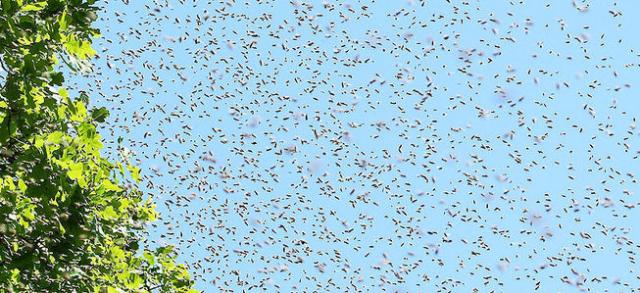
Killer bees at two o’clock
speak.
The hive, I might point out, was in the wall behind our bed. They were in there – not just a handful but a whole army – trying to tunnel their way through the plaster and lath to mount a massive shock and awe attack as we slept.
They might have been the depraved, cowardly black hats from a vintage western movie who have driven the last bit of law and order out of town. We needed that staple of vintage westerns, the guy in the white hat on a silver horse – the guy who would ride in during the last reel to vanquish the evildoers and save the day in an action-packed climax.
Enter the Beebusters. They didn’t exactly ride in in the last reel and race to an action-packed climax. They studied a lot. They took pictures. They discussed, made plans, took more pictures.
Finally, after an eternity of waiting, the day of reckoning arrived. The Beebusters themselves arrived late morning with loads of paraphernalia and a plan. First they would seal off our bedroom. Then from the outside, they would seal off the entrance so that no one could enter or leave. Then they would open up the wall and start vacuuming like crazy, capturing the critters in their specially rigged shopvac. It
Beebusters at work
sounded a bit reckless to me, but I wasn’t vacuuming, so let them be reckless.
I should point out that it’s all about the Queen Bee who sits on her throne inside the hive while all the drones bow a lot and buzz “Yes your majesty. How high, your majesty?” If the Beebusters can capture this Queen Bee, all the obsequious, bootlicking drones will follow her wherever she goes (Sort of like the obsequious, bootlicking Republicans bowing before Queen Donald).
But what if you can’t find the Queen Bee, I asked. It seems they were prepared for this possibility. They would use a make-believe queen if necessary. The little girls from across the street both began jumping up and down and shouting “I want to be a make-believe queen. I want to be a make-believe queen.” until we hosed them down and got on with our work. The make-believe queen is actually a drone in drag who will lure his fellow drones into “The Box.”
“The Box”
“Come into the box, my dears. It’s nice in the box. Nothing bad in here. Just me. And I’m sooo hot. C’mon handsome. Fly right in and we’ll have such a good time.” They will eagerly follow this siren into the bowels of “The Box” just as if he were the real thing. Bees are industrious, but they’re none too smart.
It was a big job – there were approximately 43,267 bees in our wall, and the Beebusters were able to bring most of them back alive. They now live in a pleasant retirement community on a farm far, far away.
But the killer bees hadn’t been gone two weeks when I discovered a gigantic anthill in one of our flower beds. Radioactive fallout and steroids have made the ants themselves monstrous, capable of carrying off small dogs and children. We gave them the little girls from across the street and a few strays that wandered into the yard, but they’re not satisfied. Does anyone know where I can get a giant anteater?
Local newspapers reported an amazing altercation in the village of Cargo in Cumberland, England, in 1827, a battle really (or a battle royal), between two opposing hordes – of bees. The home bees, it seems, were happily hived in the village, going about their bee business when, on June 7, a swarm from a neighboring village flew over the garden in which the first hive was situated. Without warning or so much as a by-your-leave, the interlopers darted down upon the hive and completely covered it, then began to enter the hive, pouring into it in such numbers that it soon became as crowded as happy hour at the local pub.
Then the terrible struggle began. With ear-splitting humming, two armies of combatants rushed forth, besiegers and besieged alike spilling out of the beleaguered hive into the open air. The bee-on-bee battle raged with such fury that the ground below was soon strewn with corpses. Not until the visiting swarm was vanquished and driven away did the battle end. The victors resumed possession of the hive.
The local chronicle did not attempt to explain the motivations involved, but naturalists, adding a scientific perspective, suggested that sometimes bees fight.
Rodgers and Hammerstein Are Frauds. Irving Berlin Too.
Julie Andrews and Von Trapps running from killer bees
It’s spring, and the hills of Vermont are alive with the sound of seventy degree temperatures, giving us a chance to venture out into the great outdoors. A little maintenance, clean out a flower bed or two, rake. Our resident swarm of bees had the same idea — without the raking. We’ve long debated whether these bees are honey bees or some less desirable species.
I have ended the debate. They are killer bees — murderous, cutthroat, bloodthirsty killer bees. And one of their crack snipers got me. I was tending to a bed, not threatening them in any way, and he swooped in and stung me on my eyelid. Before long I looked like I had caught a baseball with my right eye. I tried to recall what I had seen or heard about treating a bee sting and the Rodgers and Hammerstein cure came to me. I spent the rest of the day remembering my favorite things, even drinking a couple of them. It did nothing for me.
I spent a while standing out in front, stooped over, looking very much like Quasimodo, frightening away passing neighborhood children. But I soon tired of this game.
Eventually I toddled off to bed. But sleep wouldn’t come. Finally I remembered Irving Berlin’s prescription for insomnia and began methodically counting my blessings instead of sheep. As it turns out, one’s blessings and one’s favorite things are pretty much the same. Three a.m. I’m on my 137th blessing and wide awake. I won’t bore you with the details of my 137 blessings, but I
Waiting for passers by
will tell you that Rodgers and Hammerstein and bees are not among them.
Today I will perch atop the rock wall out front on hands and knees pretending to be a radiation-mutated giant bullfrog, croaking at passers by. Life goes on.
Be my little baby bumble bee. Buzz around. Buzz around. Keep abuzzing round.

 Like many actors in the 40s and 50s, LaRue spent most of his career making B-Westerns. Originally hired because he looked enough like Humphrey Bogart that producers thought this would draw in more viewers, he used his real last name as the name for most of his film characters. He was given the name Lash because, although he carried a gun, he was noted for preferring to use an 18-foot-long bullwhip to take on bad guys. Lash not only disarmed bad guys, he performed many stunts such as saving people about to fall to their doom by wrapping his whip around them — often while at full gallop on Black Diamond, his trusty horse — and pulling them to safety. Lash, like a guy named Cash, was also known for always wearing black.











 Wretched Richard's Almanac