AUGUST 15, 1935: WILL POWER

Cowboy, vaudeville performer, humorist, social commentator and motion picture actor, Will Rogers was one of the world’s best-known celebrities in the 1920s and 1930s and adored by the Will-Rogers-StampAmerican people. Known as “Oklahoma’s Favorite Son,” Rogers was born in 1879 to a prominent Cherokee Nation family in Indian Territory (now part of Oklahoma). During his amazing career, he traveled around the world three times, wrote more than 4,000 nationally-syndicated newspaper columns, and starred in 71 movies (a majority of them silent ) and several Broadway productions. He was the top-paid Hollywood movie star at the time, and in 1934, was voted the most popular male actor in Hollywood.

     As a radio broadcaster and political commentator, he was the leading political wit of the Progressive Era.  He called politics “the best show in the world” and described Congress as the “national joke factory.”

     Rogers died on August 15, 1935, with aviator Wiley Post, when their small airplane crashed in Alaska.

Never miss a good chance to shut up.


wr


There are three kinds of men. The one that learns by reading. The few who learn by observation. The rest of them have to pee on the electric fence for themselves.


We can’t all be heroes because somebody has to sit on the curb and clap as they go by.


When I die, I want to die like my grandfather who died peacefully in his sleep. Not screaming like all the passengers in his car.


Will-Rogers-Quotes-1


Ten men in our country could buy the whole world and ten million can’t buy enough to eat.


The best way to make a fire with two sticks is to make sure one of them is a match.
AUGUST 14, 1619: THOU SHALT NOT

Those folks who think they have it pretty rough in Virginia these days should thank their reactionary stars things are not as they were back in 1619. The very first general assembly got together in Jamestown that year to pass laws that pretty much told everyone how they could and could not behave. The burgesses, as members of the assembly were called, were 30 old white men determined to dictate morality to everybody else, a tradition that hasn’t changed much over the years.

     Nor has the politics. The burgesses passed laws requiring all colonists to attend two religious services every Sunday and to bear arms (pieces, swords, powder and shot) while doing so – just in case religious fervor pushed someone over the edge.  Even those bearing arms were forbidden from gambling, drinking, idleness and “excesses in apparel,” (which probably didn’t mean too much clothing).  Not wishing to overlook any sin they hadn’t thought of, the burgesses also approved a stern enactment against immorality in general. In the eyes of the burgesses, one can imagine, that might cover a lot of territory (and the colonies had lots of territory). The planting of mulberry trees, grapes and hemp was also proscribed, for we all know that that seemingly innocuous flora is the first step on the road to degradation (spelled with a ‘d’ and that rhymes with ‘p’).

     The burgesses had only nice things to say about tobacco however. Colonists were urged to dedicate the times they were not in church to the growing of said crop. The colonists responded with enthusiasm, even to the point of growing tobacco in the streets of Jamestown – 20,000 pounds a year – despite His Royal Stick in the Mud King James calling it “dangerous to the lungs.”

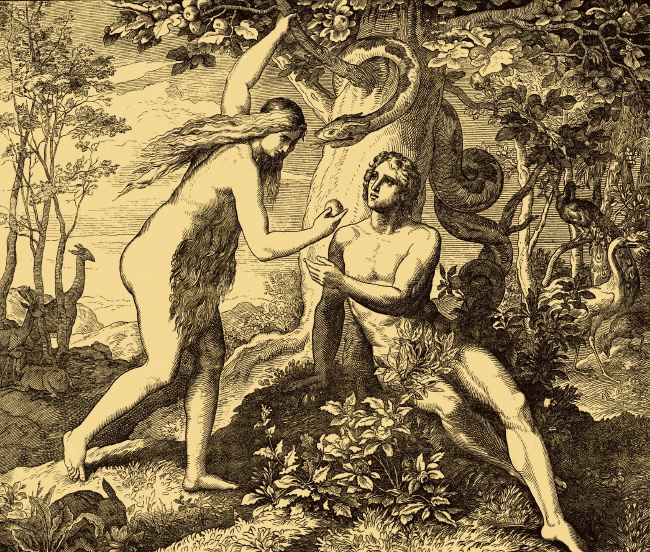
“Adam was but human—this explains it all. He did not want the apple for the apple’s sake, he wanted it only because it was forbidden. The mistake was in not forbidding the serpent; then he would have eaten the serpent.” ― Mark Twain

AUGUST 13, 1942: DEAD, A DEER, A FEMALE DEER

At some point, practically everybody on the planet has laughed and cried with Flower the Skunk, Thumper the Rabbit, the Great Prince of the forest and his unnamed mate, and Bambi, the title character in the Walt Disney classic first released on this date in 1942. It has become a favorite of generation after generation of kids and critics alike and ranks third in the American Film Institute’s all-time best animation features, “…the crowning achievement of Walt Disney’s animation studio.”

     It wasn’t a big success out of the gate. The New York Times said: “In the search for perfection, Mr. Disney has come perilously close to tossing away his whole world of cartoon fantasy.” Another critic called it “entirely unpleasant.” Hunters called it “an insult to American sportsmen.” Even Disney’s daughter complained, saying that Bambi’s mother shouldn’t have died. When Walt said he was just following the book, she protested, saying that he had taken other liberties before, and that Walt Disney could do whatever he wanted.

     As it was, we didn’t see Bambi’s mother die on-screen. They decided it was emotional enough without showing it. And there was much more we didn’t see. We didn’t see the six bunnies modeled after the Seven Dwarfs. They became five generic rabbits and Thumper. The squirrel and chipmunk comedy team didn’t make the final cut, nor did the two falling autumn leaves conversing like an old married couple. The civilization that Bambi destroyed by stepping on an ant hill and a family of squabbling grasshoppers didn’t pass the “What’s this got to do with Bambi?” test.  And Walt was talked out of showing a man burned to death by the fire that he inadvertently started.

     Oddly enough, Bambi is also listed in the Top 25 Horror Movies of all Time by Time magazine, because it “has a primal shock that still haunts oldsters who saw it 40, 50, 65 years ago.” Which brings us back to the question, did Bambi’s mother really have to die?


AUGUST 12, 1881: READY WHEN YOU ARE, C.B.

Cecil B. DeMille was a larger-than-life filmmaker throughout the first half of the last century as well as God’s public relations director. Born in 1881 in Ashfield, Massachusetts, he went on to enter the world of theater as an actor, director and playwright.  He helped to establish Paramount Pictures and co-directed his first film, The Squaw Man, the first of over 70 films, in 1914. Through the years, he burnished his reputation with lavish biblical epics such as The King of Kings, Samson and Delilah, and The Ten Commandments.

     DeMille created the first movie to have a budget of more than $1 million, paving the way for his future epics “with a cast of thousands.” Although he was adept at directing thousands of extras, he had a bit of a problem with individual actors, becoming a tad tyrannical on the set.  When making redsea1927′s King of Kings, DeMille demanded that in order to preserve the film’s spiritual integrity, the actors all had to enter into contracts promising that they would not do anything “unbiblical” for five years — that included going to baseball games,  frequenting nightclubs and  driving sexy cars.

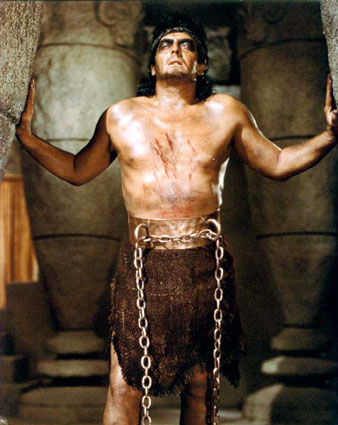
     He saw no reason his actors shouldn’t risk their lives for the good of the film.  Although Victor Mature was a superhero in Samson and Delilah, DeMille said he was “100% yellow” because he refused to wrestle a lion. Paulette Goddard lost future roles with the director by refusing to play with fire in Unconquered.

     And he loved spectacle – the parting of the Red Sea in The Ten Commandments, the toppling of the temple in Samson and Delilah, train wrecks in The Road to Yesterday, Union Pacific and The Greatest Show on Earth, and the destruction of a zeppelin in Madame Satan.

     Gloria Swanson immortalized DeMille in a movie he didn’t direct, Sunset Boulevard, with the frequently repeated line: “All right, Mr. DeMille, I’m ready for my close-up.”

Give me any two pages of the Bible and I’ll give you a picture.  — Cecil B. DeMille

AUGUST 11, 1894: POPARAZZI

Sometimes great ideas just come falling from out of nowhere, like that apple that beaned Isaac Newton while he sat under a tree daydreaming. Such was the case with Frank Epperson, born on August 11, 1894. Frank wasn’t a scientist or an inventor or any such thing. In fact, he was only 11 years old when he had his Eureka! moment.

Little Frank, who lived in Oakland, California, loved a soda concoction made by dissolving a flavored powder in water. One day as he was mixing his drink, he was distracted by something or other and left the drink with his stirring stick on the porch, completely forgetting about it.

Well, didn’t the Oakland temperatures plummet that night to a record low. The next morning Frank discovered his drink, completely frozen, the stirring stick standing straight up. You guessed it — the very first Popsicle. Only Frank called them Epsicles when, a few years later, he began to sell them to the public at Neptune Beach and later when he applied for a patent for his “frozen confectionary.”

Somewhere along the way, he changed the name to Popsicle, and in 1925 he sold the rights to the Joe Lowe Company of New York. The Popsicle eventually acquired some cousins — Fudgsicle, Creamsicle and Dreamsicle — and in 1989 it was swallowed up by Good Humor, a subsidiary of corporate giant Unilever.

Along Came Popsicle Pete

In 1939, Popsicle Pete became the official spokesman for Popsicle products. He was introduced on the Buck Rogers radio program, urging listeners to send in wrappers and win neat prizes. Popsicle Pete was . . . well, make your own characterization:


And Interstellar Dan

On this day in 1989 , Vice President Dan Quayle uttered these memorable words:  “Mars is essentially in the same orbit. Mars is somewhat the same distance from the sun, which is very important. We have seen pictures where there are canals, we believe, and water. If there is water, that means there is oxygen, that means we can breathe.”

A team of linguists continues to study the meaning of the quote.

AUGUST 10, 1749: MORE POWERFUL THAN . . .

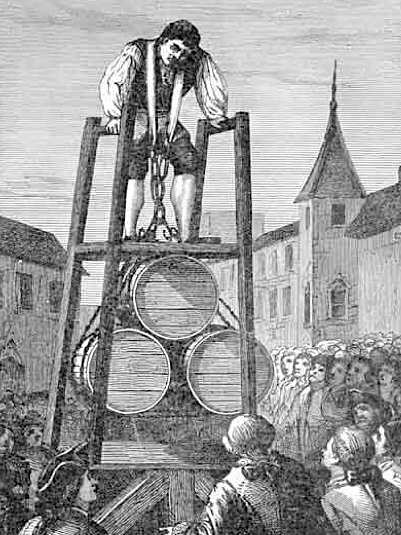
Thomas Topham, born in London about 1710, was brought up in the trade of carpentry and eventually found himself as the landlord of a small pub, the Red Lion Inn. Though he was by no means remarkable in size, he was endowed with extraordinary muscular powers and was able to entertain the patrons by performing various feats of strength. Crowds began to gather at the inn, not to drink but to see him perform.  To entertain the crowds, he might break a broomstick by striking it against his bare arm or lift a horse and toss it over a fence or roll up a pewter plate weighing seven pounds as another man would roll up a sheet of paper. In addition to his freakish strength, Topham could also sing in a basso profundo voice said to be so deep and resonant that it was scarcely human.

Strong as he was, he had basically a gentle nature. Sure, he might wrap an iron pipe around the neck of a man who irked him, but all in all he was a good-natured soul.  Naturally, the fame of this amazing strong man spread throughout England, and he became known as the Modern Samson.  He continued to wow bigger and bigger crowds – lifting 200-pound weights on his little finger or a six foot long oak table with his teeth, smashing a coconut by striking it against his ear, bending a one-inch thick iron bar around his bare arm with one blow.

     Alas, great fortune was not to continue for our Modern Samson. Like his biblical namesake, he was done in by the wiles of his very own Delilah. On August 10, 1749, his world came crashing down like that ancient temple when he discovered his wife’s infidelity.   After stabbing her to death, he used the knife on himself; dying from his wounds shortly thereafter.

AUGUST 9, 1639: TIPTOE THROUGH THE BOROUGHS

Jonas Bronck was the Norwegian son of a Lutheran minister born sometime around 1600. Or he was a Swedish sailor in the Danish Merchant Marine. Or a Dutch Mennonite who fled the Netherlands because of religious persecution. Or German.

In any event, he was an immigrant to the Dutch colony of New Netherland during a time when the greetings-bronxDutch were trying to increase its colonial population by relocating folks who had gone broke during the bursting of the tulip mania bubble in 1637. The English, who didn’t give a whit about tulips, were copulating and populating the New World like so many limey rabbits, and the Dutch were urged to get out of those wooden shoes and get with it.

Thus, Jonas Bronck arrived in New Netherland in 1639 aboard a ship ostentatiously named The Fire of Troy, whereupon he purchased himself a large tract of land from the local Lenape tribe for 400 beads. (You will remember that Dutch wheeler-dealer, Peter Minuit, who snapped up Manhattan for 26 bucks.)

Bronck’s 500 acres was just across the river from the village of Harlem, an easy commute to the Apollo Theater even then. Although Bronck traded with the locals, relations were not good, thanks to the Dutch practice of frequently murdering large numbers of them. Eventually, the they told Bronck to take his 400 beads and shove them, then killed him to reinforce the point.

Eventually, those populating English took over the Dutch lands. Jonas Bronck might have been completely forgotten, but for the river that retained Bronck’s name, mangled a bit to become the Bronx River. By extension, the land around it became The Bronx (and living there known as Bronxitis). This is fortunate, for the original Lenape name was Rananchqua.

We’ll have Manhattan, Rananchqua and Staten Island, too?

AUGUST 8, 1988: CRAZY EIGHTS

Numerologists had a field day back on 8/8/88. To start, the temperature in New York City reached a high of 88 degrees. Out in Minnesota, the Twins scored their second triple play of the season and eightyeightbeat Cleveland – by a score of 6-2. Meanwhile, the Cubs and the Phillies attempted to play the first ever night game at Wrigley Field but were rained out in the fourth inning with the score 3-1 (you do the math). The number was not lucky for Alan Napier, who played Alfred the butler in the Batman television series. He died. He was in his eighties.

     You might guess that the celebration in Eighty Eight, Kentucky, was a dandy one and it was. Numerologists descended on the little town in hordes, taking advantage of the 88 cents per gallon gasoline and the 88 cents meatloaf special at the Eighty Eight Restaurant. The celebration was over ten times (11) more festive than the one in Eight, West Virginia.

     But the numerology prize goes to a young lady named Kelly in Hackensack, New Jersey.  She was born at 8:08 in the morning, the eighth baby delivered that day, by a doctor who had eight of his own children. She naturally weighed in at 8 pounds 8 ounces.   And all the while her father paced nervously in the waiting room, humming “Beat Me Daddy, Eight to the Bar.”


AUGUST 7, 1966: CINCO DE CUGAT

Francesc d’Asís Xavier Cugat Mingall de Bru i Deulofeu was born in Spain and emigrated to Cuba when he was five. He was trained as a classical violinist and played with the Orchestra of the cugatTeatro Nacional in Havana before coming to the United States in 1915, where he rode the tango craze to stardom in movies and night clubs. Eventually Cugat and his orchestra became the resident musicians at New York’s Waldorf Astoria.

     On August 7, 1966, Cugat took his fifth stab at marriage with Charo, a Spanish guitarist and comic actress. One can only wonder why the 60-year-old Cugat would marry a 20-year-old who could barely speak English. It must have been her flamenco ability. Cugat’s previous wife, the sultry Abbe Lane, couldn’t play a lick.

     As a recording artist, Cugat followed dance trends carefully; his tango years were succeeded by  takes on the conga, the mambo, the cha-cha-cha, and the twist when each was in fashion. He had major hits with his recordings of “Pefidia” and “Brazil.”

     Cugat is the only bandleader in the Conductors-Who-Hold-Chihuahuas-While-Performing Hall of Fame.


I would rather play Chiquita Banana and have my swimming pool than play Bach and starve. ―Xavier Cugat

AUGUST 6, 1874: SAVING BODY PARTS II, THE EARS OF TEXAS ARE UPON YOU

Western justice once more prevailed when law officers killed one Jim Reed, a black hat of minimal notoriety who would probably have passed quietly into desperado oblivion had he not married Myra Maybelle Shirley. Myra Maybelle came from a once prosperous family whose business in Carthage, Missouri, had been wiped out by the Civil War. The family moved to Texas when she was 16 years old, and it was there that she fell in love with Jim Reed, a family acquaintance from Missouri who had served as a Confederate mercenary. They were married in 1866.

Reed was a lousy husband, more into horse racing and gambling than farming. He gravitated toward a nasty Cherokee named Tom Starr, who led a brutal gang of thieves. Starr (who wore a string tie fashioned from the ears of the men he had killed) mentored Reed in the art of rustling and running whiskey (and possibly a murder here and there).

Myra Maybelle, or Belle as she was now called, was the mother of two children. Nevertheless, she began to take part in her husband’s career, attending several robberies as though they were fancy dress balls, wearing velvet skirts and plumed hats. As fame and the law began to dog them, the Reeds went back to farming in Texas where they could give their children a more respectable upbringing. Too respectable for Reed evidently, for he soon grew antsy and returned to crime, holding up a stagecoach.  And once again they had the long arm of the law all over them.

With a hefty reward offered for Reed’s capture – dead or alive – bounty hunters joined the hunt. Reed was able to elude them for a bit, but on August 6, 1874, one of his fellow gang members killed him for the reward money. Two years later, Belle married Sam Starr, the son of Reed’s Cherokee partner, and became famous as the Bandit Queen, Belle Starr. Sam Starr died in a gun battle, and three years later Belle too cashed in her ill-gotten gains, bushwhacked by hombres unknown.