
October 14, 1790: If It’s Thursday, This Must Be Pitcairn

When British ships arrived at Pitcairn Island in 1814, two men paddled out in canoes to meet them. Both spoke English well, impressing the officers and men of the ships with their refinement as they met on deck. Their civilized demeanor persuaded the ships’ captains that  the mutineers from the Bounty, had created a proper society (after alcoholism, murder and disease had killed most of them off), and did not merit prosecution for the takeover.
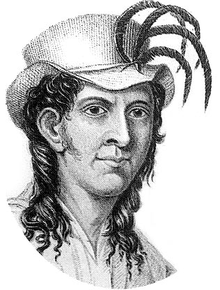
One of the two men was Thursday October Christian, son of Fletcher Christian and his Tahitian wife Mauatua. Fletcher, you will remember, was the ringleader of the mutiny that took place on the Bounty‘s voyage to Tahiti for breadfruit. Captain Philip Pipon, commander of one of the British ships, described Fletcher’s son Thursday as being “about twenty five years of age, a tall fine young man about six feet high, with dark black hair, and a countenance extremely open and interesting. He wore no clothes except a piece of cloth round his loins, a straw hat ornamented with black cock’s feathers, and occasionally a peacock’s, nearly similar to that worn by the Spaniards in South America, though smaller.”

Thursday October Christian, born on October 14, 1790, was the first child born on the Pitcairn Islands after the mutineers took refuge there. Born on a Thursday in October, he was given his name because his father wanted him to have “no name that will remind me of England,” forgetting perhaps that there are both Thursdays and Octobers in England. Captain Pipon referred to young Thursday as Friday October Christian,” because the Bounty had crossed the international date line going eastward, but the mutineers had somehow failed to adjust their calendars for this. The mutineers were living on a tropical island where everyone was running around naked. Is it any surprise that they didn’t know what day it was – or care?

As soon as Captain Pipon left, Thursday went back to his original name, not wanting to be confused with that other character from a story set on a tropical island.
 

October 13, 1947: Before There Were Muppets

The name Frances Allison probably doesn’t ring a bell with most people. In the days of live programming and test patterns, the radio comedienne and singer became well known to those who huddled around the TV set early evenings to watch the misadventures of the Kuklapolitan Players.  She was better known simply as Fran, and she was one-third of the trio Kukla, Fran and Ollie.

Created by puppeteer Burr Tillstrom, the show got its start as Junior Jamboree locally in Chicago, on October 13, 1947. Renamed Kukla, Fran and Ollie, it began airing nationally on NBC in early 1949.  Although the show, all puppets except for Fran, was originally targeted to children, it was soon watched by more adults than children. It was entirely ad-libbed.

Fran assumed the role of big sister and cheery voice of reason as the puppets engaged each other in life’s little ups and downs. It was a Punch and Judy kind of show but with less slapstick and more character development. Kukla was the nerdy leader of the amateur acting troupe, plucky and earnest, and Ollie (short for Oliver J. Dragon) was his complete opposite, a devilish one-toothed dragon who would roll on his back when sucking up or slam his chin on the stage when annoyed. Joining them were Madame Oglepuss, a retired opera diva; Beulah, a liberated witch; Fletcher Rabbit, a fussy mailman, and several others.

KFOs fan base included Orson Welles, John Steinbeck, Tallulah Bankhead, and Adlai Stevenson among many others.  James Thurber wrote that Tillstrom and the program were “helping to save the sanity of the nation and to improve, if not even to invent, the quality of television.”

Kukla, Fran and Ollie ran for ten years until 1957.  Mister, we could use a Kukla, Fran and Ollie today.

To Swazzle or Not To Swazzle

Kukla and Ollie didn’t come on the scene until the mid-20th century; but puppets has already been around for some 4,000 years. And they come in many different flavors: marionettes, finger puppets, rod puppets. The Tillstrom characters are glove puppets, controlled by a hand inside the puppet.

Punch and Judy are the most famous of this type of puppet. Their first recorded appearance in England was during the Restoration when King Charles II replaced wet blanket Oliver Cromwell and the arts began to thrive. Punch and Judy shows generally feature the fine art of slapstick with characters hitting each other as frequently as possible.

Punch speaks with a distinctive squawk, created by means of a swazzle, an instrument held in the mouth while speaking. Punch’s cackle is deemed so important in Punch and Judy circles (yes, there are Punch and Judy circles) that a non-swazzled Punch is considered no Punch at all.

“I knew Punch. Punch was a friend of mine. Senator, you’re no Punch.”


October 12, 1940: The Suitcase of Death

According to his press agent, Tom Mix, the star of 291 full-length westerns was the real thing – a genuine, actual cowboy hero of the American Wild West; born under a sagebrush in Texas, veteran of Tom Mix BBBnot one but three wars (Spanish-American War, Boxer Rebellion and Boer War); a sheriff in Kansas, a marshal in Oklahoma, a Teddy Roosevelt Rough Rider and a Texas Ranger, to boot.

Seems, however, he was really born in Driftwood, Pennsylvania, deserted the Army in 1902; marched in a Rough Rider parade, and was not quite a lawman but a so-so drum major in the Oklahoma Territorial Cavalry before heading off to Hollywood in 1909. Nevertheless, Mix became one of the top silent-film stars, at one time the highest-paid actor in Hollywood. Unfortunately, like many silent film stars Mix had a difficult transition to talkies. His squeaky voice didn’t match his beefy cowboy image.

On October 12, 1940, having traded in his faithful horse Tony for a bright yellow Cord Phaeton sports car, Mix was speeding north from Tucson at 80 mph when he failed to notice a sign warning that a bridge was out on the road ahead. The Phaeton swung into a dry wash, and Mix was smacked in the back of the head by one of the heavy aluminum suitcases he was carrying in the convertible’s backseat. The impact killed him instantly.

Today, visitors to the site of the accident (now called the Tom Mix Wash) can see a rather diminutive (2-foot–tall) iron statue of a riderless horse with a rather wordy plaque that reads: “In memory of Tom Mix whose spirit left his body on this spot and whose characterization and portrayals in life served to better fix memories of the Old West in the minds of living men.” And if you visit the Tom Mix Museum in Dewey, Oklahoma, you can view the featured attraction – the dented “Suitcase of Death.”

OCTOBER 11, 1983: DON’T YANK THE CRANK

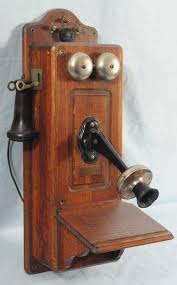
The title refers to a movement that took place in Maine back in 1981. Movement is probably a pretty strong word for laid-back Maine where crankdemonstrators tend not to get worked up into a chanting frenzy over things. And even less so in a sleepy little town like Woodstock whose population squeaked by 1,200 a couple of years ago.

Bryant Pond is Woodstock’s largest settlement and as much of an urban center as you’re likely to find. It captured its fifteen minutes of national fame and media attention during the mid1970s when its family-owned Bryant Pond Telephone Company became the last telephone exchange in the United States to use hand-cranked phones. Then in 1981, the two-position magneto switchboard in the living room of the owners was purchased by the Oxford County Telephone & Telegraph Company, a larger company in the Maine neighborhood. The Bryant Pond Telephone Company was swallowed like so many krill off the shores of Maine.

Two Bryant Pond residents started the “Don’t Yank The Crank” movement to save their crank telephones, financed by the sale of tee shirts – a valiant effort but nonetheless futile. At a meeting in the local school gymnasium warmed by a wood stove, townsfolk spoke out. “We have the oldest pay station in the United States,” said one resident, either complaining or bragging. “You put in a nickel and wind it up.” “You are a person instead of a number.” And did they mention no robocalls?

Alas, to no avail. The last “crank calls” took place on October 11, 1983, and the beloved telephones slipped into history like so much Americana.

Just Put Your Lips Together

Harry “Steve” Morgan and his alcoholic sidekick, Eddie, are a couple of ne’er-do-wells crewing a boat for hire on the island of Martinique. to_have_and_have_not_1944_film_posterLife is okay, but World War II is happening all around them, doing a number on the tourist trade and thus their livelihood. Howard Hawks’ film To Have and Have Not which premiered in New York on October 11, 1944, was notable for bringing together what would become one of Hollywood’s hottest couples, Humphrey Bogart and Lauren Bacall.

The film takes the title from the book by Ernest Hemingway but not much else. Hawks was a Hemingway fan but thought this particular book was a “bunch of junk.” Even so, Hemingway worked with Hawks on the screenplay, in which Bogart once again gives up his professed neutrality in the war to thwart the Nazis. The plot is well thickened by the stormy relationship between Bogart and Bacall who plays Slim, a saucy singer in the club where Morgan drinks away his days.

Another notable member of the cast is Hoagy Charmichael who appears as the club piano player, Cricket. He and Bacall perform several Charmichael songs: “How Little We Know,” “Hong Kong Blues,” and “The Rhumba Jumps.” Bacall does her own singing, even though persistent rumors would have a 14-year-old Andy Williams singing for her.

The most memorable take away from the film is one line of dialogue delivered seductively by Bacall: “You know how to whistle, don’t you, Steve? You just put your lips together and . . . blow . . .”

SEPTEMBER 28, 1951: SHOW A LITTLE RESPONSIBILITY, EARTHLINGS

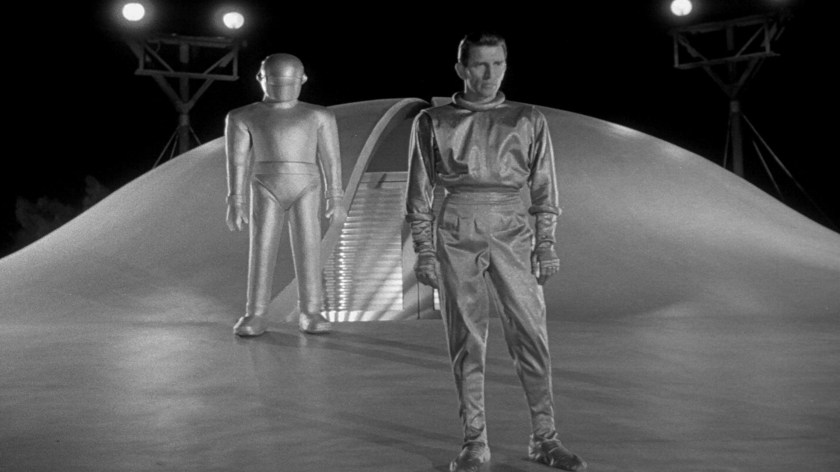
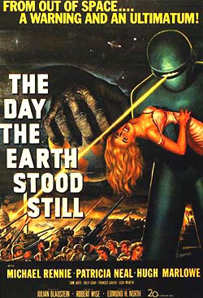
It’s a classic sci-fi scenario. A flying saucer lands in Washington D.C. (or substitute your favorite location). A very trigger happy Army battalion immediately surrounds the alien vehicle. A single individual emerges,day-the-earth-stood-still2 looking for all the world like one of us except for his shiny spacesuit. He claims to come in peace but the Army is having none of it. We need to build a wall, everyone agrees.  The space visitor who arrived in theaters everywhere on September 28, 1951, went by the name Klaatu (as in “Klaatu barada nikto”) and was played with alien sophistication by British actor Michael Rennie. The film, as any five-year-old space junkie can tell you, was The Day the Earth Stood Still.

Naturally, within minutes of declaring his peaceful intentions, Klaatu is shot by an over-zealous soldier. Klaatu’s very large, metallic sidekick emerges from the spaceship and quickly turns all the Army’s weapons into so much NRA dust. Klaatu is taken to the hospital where, when no one is looking, he heals himself. He then goes missing to move among the people in an attempt to discover just what makes earthlings tick. We quickly discover that he is wiser and more reasonable than all of us put together.

Klaatu takes a room at a boarding house, where he meets a widow and her son who become thoroughly entwined in the plot. He also meets an Einstein-like professor who is smart enough to converse with Klaatu on his level. Klaatu explains to the professor in a non-belligerent manner that, even though he has come in peace, that doesn’t mean’s not going to destroy the planet  (unlike the aliens in War of the Worlds who pulverized first and asked questions later). It seems that folks from elsewhere in the galaxy are a little concerned about our playing around with weapons of mass destruction.

Various sub-plots play themselves out as the movie hurtles toward a final showdown during which Klaatu politely tells all the world’s scientists that if they don’t play nice “this Earth of yours will be reduced to a burned-out cinder.”

Klaatu then bids them a fond farewell, and he and his metallic sidekick ride off into space, as one bystander asks another bystander: “Who was that masked man?”

SEPTEMBER 27 1937: ONLY 89 DAYS UNTIL CHRISTMAS

Miracle on 34th Street is arguably the best ever Christmas movie. Early in the film, an indignant Kris Kringle, played by Edmund Gwenn, chides the Macy’s Thanksgiving Day parade Santa for being drunk on duty. The inebriated Santa was not Charlie Howard. The movie was made in 1947; Charlie was the Macy’s parade Santa from 1948 to 1965.

Even before his Macy’s gig, Charlie was already the most famous and sought after Santa in the nation, having played the jolly old elf since his 4th grade Christmas pageant. He began passing his Santa skills on to other would-be Santas on September 27, 1937, when the Charles W. Howard Santa Claus School opened its doors in Albion, NY. The campus was actually Charlie’s home, until in the late 1940s he opened Christmas Park right next door. There fledgling Santas could practice their ho-ho-hos on actual little children.

Now in its 84th year (Charlie Howard died in 1966), the school promises a well-rounded Santa education covering such topics as the history of St. Nicholas and Santa Claus, the proper use of the red Santa suit and Santa make-up, working with reindeer, and flying sleigh lessons. Tuition is $550.  Students may major in either Santa or Mrs. Santa Claus. But hurry — classes begin in late October.


SEPTEMBER 26, 1849: DROOLING FOR SCIENTIFIC PROGRESS

There’s a certain something that makes the scientific mind differ from the ordinary mind.

An example: We are in the habit of walking into our dog’s room (it’s a hypothetical room, okay?) at cocktail time and feeding Rover (becausepavlov he looks like a Rover, okay?) (and he’s hypothetical too). This makes Rover quite happy. One day we walk in, drinking our cocktail but forgetting Rover’s food. No, he doesn’t bite us (an angry look, maybe). But he salivates even though there’s no food. What do we do? We beat Rover, clean up his drool, drink our cocktail, and get on with our lives.

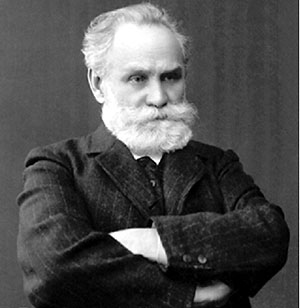
But a scientist? He’d stare at that saliva, ponder it, apply a little scientific method and possibly come up with a bunch of new scientific ideas. Ivan Pavlov, born on September 26, 1849, did just that. He saw his Rover drool, and he developed a major branch of learning called classical (or Pavlovian) conditioning with theories and laws and all sorts of scientific accoutrements. This in turn led to concepts such as comparative psychology, behavior modification and Brave New World.

Ever the scientist, even on his death bed, Pavlov engaged a student to sit with him and take notes as he died. He did not salivate. We don’t know if the student did.

I’ll be with you in apple blossom time

The animated 1948 film Melody Time, from Walt Disney Studios features a 19-minute segment with Dennis Day as an apple farmer who sees others going west, wishing he was not tied down by his johnny-appleseedorchard, until an angel appears, singing a happy apple song, setting him on a mission. When he treats a skunk kindly, all animals everywhere thereafter trust him. The cartoon features lively tunes, and a simplistic message of goodness, and probably helped to cement the image of Johnny Appleseed firmly in American lore.

John Chapman, the flesh and blood Johnny Appleseed, was born in Massachusetts on September 26, 1774.   At the age of 18, he persuaded his 11-year-old half-brother Nathaniel to go west with him to live the lives of carefree nomadic wanderers – rolling stones gathering no moss. Eventually Nathaniel grew up and quit the rambling around to gather moss and help his father farm. Johnny didn’t.

Johnny embarked on a career as an orchardist, apprenticing to a man who had apple orchards. Eventually, he returned to roaming, and the popular accounts have him spreading apple seeds randomly, everywhere he went. He actually planted nurseries, built fences around them, left the nurseries in the care of a neighbor who sold trees on shares, and returned every year or two to tend the nursery.

And Johnny Appleseed was against grafting. Therefore his apples were of a sour variety and used primarily for hard cider and apple jack. “What Johnny Appleseed was doing and the reason he was welcome in every cabin in Ohio and Indiana was he was bringing the gift of alcohol to the frontier. He was our American Dionysus.”

Johnny also spread the Swedenborgian word of God, preaching as he traveled. The Swedenborgian movement was a popular new religion of the time promoting repentance, reformation, and regeneration of one’s life.   Johnny would tell stories to children and lay the gospel on adults, receiving a floor to sleep on and supper in return.  Said one of his converts: “We can hear him read now, just as he did that summer day, when we were busy quilting upstairs, and he lay near the door, his voice rising denunciatory and thrillin’—strong and loud as the roar of wind and waves, then soft and soothing as the balmy airs that quivered the morning-glory leaves about his gray beard.”

And a wee bit of apple jack didn’t hurt either.


SEPTEMBER 25, 1789: MONROE BEFORE MADISON EXCEPT AFTER JEFFERSON

When the Constitutional Convention sent the proposed U.S. Constitution to the states for ratification, Anti-Federalists criticized the power it gave the national government and its lack of explicit constitutionprotections for individual rights. Several states ratified the Constitution only given the promise that it would be immediately amended.

James Madison from Virginia proposed 19 amendments to answer the states’ objections. The Senate then whittled these down to 12, which were approved by Congress on September 25, 1789,and sent on to the states by President Washington.

The states ratified the last 10 of the 12 amendments, and they became the first 10 amendments to the Constitution, now referred to as the Bill of Rights.

The first of the two rejected amendments would have established how members of the House of Representatives would be apportioned to the states. Although it was rejected, it is covered elsewhere in the Constitution. The second forbade Congress from raising its own pay; Congress could vote for a raise but it would only apply to the next Congress. Nearly two hundred years later, a clever university student realized that the amendment remained “alive” because it had no deadline for state ratifications. He organized a successful campaign seeking ratification of the amendment, and it became the 27th (and most recent) amendment to the Constitution.

king me

Many of those members of the Constitutional Convention wanted Washington to become America’s own King George I. Although cooler heads prevailed, it’s interesting to think about the possibility. A list of our royalty might look something like this.

George I (George the Honest)

John I

Thomas I

James I

James II

John II (John the Junior)

Andrew I (Andrew the Old Hickory)

Martin I

William I (William the Tippecanoe)

John III (John the Tyler Too)

James III royal

Zachary I

Millard I

Franklin I

James IV

Abraham I (Abraham the Emancipator)

Andrew II

Ulysses I

Rutherford I

James V

Chester I

Grover I

Benjamin I

Grover I Part II

William I

Theodore I (Theodore the Big Stick)

William II (William the Fat)

Woodrow I

Warren I

Calvin I

Herbert I

Franklin II

Harry I

Dwight I (Dwight the Ike)

John IV

Lyndon I

Richard I (Richard the Not a Crook) Abdicated the throne

Gerald I

James VI

Ronald I

George II

William III

George III (George the W)

Barack I (Barack the Kenyan)

Donald I (Donald the . . .)

Joe I


SEPTEMBER 24, 1991: OH, THE THINGS YOU’LL WRITE

Probably the foremost children’s book author of the 20th century died on September 24, 1991, at the age of 87. Dr. Seuss, Theodor Geisel, published 46 books for children including a new kind of first reader that sent Dick and Jane into well-deserved retirement.

Dr. Seuss was born in the early 1920s, when Geisel (born in 1904) was attending Dartmouth College. Among his pursuits there was work on the humor magazine Dartmouth Jack-O-Lantern, for which he rose to the rank of editor-in-chief. However, one dark day at Dartmouth, Geisel was caught drinking gin at a party in his room. This was frowned upon by the Dean, who insisted that he resign from all extracurricular activities, including the college humor magazine. To continue work on the Jack-O-Lantern surreptitiously, Geisel began signing his work with the pen name Dr. Theophrastus Seuss. (Other pseudonyms included Theo LeSieg and Rosetta Stone.

Geisel had a successful career in advertising (Flit, Standard Oil, U.S. Army) and as an editorial cartoonist denouncing fascists, racists, isolationists and Republicans.  But it was his children’s books that gave him lasting recognition. His first, published in 1937, was And to Think I Saw It on Mulberry Street. He followed with such celebrated books as The 500 Hats of Bartholomew Cubbins, Horton Hatches the Egg, Horton Hears a Who!, and How the Grinch Stole Christmas!. In 1954, Geisel was challenged to write a book using only 250 words appropriate to beginning readers, “a book children can’t put down.” Nine months later, using 236 of the words given to him, Geisel completed The Cat in the Hat.

Geisel made a point of not beginning the writing of his stories with a moral in mind. “Kids can see a moral coming a mile off,” he said.

Numerous adaptations of his work have been created, including 11 television specials, four feature films, a Broadway musical and four television series.

“Today you are You, that is truer than true. There is no one alive who is Youer than You.”

“I meant what I said and I said what I meant. An elephant’s faithful one-hundred percent!”

“If you never did you should. These things are fun and fun is good.”

“They say I’m old-fashioned, and live in the past, but sometimes I think progress progresses too fast!”

“I do not like green eggs and ham, I do not like them Sam-I-Am.”

“Writing simply means no dependent clauses, no dangling things, no flashbacks, and keeping the subject near the predicate. We throw in as many fresh words we can get away with. Simple, short sentences don’t always work. You have to do tricks with pacing, alternate long sentences with short, to keep it vital and alive…. Virtually every page is a cliffhanger–you’ve got to force them to turn it.”

Froggie went A-forecasting

On September 24, 1788, the Morning Chronicle and London Advertiser described a rather ingenious barometer devised by an unnamed Frenchman. The instructions: Equip a clear glass bottle with earth and water to a depth of about four fingers and a tiny ladder that reaches from the bottom to the lower part of the neck. Find a small green frog and put it in the bottle. Cover the bottle with a piece of parchment pricked with a pin to admit air. As long as the weather remains fair, the frog will perch at the top of the ladder, but if rain approaches the frog will go down into the water.


SEPTEMBER 23, 1889: DEAL ME IN, YAMAUCHI-SAN

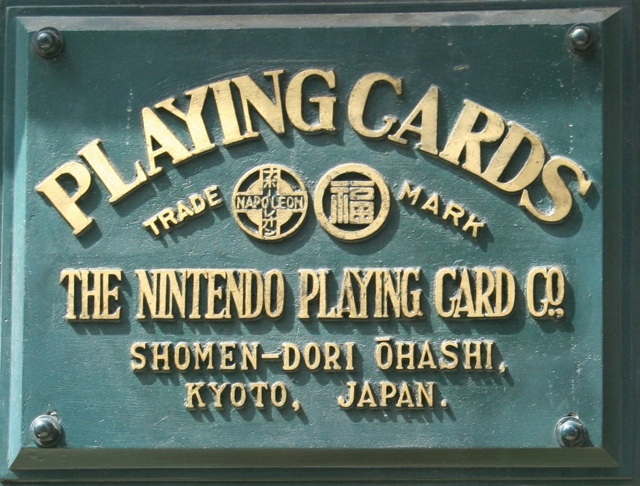
Nintendo, the consumer electronics giant was founded on September 23, 1889. No, it wasn’t the first video gaming company, a hundred years ahead of its time. Super Mario Brothers and Pokémon were not evennintendo1 glints in some developer’s eyes. The company was founded to produce playing cards. Playing cards had been introduced to Japan centuries earlier, but each time a card game became popular, folks began gambling on it, and the government banned it. One card game, hanafuda, resisted this trend. It used Western style cards with images but no numbers. The lack of numbers and the fact that the game was quite complicated limited its appeal to gambling types.

Nintendo founder Fusajiro Yamauchi produced and sold handcrafted hanafuda cards painted on mulberry tree bark — hardly high tech. The company hummed along happily producing its cards for another fifty years or so until an antsy grandson of the founder began to expand. His expansion efforts were rather haphazard and for the most part less than successful. There was a taxi company and a TV network, a food company selling instant rice. Then there was the chain of “love hotels,” offering accommodations for “resting” at hourly rates with such amenities as unseen staff members and hidden parking lots.

Nintendo stock soon bottomed out. In 1966, Nintendo got into the toy business with such products as Ultra Hand, Ultra Machine and Love Tester. During the 1970s, the company moved into electronics and arcade games. Then in 1981, it introduced Donkey Kong and the rest is — well, you know what they say.

Nintendo still makes hanafuda cards.

Madame Would-Be President

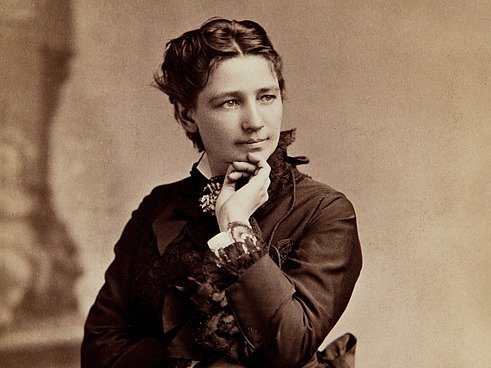
Born on September 23, 1838, Victoria Woodhull, although rather woodhullfamous or infamous in her day, does not jump readily to mind today. She wore many hats: newspaper publisher, stock broker, lobbyist, traveling clairvoyant, public speaker on women’s suffrage. She was also the first woman to run for president in the United States. That was in 1872 as the candidate of the Equal Rights Party. Noted abolitionist Frederick Douglass was selected as her running mate. However, he never acknowledged it, and campaigned for Republican Ulysses S. Grant.

She had a few things going against her. Women couldn’t vote, so she couldn’t even vote for herself. She was not old enough to serve as president. And just a few days before the election she was arrested on obscenity charges for publishing an account of an adulterous affair between the minister Henry Ward Beecher and Elizabeth Tilton.

She didn’t receive any electoral votes, and no one knew her popular vote total since her votes weren’t counted. One gentleman in Texas did publicly admit voting for her.

One of the world’s most popular entertainments is a deck of cards, which contains thirteen each of four suits, highlighted by kings, queens and jacks, who are possibly the queen’s younger, more attractive boyfriends.”
― Lemony Snicket