APRIL 12, 1788: WHAT’S IN A NAME

Cape Disappointment is a headland at the mouth of the Columbia River at the southwesternmost tip of Washington State. Its main claim to fame is its fog. At 106 foggy days a year, Cape Disappointment is the foggiest spot in the United States. And then there’s the name, one that surely must put the Cape Disappointment Chamber of Commerce through its paces. Where did it get that name, you query? Good of you to ask. It just happens to have been named on April 12, 1788.

John Meares was an explorer, navigator, fur trader and a bit of a scoundrel. His first expedition to the north Pacific ended in failure. Sailing with false papers claiming Portuguese registry to avoid licensing and duties and with inadequate provisions, he was forced to winter in Prince William Sound. All but ten of his men died. Meares and these men were saved by the arrival of a British trader. To show his gratitude, Meares sued the trader, claiming he had been overcharged for the supplies that saved their lives.

In 1788, he was back in the north Pacific collecting sea otter furs to sell in China. Sailing southward along the Washington coast, he ran into nasty weather at that unnamed headland at the mouth of the Columbia River. Forced to turn back, he called the place X#!##X!&!! which was later cleaned up to Cape Disappointment.

A few years later, Meares would bring Britain and Spain to the brink of war, but that’s a story for another day.

Magic Kingdoms Here and There

It was a Big Apple Fantasyland. Finishing touches were still being put in place on New York City’s Hippodrome just hours before its April 12, 1905, opening. Seating 5300 people, it dwarfed the Metropolitan Opera with its 3000 seats. A marvel of theatrical architecture, its stage was 12 times larger than any existing Broadway house and was capable of holding a thousand performers at a time or, perhaps, a full-sized circus complete with clowns and horses and acrobats and a flying elephant or two.

Speaking of Flying Elephants (a Clever Segue to 1992)

Could Mickey Souris really cut it among continental consumers? Would the rodent empire have the necessary je ne sais quoi to win those jaded Gallic hearts and minds? No more guessing or advance planning or idle speculation after D-Day (as in Disney) — April 12, 1992, the day Euro Disney opened its gates in Marne-La-Vallee on the outskirts of Paris. Gladstone Gander or Goofy?
The lucky duck prevailed. The royaume magique became one of Europe’s leading tourist destinations with some 15 million annual visitors. Disney had created another Fantasyland.


APRIL 11, 1938: GIVE ME AN ALTO OR GIVE ME DEATH

Call it destiny. Two men stranded in Kansas City when a storm closed the airport met in a hotel lobby, engaged in conversation, and – go figure – discovered they each had profound worries about the future of the barbershop quartet. This was not just empty lamenting on the part of Owen C. Cash and Rupert I. Hall; these founding fathers acted, and the Society for the Preservation and Encouragement of Barber Shop Quartet Singing in America was born. They wrote a letter that became a mission statement:

“In this age of dictators and government control of everything, about the only privilege guaranteed by the Bill of Rights not in some way supervised or directed is the art of barbershop quartet singing. Without a doubt, we still have the right of peaceable assembly which, we are advised by competent legal authority, includes quartet singing.

“The writers have, for a long time, thought that something should be done to encourage the enjoyment of this last remaining vestige of human liberty. Therefore, we have decided to hold a songfest on the roof garden of the Tulsa Club on Monday, April 11, 1938, at 6:30 pm.”

Twenty-six men attended that first rooftop meeting. Attendance at subsequent meetings multiplied rapidly, and at the third meeting, 150 harmonizers stopped traffic on the street below. A reporter for the Tulsa Daily World put the story on the national news wires and the rest is history.

Today the Society for the Preservation and Encouragement of Barber Shop Quartet Singing in America (SPEBSQSA, as it’s more familiarly known) has 25,000 members,. That acronym SPEBSQSA was the founders’ way of demonstrating that one could  be a barbershop quartet enthusiast and still have a sense of humor; it was a parody of the New Deal’s “alphabet soup” of acronyms, and the society has said “attempts to pronounce it are discouraged.”

Wretched Richard’s Little Literary Lessons — No. 7

Imagery

img·ery ˈi-mij-rē, -mi-jə-

A literary device in which the author uses words and phrases to create “mental images” that help the reader better imagine the world the author has created.

With Huey at the wheel, South Miami, Key Largo and Marathon had been blurs in a landscape littered with condominiums and palm trees and then longer and longer stretches looking out to sea. Squadrons of pelicans flying in Blue Angel formation patrolled the waters offshore. Occasionally one would break ranks and swoop down to make an arrest. The perp quickly disappeared into the pelican’s private holding tank, demanding perhaps a phone call to his lawyer. But he was quickly swallowed without benefit of counsel like so much seafood. A large billboard urged them to “go all the way” to Key West, and Huey announced that they would make it in time for the sunset.


Put yourself in the picture: Voodoo Love Song


APRIL 10, 1953: COMIN’ AT YA

The poobahs at Hollywood’s major film studios watched with amazement and envy as the independently produced 3-D movie Bwana Devil wowed audiences in late 1952.  Columbia Pictures quickly threw together a black- and-white thriller that for an hour hurled practically every prop on the set at the beleaguered audience. It was just as quickly forgotten.  Then on April 10, 1953, Warner Brothers released its entry — in color and stereophonic sound — House of Wax, a horror film starring Vincent Price as a sculptor who kills folks, covers them with wax, dresses them up as famous historical figures, and displays them in his wax museum. Audiences loved it, making it one of the biggest hits of the year. Even critics gave it a go. And although it took a while, the Library of Congress selected it in 2014 for inclusion in the National Film Registry, deeming it “culturally, historically, or aesthetically significant.”

The film revived Vincent Price’s career, positioning him as the go-to guy when you needed a mad scientist or fiendish psychopath.  Although House of Wax had a couple of classic 3-D effects (the pitchman with a paddleball and a character who seemingly stands up in the audience and runs into the screen), it was not loaded down with them. This might have been because the director was blind in one eye and couldn’t understand what all the fuss was about.

And What Do We Suppose Jumbo the Elephant Really Was

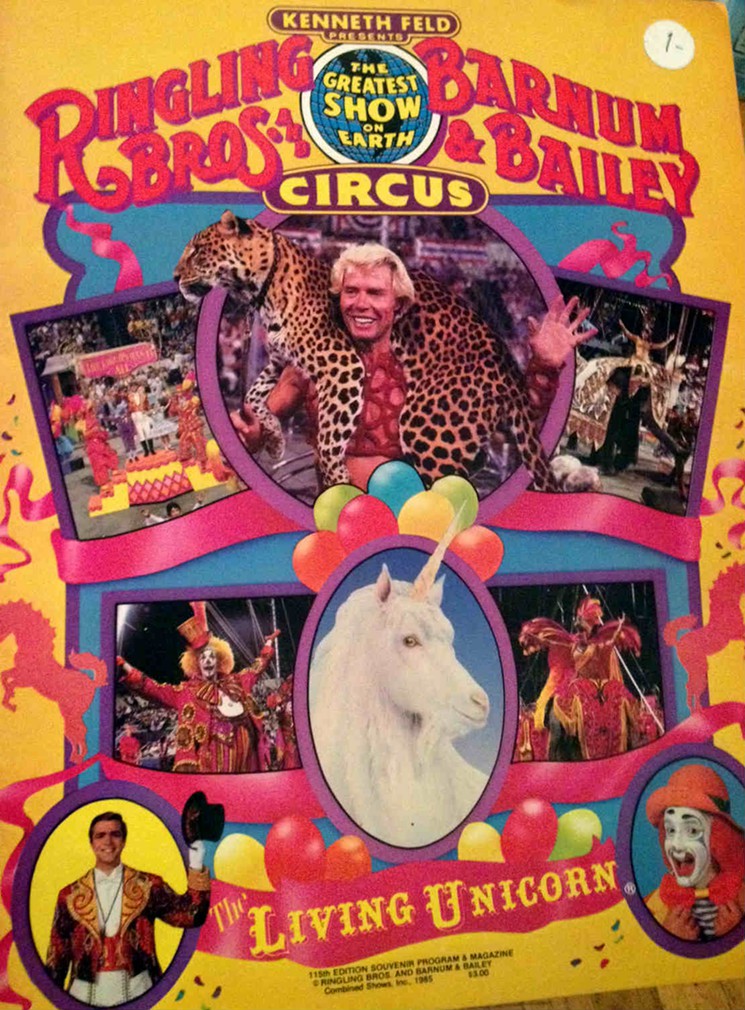
On this day in 1985, Lancelot the Unicorn who had been touring with the Ringling Brothers and Barnum and Bailey Circus — famous for outlandish attractions — was exposed as a fraud.  Audiences were appalled to learn that Lancelot wasn’t a real unicorn at all, just a goat with a horn surgically attached to its forehead.

IF IT HAD ONLY BEEN A NACHO

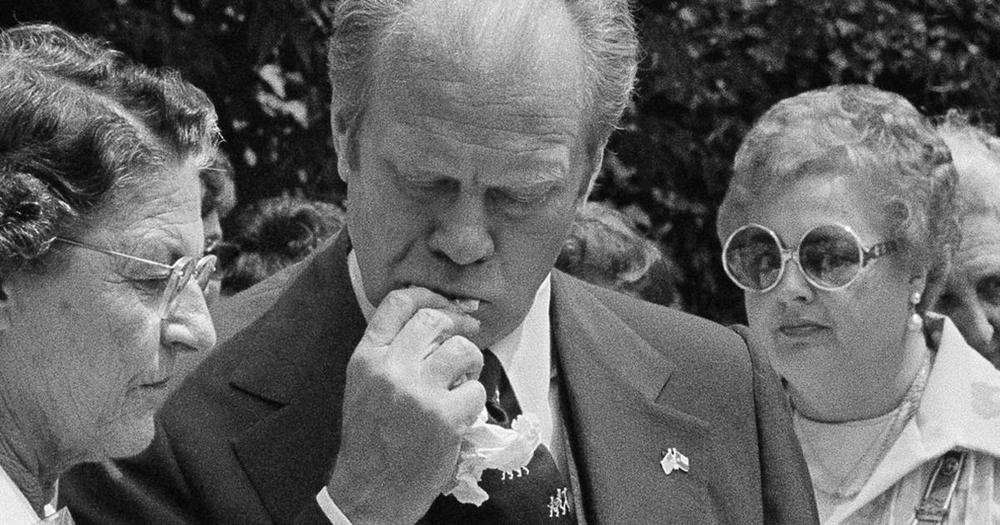
It would seem that in modern politics every president has been forced to deal with a scandal, big or small –vicuna coat, Watergate, Iran Contra, Stormy Daniels. Gerald Ford’s scandal would probably be trivial in comparison to most. But it may have cost him re-election. It was April 10, 1976, in San Antonio, Texas, at the Alamo, where a tiny faux pas morphed into the Great Tamale Incident as the President attempted to eat a tamale without removing the corn husk, playing into his reputation as a bit of a bumbler.

APRIL 9, 1940: YOUR SHOPPING CART IS EMPTY

Sylvan Goldman was an idea man. One of his more persistent ideas led to his choice of careers. Actually, it was more than an idea — a concept, an eternal truth perhaps. “The wonderful thing about food is that everyone uses it — and uses it only once.”

Born in the Oklahoma Territory, he and his brother went into wholesale produce only to be wiped out by plunging oil prices.  After studying all the latest methods for retailing groceries, they bounced back with a chain of self-service stores featuring woven baskets for  carrying groceries. The stores were a big success, and they were bought out by the Safeway chain. Once again hard luck hit; their Safeway stock tanked during the Depression. And once again they bounced back; by the mid-30s they were half owners of the Piggly Wiggly chain.

Goldman continued to dream about customers moving more and more groceries. And one night in 1936 he had a eureka moment — inspired by a wooden folding chair. Put wheels on the legs and a big basket on the seat and you have a shopping cart.

Goldman and a mechanic friend began tinkering. They devised a metal cart with not one but two wire baskets. For efficient storage, the carts could be folded and the baskets nested. Goldman called his invention a folding basket carrier, receiving a patent on April 9, 1940.

When the carriers were introduced to the public, Goldman encountered one tiny problem. Customers didn’t want to use them. Men thought they would look like sissies pushing a cart. Women felt like they were pushing a baby carriage.  And older shoppers thought it made them look helpless. Goldman was always ready with another idea. He hired attractive models, both men and women, to push the carts around, as well as charming greeters urging customers to take one for a spin.

By the 1940s, the carts had become so much a part of the American shopping experience that the Saturday Evening Post devoted its cover to them. And they got bigger and bigger until they got tiny as little icons on websites everywhere.

Goldman’s Folding Carrier Basket Company is still in business today. Goldman isn’t. He died in 1984.

APRIL 8, 1832: TAKE MY WIFE . . . PLEASE

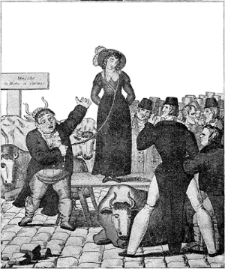
Earlier centuries saw a great many practices that were commonplace then but which would be considered inappropriate in our more enlightened age. Nowhere was this truer than in (merry old) England — purchasing a plump Irish child for special dinner occasions in the 18th century, for instance, or in the 19th century, selling a spouse one had grown weary of.  One such sale took place on April 8, 1832, an account of which was recorded for the amusement of generations that followed.  Joseph Thompson, a farmer, had been married for three unhappy years when he and his wife decided to call it quits.  As was customary, Thompson took his wife to town and set her up for public auction.  At noon, the sale commenced with Thompson delivering a short speech:

“Gentlemen, I have to offer to your notice my wife, Mary Ann Thomson . . . whom I mean to sell to the highest and fairest bidder.  Gentlemen, it is her wish as well as mine to part for ever.  She has been to me only a born serpent.  I took her for my comfort, and the good of my home; but she became my tormentor, a domestic curse, a night invasion, and a daily devil.  Gentlemen, I speak truth from my heart when I say — may God deliver us from troublesome wives and frolicsome women!  Avoid them as you would a mad dog, a roaring lion, a loaded pistol, cholera morbus, Mount Etna, or any other pestilential thing in nature.”

What a sales pitch!  This guy could sell anything. The asking price for Mary Ann was 50 shillings. Eventually, the price was knocked down and a deal was made — 20 shillings and a Newfoundland dog.

Everyone satisfied, they parted company, Mary Ann and a gentleman named Henry Mears in one direction, Joseph and the dog in the other.

APRIL 7, 1864: IT WAS A HUGE HUMPY BEAST

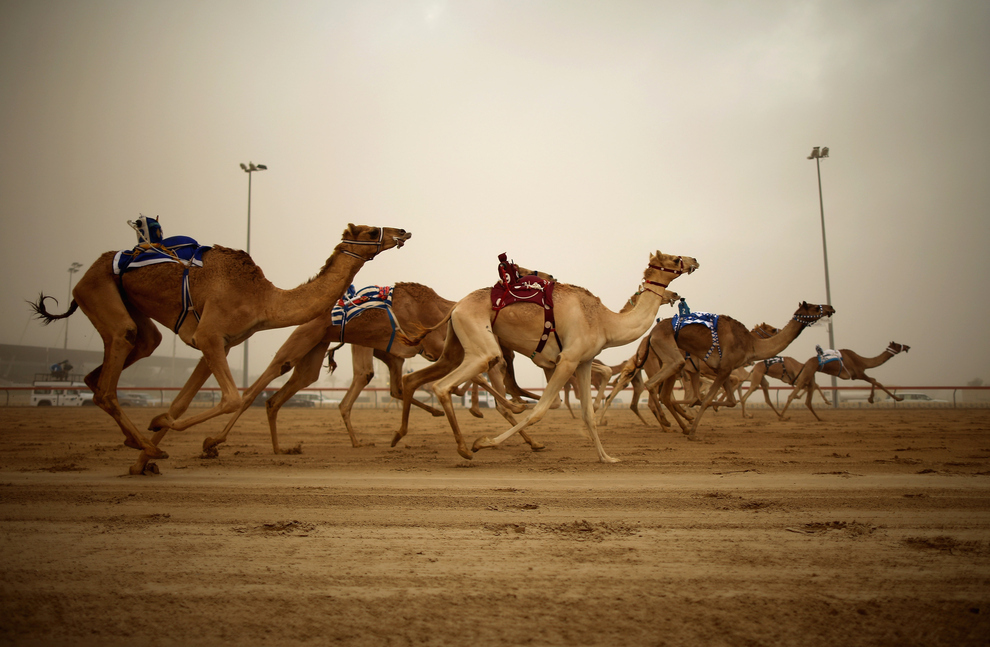
The first camel race in the United States was held in Sacramento, California, on April 7, 1864. The dromedaries belonged to Samuel McLeneghan who had paid $1,495 for 35 of them at an auction in Benicia, California. The camels had a curious history, one that began with an American military expedition to northern African nations along the coast of the Mediterranean Sea. The idea of the expedition and the importing of camels belonged to Secretary of War Jefferson Davis (this is of course the Jefferson Davis who later led the Confederacy, which had no camels that we know of). Davis convinced Congress to go along with this scheme and his vision of a Camel Corps that would carry military supplies across the country from east to west, it being reasoned that camels could carry heavier loads than horses on less food and water (sort of the same idea behind today’s guest worker programs for foreigners).

Unfortunately, the Camel Corps looked better on paper than in reality. The camels did not get along with their fellow animals or people: they stampeded horses and mules, attacked and bit pedestrians and chewed laundry off clotheslines. Camel caravans were only allowed to pass through some towns at night. With the Civil War getting underway (and Jefferson Davis going to the other side), interest in the project flagged and the Camel Corps disbanded. Of the camels that didn’t go to the races with McLeneghan, some joined the circus; some were employed by private companies. Eventually, many were abandoned in the desert. And for years afterward, prospectors and drifters might come rushing into a bar, raving about the strange apparition they had seen in the desert.

APRIL 6, 1722: AND TWO RUBLES FOR A FIVE 0’CLOCK SHADOW

In 1722, Peter the Great of Russia abolished a tax he had introduced some twenty years earlier, it having proved to be a rather hairy source of national income. The tax had been the result of an 18-month European tour to seek the aid of European monarchs, and to observe how other militias and armies were trained. During the tour, he learned that many European customs and styles were far superior to the antiquated ways in Russia. One of the first rulings he made upon his return was that all of his courtiers and officials shave off their long beards, as being clean-shaven was the European style. Anyone who kept their beard was subject to an annual Beard Tax of 100 rubles. Upon payment of the tax, bearded Russians were given a token; on one side of the token was an image of the lower part of a face with a full beard and the inscription “the beard is a superfluous burden.”

The idea of a beard tax had a bit of a history. Nearly 200 years earlier, King Henry VIII of England, who wore a beard himself, had introduced a tax on beards, although he probably didn’t pay the tax himself (it’s good to be the king). The tax was a graduated tax, varying with the wearer’s social position, not the length of his beard. Some years later, his daughter, Elizabeth I, reintroduced the beard tax, taxing every beard of more than two weeks’ growth, although she probably didn’t pay the tax herself (it’s good to be the queen).

APRIL 5, 1951: FIRST CAME THE WHEEL

Inventors are born every day, and April 5, 1951, was no exception. Dean Kamen was an inventor as well as a master of hype. Among his inventions are the iBOT an all-terrain electric wheelchair and a device that uses compressed air to launch SWAT teams to the roofs of tall buildings in a single bound.  Interestingly enough, Kamen’s father was an illustrator for Mad and Weird Science.

The most famous of his inventions by far was a closely guarded secret that he claimed would change the world when made public.  Among those touting its revolutionary potential was Apple’s Steve Jobs. Unveiled in 2001, the Segway is an electric, self-balancing human transporter. It has two parallel wheels and is controlled by the shifting of the operator’s body weight. Its computerized gyroscopes make it almost impossible to tip over (although George W. Bush did in a test drive).

Consumer reaction was more a whimper than a bang. About the only groups it caught on with are mall and airport security personnel. Adding to the insult, Time Magazine included the Segway in its list of the 50 worst inventions.

British entrepreneur Jimi Heseleden bought the Segway company in 2010. He died that same year when he fell off a cliff while riding his Segway.

Back Before the Wheel

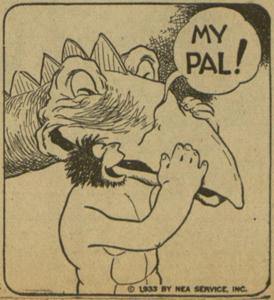
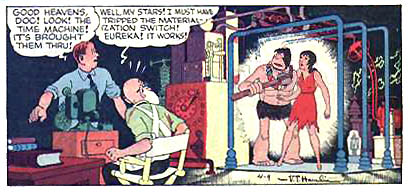
Another important invention made its debut on April 5, 1939 — Dr. Elbert Wonmug’s time machine. Oh, there had been time machines before this, but this would be the first to transport an honest-to-goodness caveman from way back in the Bone Age right into the 20th century. The caveman was none other than Alley Oop, beamed in from the kingdom of Moo where for the past seven years he had been doing typical caveman things — riding around on his pet dinosaur in a furry loincloth, brandishing his big club at his many enemies, and courting the lovely Ooola.
But once in the 20th century with a time machine to beam him about, Oop was no longer bound by prehistoric limitations. He became a roving ambassador, traveling to such destinations as ancient Egypt, Arthurian England and the American frontier, rubbing elbows with such folks as Robin Hood, Cleopatra, Ulysses, Shakespeare and Napoleon. At one point he even visited the moon. Pretty impressive for a Neanderthal.

APRIL 4, 1914: TO BE CONTINUED

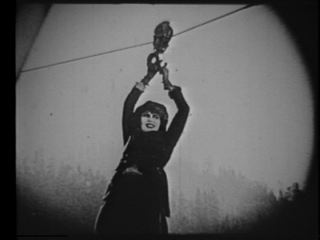
The Perils of Pauline, one of the earliest American movie serials and a classic example of the damsel in distress genre, premiered in Los Angeles on April 4, 1914. Every week for twenty weeks, actress Pearl White faced imminent danger and sure death at the hands of pirates, hostile Indians, gypsies and various mustachioed villains, escaping at the last possible second through her own ingenuity, resourcefulness and pluck. Her adventures in Pauline and the follow-up Exploits of Elaine were popular movie fare through the 1920s. Neither serial was a true “cliffhanger” in which episodes end with an unresolved danger to be resolved at the beginning of the next installment.  Instead White jumped in and out of the jaws of death in each installment.

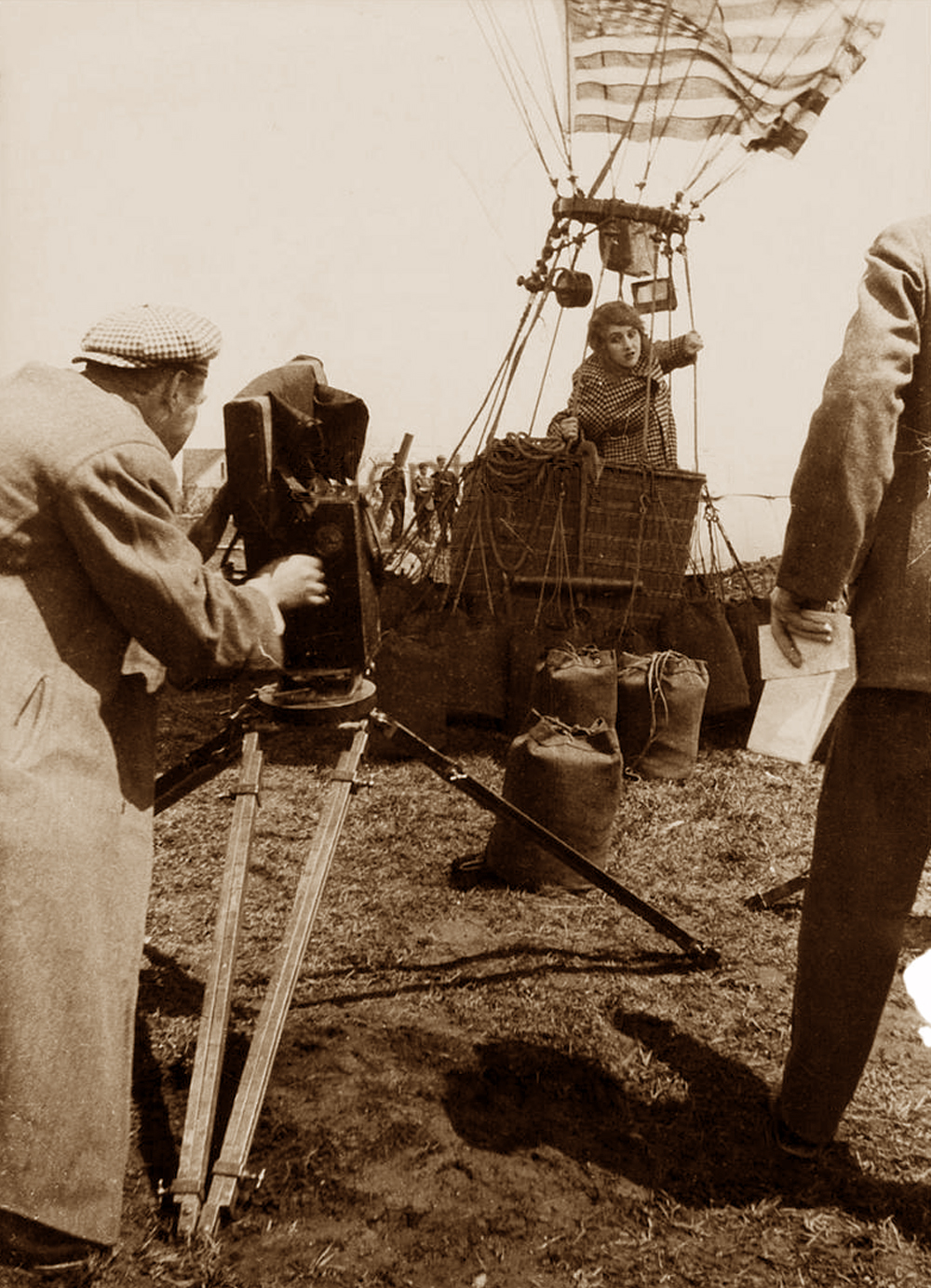
Like many other silent film stars, Pearl White performed her own stunts for the serial, at considerable risk. During one scene, the hot-air balloon she was piloting escaped and carried her across the Hudson River into a storm, before landing miles away. In another incident, she permanently injured her back in a fall.

And of course White was more than once tied to railroad tracks by a mustache-twirling villain. One such scene was filmed on a curved trestle in New Hope, Pennsylvania on the Reading Company’s New Hope Branch. Now referred to as “Pauline’s Trestle,” it is a tourist attraction offering rides from New Hope to Lahaska, Pennsylvania, across the original trestle.

Wretched Richard’s Little Literary Lessons — No. 6

cliff-hanger

[klif-hang-er]

noun

1. a melodramatic adventure serial in which each installment ends in suspense in order to interest the reader or viewer in the next installment.

2. a situation or contest of which the outcome is suspensefully uncertain up to the very last moment:

Stopping for a moment, she convinced herself that she had to have a good lead over her pursuers, if they were even following her. She had to find Paul. Looking around, however, she realized that not only didn’t she know where Paul was, she didn’t know where she was. She decided to work her way back in the same general direction from which she thought she had come, keeping herself hidden. If they were chasing her, they would not be stealthy. She’d hear them before they saw her. And try to find Paul. Or someone else to help. But who?

Her foot caught the bottom of her sarong, and she fell to the ground. “This damn outfit,” she said aloud as she tried to untangle herself. “I might as well be wearing a strait jacket.”

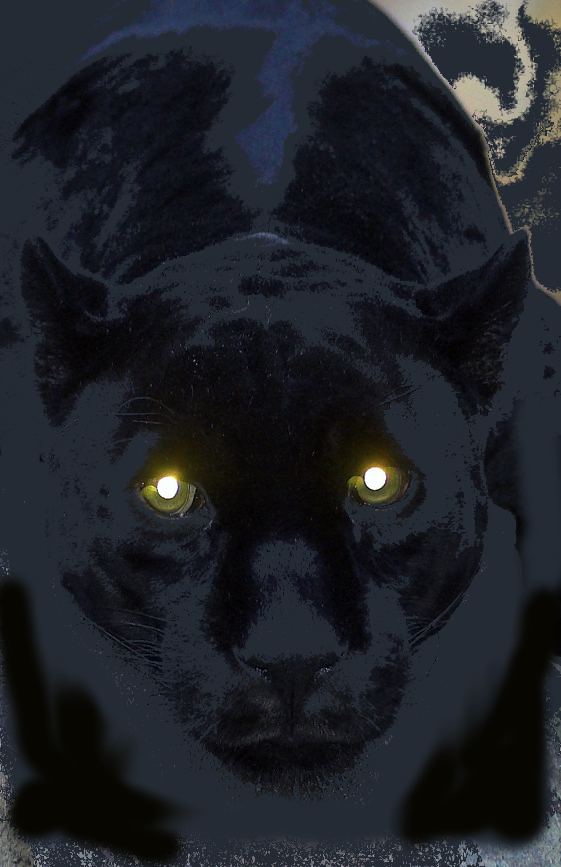
She pulled herself up to her hands and knees and looked around. There just a few feet ahead of her, two golden eyes blazed in the dark. At first they were disembodied, hovering in the air, but as they stared at her, she began to discern an outline of whatever it was that possessed the eyes. It was big, really big, and as black as the night around it. It was a cat, at least four feet at its shoulders. And it wasn’t purring.

Get me off this cliff.

APRIL 3, 1667: THE LIONS ARE COMING, THE LIONS ARE COMING

In addition to being a member of the British peerage, Edward, Marquis of Worcester, who died on April 3, 1667, was a bit of a dabbler, a sort of ersatz inventor, and author of an odd little book called A Century of Inventions. The book, written some ten years earlier, describes, as the title suggests, a hundred speculative projects, none of them, however, detailed enough to allow a reader to actually put them into practice: secret writing with peculiar inks, explosive devices that would sink any ship, ships that would resist any explosive devices, floating gardens, a method to prevent sands from shifting, automatic assault pistols and cannons, a timer for lighting candles at any time during the night, a hundred-foot pocket ladder, flying machines.

Although many of his ideas foreshadowed later inventions, it is unclear whether he had thought through the methods by which they would work. One idea was put to work with success although unusually so. As the owner of Raglan Castle, he had constructed some hydraulic engines and wheels for bringing water from the moat to the top of the castle tower.  During the Civil War, Roundheads had approached the castle with not the best of intentions. The Marquis had his waterworks put into play. “There was such a roaring,” he later wrote, “that the unwelcome visitors stood transfixed, not knowing what to make of it.” On cue, one of the Marquis’ men came running toward them shouting that the lions were loose. The intruders tumbled over one another down the stairs in an effort to escape, never looking back until the castle was out sight.

Fifty more clever ideas

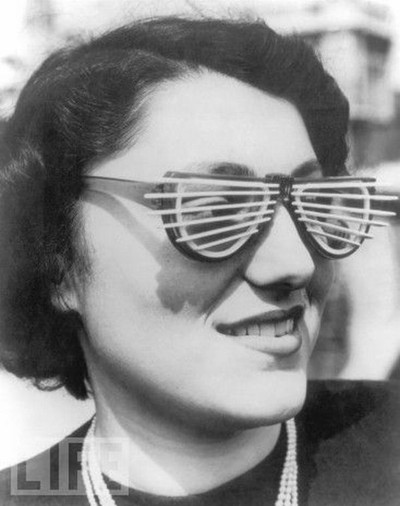
The Marquis’ 100 nifty inventions most likely did not inspire Time Magazine to create its list of inventions at the turn of this century, although it could have.  The Time list heralded fifty creations that it called the worst of all time.  Wretched Richards Almanac has visited some of these in the past and will visit others in the future (like on April 5).  The list includes such sure-fire ideas as Hair in a Can, Tanning Beds, Venetian-Blind Sunglasses, Smell-o-Vision, Hula Chair and many more.