APRIL 10, 1953: COMIN’ AT YA

The poobahs at Hollywood’s major film studios watched with amazement and envy as the independently produced 3-D movie Bwana Devil wowed audiences in late 1952.  Columbia Pictures quickly threw together a black- and-white thriller that for an hour hurled practically every prop on the set at the beleaguered audience. It was just as quickly forgotten.  Then on April 10, 1953, Warner Brothers released its entry — in color and stereophonic sound — House of Wax, a horror film starring Vincent Price as a sculptor who kills folks, covers them with wax, dresses them up as famous historical figures, and displays them in his wax museum. Audiences loved it, making it one of the biggest hits of the year. Even critics gave it a go. And although it took a while, the Library of Congress selected it in 2014 for inclusion in the National Film Registry, deeming it “culturally, historically, or aesthetically significant.”

The film revived Vincent Price’s career, positioning him as the go-to guy when you needed a mad scientist or fiendish psychopath.  Although House of Wax had a couple of classic 3-D effects (the pitchman with a paddleball and a character who seemingly stands up in the audience and runs into the screen), it was not loaded down with them. This might have been because the director was blind in one eye and couldn’t understand what all the fuss was about.

And What Do We Suppose Jumbo the Elephant Really Was
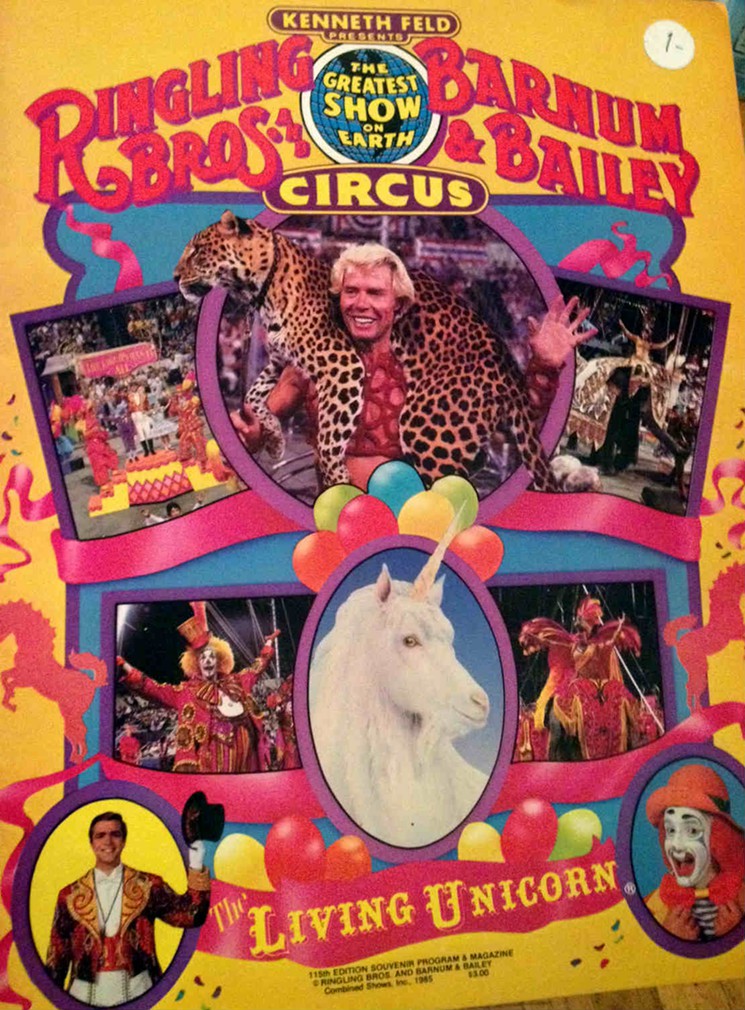
On this day in 1985, Lancelot the Unicorn who had been touring with the Ringling Brothers and Barnum and Bailey Circus — famous for outlandish attractions — was exposed as a fraud.  Audiences were appalled to learn that Lancelot wasn’t a real unicorn at all, just a goat with a horn surgically attached to its forehead.

IF IT HAD ONLY BEEN A NACHO
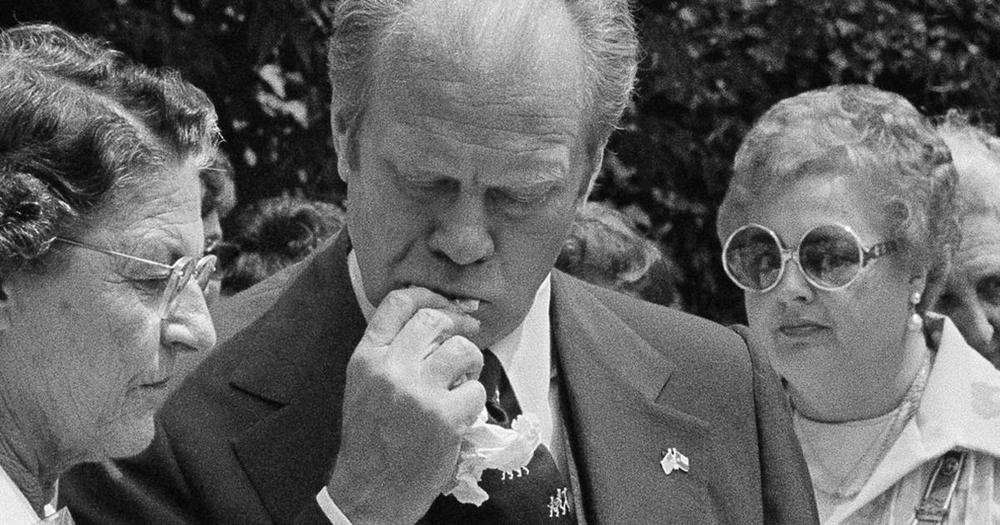
It would seem that in modern politics every president has been forced to deal with a scandal, big or small –vicuna coat, Watergate, Iran Contra, Stormy Daniels. Gerald Ford’s scandal would probably be trivial in comparison to most. But it may have cost him re-election. It was April 10, 1976, in San Antonio, Texas, at the Alamo, where a tiny faux pas morphed into the Great Tamale Incident as the President attempted to eat a tamale without removing the corn husk, playing into his reputation as a bit of a bumbler.

APRIL 9, 1940: YOUR SHOPPING CART IS EMPTY

Sylvan Goldman was an idea man. One of his more persistent ideas led to his choice of careers. Actually, it was more than an idea — a concept, an eternal truth perhaps. “The wonderful thing about food is that everyone uses it — and uses it only once.”

Born in the Oklahoma Territory, he and his brother went into wholesale produce only to be wiped out by plunging oil prices.  After studying all the latest methods for retailing groceries, they bounced back with a chain of self-service stores featuring woven baskets for  carrying groceries. The stores were a big success, and they were bought out by the Safeway chain. Once again hard luck hit; their Safeway stock tanked during the Depression. And once again they bounced back; by the mid-30s they were half owners of the Piggly Wiggly chain.

Goldman continued to dream about customers moving more and more groceries. And one night in 1936 he had a eureka moment — inspired by a wooden folding chair. Put wheels on the legs and a big basket on the seat and you have a shopping cart.

Goldman and a mechanic friend began tinkering. They devised a metal cart with not one but two wire baskets. For efficient storage, the carts could be folded and the baskets nested. Goldman called his invention a folding basket carrier, receiving a patent on April 9, 1940.

When the carriers were introduced to the public, Goldman encountered one tiny problem. Customers didn’t want to use them. Men thought they would look like sissies pushing a cart. Women felt like they were pushing a baby carriage.  And older shoppers thought it made them look helpless. Goldman was always ready with another idea. He hired attractive models, both men and women, to push the carts around, as well as charming greeters urging customers to take one for a spin.

By the 1940s, the carts had become so much a part of the American shopping experience that the Saturday Evening Post devoted its cover to them. And they got bigger and bigger until they got tiny as little icons on websites everywhere.

Goldman’s Folding Carrier Basket Company is still in business today. Goldman isn’t. He died in 1984.

April 8, 1904: It Was the Best of Times Square . . .

In 1904, a bit of real estate in the middle of Manhattan called Long Acre Square got a new name. New York Times publisher Adolph S. Ochs had just moved his newspaper’s operations to a new skyscraper on 42nd Street. He persuaded the City of New York to construct a subway station there, and the area was renamed Times Square. Just three weeks later, the first electrified sign appeared at the corner of 46th Street and Broadway.

During its heyday through the 1920s, celebrities such as Irving Berlin, Fred Astaire, and Charlie Chaplin were closely associated with the area, nicknamed The Tenderloin because of its desirable location in Manhattan. However, crime and corruption, and their friends gambling and prostitution were sneaking in. Beginning with the onset of the Great Depression in the 1930s and through the following decades, Times Square gained its reputation as a dangerous neighborhood. The seediness of the area became a symbol of the dismal state of the city. The tourists who continued to flock to the city’s most famous landmark were greeted by go-go bars, sex shops, adult theaters, and a very unDisneylike atmosphere. (oh, you got trouble right here in New York City)

Revitalization began in thew 1990s and today Times Square is a place you’d take your elderly mother.  And lots of people do.  Times Square is the world’s most visited tourist attraction, hosting over 39 million visitors (and their elderly mothers) yearly.

It’s squeaky clean now and glitzier than ever. (It’s the only neighborhood with zoning ordinances requiring building owners to display illuminated signs.)

Dream on, Las Vegas; Times Square is king.

Take My Wife . . . Please

Earlier centuries saw a great many practices that were commonplace then but which would be considered inappropriate in our more enlightened age. Nowhere was this truer than in (merry old) England — purchasing a plump Irish child for special dinner occasions in the 18th century, for instance, or in the 19th century, selling a spouse one had grown weary of.  One such sale took place on April 8, 1832, an account of which was recorded for the amusement of generations that followed.  Joseph Thompson, a farmer, had been married for three unhappy years when he and his wife decided to call it quits.  As was customary, Thompson took his wife to town and set her up for public auction.  At noon, the sale commenced with Thompson delivering a short speech:

“Gentlemen, I have to offer to your notice my wife, Mary Ann Thomson . . . whom I mean to sell to the highest and fairest bidder.  Gentlemen, it is her wish as well as mine to part for ever.  She has been to me only a born serpent.  I took her for my comfort, and the good of my home; but she became my tormentor, a domestic curse, a night invasion, and a daily devil.  Gentlemen, I speak truth from my heart when I say — may God deliver us from troublesome wives and frolicsome women!  Avoid them as you would a mad dog, a roaring lion, a loaded pistol, cholera morbus, Mount Etna, or any other pestilential thing in nature.”

What a sales pitch!  This guy could sell anything. The asking price for Mary Ann was 50 shillings. Eventually, the price was knocked down and a deal was made — 20 shillings and a Newfoundland dog.

Everyone satisfied, they parted company, Mary Ann and a gentleman named Henry Mears in one direction, Joseph and the dog in the other.

APRIL 6, 1722: AND TWO RUBLES FOR A FIVE 0’CLOCK SHADOW

In 1722, Peter the Great of Russia abolished a tax he had introduced some twenty years earlier, it having proved to be a rather hairy source of national income. The tax had been the result of an 18-month European tour to seek the aid of European monarchs, and to observe how other militias and armies were trained. During the tour, he learned that many European customs and styles were far superior to the antiquated ways in Russia. One of the first rulings he made upon his return was that all of his courtiers and officials shave off their long beards, as being clean-shaven was the European style. Anyone who kept their beard was subject to an annual Beard Tax of 100 rubles. Upon payment of the tax, bearded Russians were given a token; on one side of the token was an image of the lower part of a face with a full beard and the inscription “the beard is a superfluous burden.”

The idea of a beard tax had a bit of a history. Nearly 200 years earlier, King Henry VIII of England, who wore a beard himself, had introduced a tax on beards, although he probably didn’t pay the tax himself (it’s good to be the king). The tax was a graduated tax, varying with the wearer’s social position, not the length of his beard. Some years later, his daughter, Elizabeth I, reintroduced the beard tax, taxing every beard of more than two weeks’ growth, although she probably didn’t pay the tax herself (it’s good to be the queen).

March 15, 44 BC: I Only Have Ides for You

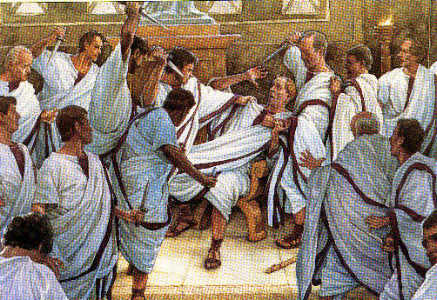
Beware. Today is the ides of March, a day once enthusiastically celebrated among the common people with picnics, drinking, and revelry. In the ancient Roman calendar, each of the 12 months had an ides (from the Latin to divide). In March, May, July and October, the ides fell on the 15th day. In all other months, the ides fell on the 13th.  There is a reason for this, but the logic declined and fell with Rome, and the ides lost their original intent and purpose and eventually came to mean the day that a bunch of guys are going to stick knives into you.

This was thanks to Shakespeare,  Julius Caesar, and Caesar’s pals Brutus et al.  In Act I, Scene 2, of Shakespeare’s history, the old soothsayer utters these words, dripping with foreboding: “Beware the Ides of March.” Pretty straightforward, but does Caesar pay attention? Of course not. And on March 15, 44 BC, aided by his friends, he buys the forum, so to speak, exiting stage left halfway through the play even though it bears his name.

Despite an occasional pretentious allusion to the Ides of March and the popular song, today’s calendar is pretty much ideless (as ideless as a painted ship upon a painted ocean, to slip in a quick pretentious allusion).

March 14, 1880: Away with Rum, By Gum

“The Salvation Army will attract the Kingdom of the Devil in Harry Hill’s Variety Theater on Sunday, March 14, 1880 at 6:30 pm sharp”  Thus read the announcement of the first public meeting of the Army in the United States.  It was a meeting of the strangest of bedfellows — the Army and the infamous Harry Hill who ran New York’s most well-know concert saloon, a place they said was “nothing more than one of the many gates to hell.”

A small platoon of the Salvation Army under the command of George Scott Railton had arrived in New York City just two days earlier.  The enterprising Harry Hill, having read about their arrival from England, contacted Railton with an offer to pay the group to take the stage on Sunday evening.  Although Railton was warned that respectable people would refuse to attend a meeting in such a vile place, Railton was intrigued by the idea that such a notorious sinner would welcome him before any of the local churches did.

On Sunday evening, Railton and seven Salvation Army lasses took the stage.  Railton knelt and the seven lasses formed a semicircle around him assuming “various and curious positions.”    They sang hymns and invited the audience to repent and be saved.  The audience applauded politely, but other than one habitual drunkard, Ashbarrel Jimmie, no one accepted the invitation to repent.

Undeterred, the Salvation Army soldiered on and, red kettle by red kettle, became a fixture in the United States.

Saving Nanki-Poo

Gilbert and Sullivan’s most famous work The Mikado premiered in London in 1885. It almost didn’t happen. A year earlier, Arthur Sullivan, whining about his precarious health and a desire to devote himself to more serious music, told W.S. Gilbert that he couldn’t bring himself to do another piece of the kind the two had previously written. Gilbert was surprised to hear of Sullivan’s qualms, having started work on a new opera in which people fell in love against their wills after taking a magic lozenge. Gilbert wrote Sullivan asking him to reconsider, but the composer replied that he was through with such operas. Gilbert, after much whining of his own, persuaded Sullivan by promising a plot in which no supernatural element occurs “. . . a consistent plot, free from anachronisms, constructed in perfect good faith and to the best of my ability.”

The Mikado was born. With a setting in Japan, an exotic locale far away from Britain, Gilbert was able to poke fun at British politics and institutions by disguising them as Japanese and, with Sullivan’s music, create one of the greatest comic operas, featuring such characters as Nanki-Poo, the wandering minstrel; Yum-Yum, Nanki-Poo’s love; Ko-Ko, the Lord High Executioner; and Pooh-Bah, the Lord High Everything Else.  This is the origin of the word poo-bah — a pretty important person, a high muckety-muck, nabob, honcho, Donald Trump.


March 13, 1923: Rock-a-bye, Baby On the Treetop

In 1906, Eleanor Roosevelt, then a young mother living in New York City, bought a cage made of chicken wire and hung it outside the window of her townhouse. The cage was for her daughter Anna to nap in and enjoy the fresh outside air. Her neighbors threatened to call in the authorities. Young Eleanor wasn’t really a wicked mother; she was just a few years ahead of her time. Fast forward to the 1930s; baby cages are a booming business, particularly in London.

In between, Emma Read of Spokane, Washington, had the foresight to apply for a patent for “an article of manufacture for babies and young children, to be suspended upon the exterior of a building adjacent to an open window, wherein the baby or young child may be placed.” She envisioned a cage with removable curtains and an overlapping slanted roof to protect the suspended tyke from rain and snow — And from rattles and other toys maliciously thrown by the rotten little kid in the cage on the floor above.  Her patent was granted on March 13, 1923.

Interest peaked and petered out in the 1950s, and the baby cage disappeared into history despite the fascinating concept of children being caged.


Gonna Find Me a Planet

An advanced civilization inhabited Mars, but the times were desperate. The planet was becoming arid, and the Martians had constructed a series of canals and oases in an attempt to tap the polar ice caps. This was the theory espoused by Percival Lowell based on studies from his observatory in Flagstaff, Arizona, during the early 20th century. Lowell was born on March 13, 1855, and after many years traveling in and studying the Far East, he turned his attention to the far reaches of space. He was all over Mars, writing three books on the red planet that captured the public imagination and helped give rise to the notion of men from Mars.

The existence of canals was later disproved by more powerful telescopes and space flights, but Lowell would make a more important contribution to planetary studies during the last years of his life. Turning from Mars to Neptune and Uranus, Lowell became convinced that their positions were affected by a hypothetical Planet X. Lowell began searching for the mystery planet in 1906. Dying in 1916, Lowell himself did not witness the discovery, but the Lowell Observatory announced on what would have been his 75th birthday — March 13, 1930 — that they had discovered the planet Pluto.

Sadly, after nearly a century as our ninth planet, Pluto was cruelly downgraded to the status of dwarf planet in 2006.  And the name Pluto will become more associated with the Disney hound dog of that name.

Of Which You Ain’t Nothing But a

Mike Stoller (right), born March 13, 1933, working with his partner Jerry Leiber, helped shape rock leiberand roll with an amazing list of hit songs beginning with Hound Dog in 1952. Elvis Presley , the Beatles, the Rolling Stones, the Beach Boys, John Lennon, Otis Redding, Jimi Hendrix, and Frank Sinatra top the list of the many artists who have recorded their songs. More than three dozen of their hits were featured in the Broadway production Smokey Joe’s Cafe including the title tune, Young Blood, Dance With Me, Searchin’, Kansas City, Poison Ivy, On Broadway, Yakety Yak, Charlie Brown, Loving You, Jailhouse Rock, Spanish Harlem and Stand by Me.

In an interview, Stoller was asked to compare Elvis Presley’s 1956 version of Hound Dog with the original recorded by Big Mama Thornton. “It sounded kind of stiff and a bit too fast, a little nervous,” he answered. “It didn’t have that insinuating groove like on Big Mama’s record.”

Eventually, he grew to like the Presley version.   After it sold seven million copies it began to sound better.”


March 12, 1609: Wanna Get to Heaven, Let Me Tell You What To Do

Prophet, evangelist, guardian of the gates of heaven and hell, and notorious pain in the butt Lodowicke Muggleton was born in 1609. Uneducated, he worked as a tailor until his forties when he began to have revelations, announcing to the world that he and his cousin were the last two witnesses of God that would ever be appointed on earth and the exclusive deciders of who got into heaven and who didn’t. When his cousin died, Muggleton took this great burden upon himself.

Blessing those who listened to him and cursing those who didn’t, he eventually attracted a few followers who became known as Muggletonians. His cursing and raving made him enough of a public nuisance that he was twice jailed, fined and sentenced to stand in the pillory for several days. He had a particular dislike of Quakers which he spelled out in his book with the catchy title The Neck of the Quakers Broken or Cut in Sunder by the Two-Edged Sword of the Spirit Which Is Put Into My Mouth (1663).

Among some of the more interesting Muggletonian beliefs: Heaven is six miles above Earth; God is between five and six feet tall and has absolutely no interest in the affairs of mankind. Man’s greatest enemy is not the Devil, who doesn’t exist, but Reason, which, for humans, is unclean and filthy. They had no organized worship; they would sometimes meet in taverns to talk and sing rancorous Muggletonian songs.

Muggleton died at the age of 88, and his religion more or less continued for centuries after him. One Philip Noakes who bequeathed to the British Library an archive of Muggletonian documents in 1979 is thought to have been the last surviving Muggletonian, although this entry is bound to bring a few more out of hiding.

Perhaps He Was a Muggletonian

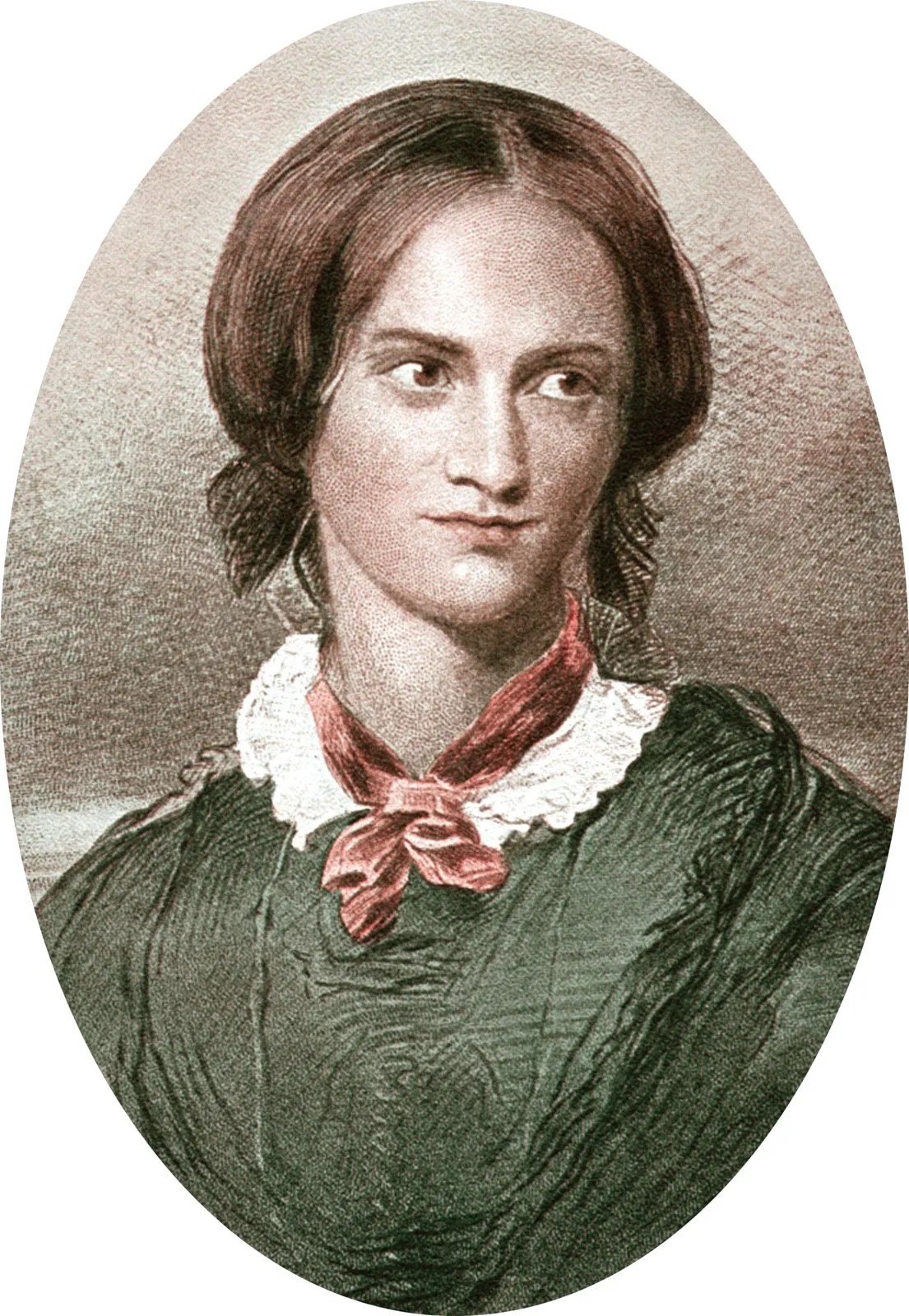
In 1837, British poet laureate Robert Southey wrote a letter to 20-year-old Charlotte Brontë.  The letter was in reply to her letter of a few months earlier asking him for his opinion on whether a poem she enclosed was any good and whether she should continue to write.  Her letter and the poem are lost, but Southey’s infamous reply was not.  One noted passage: “Literature cannot be the business of a woman’s life, and it ought not to be. The more she is engaged in her proper duties, the less leisure will she have for it even as an accomplishment and a recreation. To those duties you have not yet been called, and, when you are, you will be less eager for celebrity.”

Brontë’s thank you letter resonates with veiled sarcasm: “Once more allow me to thank you with sincere gratitude.  I trust I shall never more feel ambitious to see my name in print; if the wish should rise, I’ll look at Southey’s letter and suppress it.”  Ten years later, she wrote Jane Eyre.  Raise your hand if you remember Robert Southey.


March 11, 1958: And Then We’ll Nuke North Carolina

In 1958, the U.S. Air Force bombed South Carolina. Surprisingly, the bombing of Mars Bluff, a rural area near Florence, was not intentional. The bomb was a nuclear weapon carried by a B-47 Stratojet en route from Savannah, Georgia, to the United Kingdom. (The Air Force was not planning to bomb the Brits; the plane was on its way to military exercises and was required to carry nuclear weapons in the event of a sudden Dr. Strangelovian incident with the Soviet Union.)  A fault light in the cockpit indicated that the bomb harness locking pin for the transatlantic flight did not engage, and the navigator was summoned to the bomb bay to investigate. As he reached around the bomb to pull himself up, he mistakenly grabbed Printthe emergency release pin. The bomb dropped to the floor of the B-47, its weight forcing the bomb bay doors open and sending the bomb 15,000 feet down to unsuspecting Mars Bluff. Oops.

Because the removable core of fissionable uranium and plutonium was stored separately on board the plane, the bomb was not actually atomic, but it did contain 7,600 pounds of explosives. And it created a pretty good mushroom cloud over Mars Bluff, leaving a 75-foot wide and 35-foot deep crater where Walter Gregg’s home and vegetable garden had been. The only real casualties were several chickens who bought the farm so to speak.

The crater is still preserved but grown over, pretty much just a big hole. Steven Smith, who chaired a 50th anniversary event a few years ago, couldn’t understand why it never became a real tourist attraction. “It sure could be,” he said. “This is a national treasure!”

Take This Verb and Parse It

Diagramming sentences – what fond memories that brings back.  Shuffling nouns and verbs and predicate adjectives around until they find their proper position on the diagram.  Those were the days, my friend.  However, it’s with some sorrow that I contemplate our dear parts of speech.  One of their number has fallen upon some hard times.

“Snow White bit into the apple,” said the brothers grimly.

Pity the poor adverb.  Modern writing mavens pretty much eschew the adverb today – plucking it from the garden of good writing (or the garden of bad metaphors, if you prefer) as though it were an insignificant weed.  Okay, maybe it’s sometimes overused, but in moderation, like alcohol, caffeine and fat, it serves a noble purpose.

It wasn’t always considered a sin to associate with an adverb.  Some important folks have — as I will demonstrate.  Going way back to cite an example from a good book (or as many prefer The Good Book)  “Verily, I say unto you . . .”  Okay, all together now, what part of speech is that word verily?  You got it.  And it’s used more than once by you know who.  Okay, who wants to go first? Just step right up and say “Lose that adverb.”  I’d say that’s inviting a smiting.

Thomas Mann:  Hold fast to time!  Use it!  Be conscious of each day, each hour!  They slip away unnoticed all too easily and swiftly.

E. B. White: Be obscure clearly.

Mark Twain:  The intellect is stunned by the shock but gropingly gathers the meaning of the words.

Or you may remember that catchy tune by Francis Scott Key with words that go something like this: Whose broad stripes and bright stars, thru the perilous fight, O’er the ramparts we watched, were so gallantly streaming?  Call the adverb police.

And finally, moving into the future, I quote just three words from one Captain Kirk: “to boldly go.”  Now there’s a strong, sassy adverb coming to the rescue of a puny little verb and splitting an infinitive just for good measure.


March 10, 1876: It’s a Telephone, My Dear Watson

Who would have thought back on March 10, 1876, that in a hundred or so years practically every other human on the face of the earth would have a phone pressed against the side of his or her head at any given moment. Certainly not Alexander Graham Bell, as he was in the process of making the very first phone call. It wasn’t much of a call, certainly not long distance. Bell called his assistant Thomas A. Watson who was in the next room. The phones they used weren’t much to behold; they looked more like tin cans connected by a long string than today’s sleek models. But nevertheless they made history.

The moment of truth in Bell’s own words: “I then shouted . . . the following sentence: Mr. Watson come here — I want to see you. To my delight he came and declared that he had heard and understood what I said.”

Enter the quibblers. Why didn’t Watson answer Bell using that brand new telephone, they ask. And if Bell shouted his words and Watson were in the very next room, he’d very likely hear them without the phone, they suggest.

Watson’s diary says Bell’s words were actually “Mr. Watson, come here, I want you. ” a minor difference but just chock full of innuendo, they say, eyebrows raised. And some even suggest that the incident is all fabrication, that Bell actually stole the idea for the telephone from another inventor, Elisha Gray.

History does not record Bell’s disappointment when he tried to duplicate the experiment and was put on hold.

The Milkman Cometh

New Mexico State University’s first ever graduation was to have taken place on this date in milkman1893 but was abruptly canceled when Sam Steel, the lone graduating senior, was shot and killed while delivering milk the day before graduation.

Said the local paper: “The hearts of the whole community were stricken with sadness when it was learned that Samuel Steel, the most brilliant student of our College, had been foully and wil(l)fully murdered on Thursday evening, March 9th. We do not consider it in place to refer to the details of this ghastly deed, which are known to most of our readers; we only feel assured that it was perpetrated in sheer cold-bloodedness, and, knowing the victim as well as we have done, without the slightest provocation.”

Knowing what we do today about the reputation of milkmen, one might speculate that there could have been a slight provocation.