December 22, 1864: Georgia on His Mind

A tie might have been more appropriate. But it was 1864, the country was locked in a nasty civil war and the Christmas spirit was shermanwearing a little thin, even among the Whos down in Whoville. Union General William T. Sherman had spent most of his holiday season marching from Atlanta toward the Atlantic Ocean, being quite the Grinch along the way, destroying pretty much everything in his path. “I’ll stop Christmas from coming” he was heard to frequently mutter.

Sherman and his troops reached Savannah just before Christmas and, as the story goes, his heart grew three sizes that day. He didn’t destroy Savannah. Instead he sent a junior officer all the way back to Washington D.C. to personally deliver a Christmas card to President Lincoln on December 22. A message in the card read: “I beg to present you, as a Christmas gift, the city of Savannah, with 150 heavy guns and plenty of ammunition, and also about 25,000 bales of cotton.” And a partridge in a pear tree.

christmas

December 21, 1946: Don’t You Know Me, Bert? Ernie?

Frank Capra said that it was his favorite of the many movies he made throughout a phenomenal career. He screened it for his family every Christmas season. Yet it’s initial 1946 release at the Globe Theater in New York did not bring about yuletide euphoria and visions of sugar plums. It’s a Wonderful Life premiered to mixed and sometimes dismissive reviews, but it went on to become one of the most critically acclaimed films ever made, garnering a permanent spot in every list of the top films of the last century.

From its very beginning, it did not inspire great expectations. It was based on an original story “The Greatest Gift”written by Philip Van Doren Stern in 1939. After being unsuccessful in getting the story published, Stern made it into a Christmas card, and mailed 200 copies to family and friends in 1943.  In 1944, RKO Pictures ran across the story and bought the rights to it for $10,000, hoping to turn the story into a vehicle for Cary Grant. Grant made another Christmas movie, The Bishop’s Wife, instead, and the story languished on a shelf until RKO, anxious to unload the project, sold the rights to Capra in 1945.

Capra, along with several other writers, including Dorothy Parker, created the screenplay that Capra would rename It’s a Wonderful Life.

The town of Seneca Falls, New York claims that Capra modeled Bedford Falls after it. The town has an annual “It’s a Wonderful Life” Festival in December, a Hotel Clarence, and the “It’s a Wonderful Life” Museum. The town of Bedford Falls itself, however, was built in Culver City, California, on a 4-acre set originally designed for the western Cimarron. Capra added a working bank and a tree-lined center parkway, planted with 20 full grown oak trees. Pigeons, cats, and dogs roamed at will.

The dance scene where George and Mary end up in the swimming pool was filmed at the Beverly Hills High School. The pool still exists.

itsa-wonderfulll

December 20, 1880: Remember Me to Herald Square

On December 20, 1880, the stretch of Broadway between Union Square and Madison Square in New York City was illuminated by electric lights for the first time, becoming one of the first streets in the country to be lit up.  It had been exactly one year since over in New Jersey, in broadwayMenlo Park, Thomas Edison had demonstrated his incandescent light.  By the 1890s, the section of Broadway from 23rd Street to 34th Street had become so brightly illuminated by electrical advertising signs, that it was dubbed “The Great White Way.”  Later, when the theater district moved uptown to the Times Square area, the name moved with it.

Broadway is the oldest north-south thoroughfare in New York City, dating back to the first New Amsterdam settlement.  The name Broadway is an English translation of the Dutch breede weg, which means something like “street of hot pretzel vendors.”  Although best known for the boulevard portion that runs through Manhattan, Broadway also runs through the Bronx and north for another 18 miles through Westchester County to Sleepy Hollow.  There are countless landmarks along the route, but the one that first springs to mind this time of year is Macy’s Herald Square department store, between 34th and 35th Streets, where Christmas begins with Macy’s annual parade,  and its windows spectacularly celebrate the season.

Talk About Holiday Spirit

On December 20, 1989, Vice President Dan Quayle mailed out 30,000 Christmas cards with the inscription “May our nation continue to be the beakon of hope.”

December 19, 1732: The Nack and How To Get It (Copy)

Filled with proverbs preaching positive virtues such as industry and prudence, Poor Richard’s Almanack debuted on this day in 1732 and was published yearly until 1757. It became one of the most popular publications in colonial America, selling an average of 10,000 copies a year. In addition to its homilies, the almanac offered seasonal weather forecasts, Heloise-style Poor_Richard's_Almanackhousehold hints, puzzles, and various other diversions.

Poor Richard, who was of course Benjamin Franklin, was modeled in part on Jonathan Swift’s Isaac Bickerstaff, a self-described philomath and astrologer who in a series of letters in 1708 and 1709, poked fun at and even predicted the imminent death of another astrologer and almanac maker,  John Partridge. Franklin’s Poor Richard followed suit and, in a running joke in the early editions, predicted and falsely reported the deaths of contemporary astrologers and almanac makers.

Poor Richard’s Almanack extolled a list of 13 virtues to live by – temperance, silence, order, resolution, frugality, industry, sincerity, justice, moderation, cleanliness, tranquility, chastity, and humility – although there’s no evidence that Franklin personally tried to practice any of them. (Wretched Richard subscribes to every one of them.)

Reflecting on Franklin and his almanac, James Russell Lowell wrote that Franklin: “was born in Boston, and invented being struck with lightning and printing and the Franklin medal, and that he had to move to Philadelphia because great men were so plenty in Boston that he had no chance, and that he revenged himself on his native town by saddling it with the Franklin stove, and that he discovered the almanac, and that a penny saved is a penny lost, or something of the kind.”

The Almanack gained worldwide attention: Napoleon Bonaparte had it translated into Italian; it was twice translated into French, reprinted in Great Britain in broadside, and was the first work of English literature to be translated into Slovene.

A sample of Poor Richard’s wisdom:

Three may keep a secret, if two of them are dead.

There cannot be good living where there is not good drinking.

Any society that will give up a little liberty for a little security will deserve neither and lose both.

With the old Almanack and the old Year,
Leave thy old Vices, tho ever so dear.

Fish and visitors stink after three days.

There are more old drunkards than old doctors.


December 18, 1966: You’re a Mean One

grinch-thumb-525x325-23201In 1957, the most infamous Christmas curmudgeon since Ebeneezer Scrooge made his debut in a picture book called How the Grinch Stole Christmas by the amazing Dr. Seuss (Theodor Geisel). It marked the first time an adult had been featured as the main character in a Seuss book and the first time a villain had starred. The book has remained a classic since then. Some conspiracy theorists suggest (and the doctor concurs) that the Grinch is Dr. Seuss himself. In the story, the Grinch complains that he has put up with the Whos’ Christmas celebrations for 53 years. Dr. Seuss was 53 when the book was written and published.

Several years later, on December 18, 1966, the furry misanthrope, now a sickly shade of green, was ready for prime time – television, that is. Chuck Jones of Warner Brothers cartoon fame brought the story to living room screens featuring Boris Karloff as narrator and Grinch. In addition to providing the story, Dr. Seuss created the lyrics for the songs featured in the animated special. (The songs were sung by Thurl Ravenscroft, who some will remember as the bass voice on Rosemary Clooney’s  “This Ole House” or Tony the Tiger – “They’re grrreat!”)

The word grinch has found its way into dictionaries as a person whose lack of enthusiasm or bad temper spoils or dampens the pleasure of others. “Noise, noise, noise, noise.”

December 17, 1900: Getting in Touch with Our Outer Selves

December 17 was an historically busy day in the world of ufology and marsmessagethings extra-terrestrial. While we think of the 1950s as the real age of interplanetary happenings, folks had long been preoccupied by the possibility (or perhaps the certainty) of life beyond planet Earth.

Wasn’t it likely that other heavenly bodies were populated? And wasn’t it a given, observing Earthbound mankind, that beings out there were far more intelligent than us?

Back in the nineteenth century, there was much speculation about the inhabitants of other planets.  Certainly, intelligent beings might live on the Moon, Mars, and Venus; but since travel there was difficult at best we settled for the possibility of somehow communicating with the ETs, itself a poser since there was no radio and the postal service was pitifully land-bound. We were sort of stuck back in the technology of smoke signals.

Carl Friedrich Gauss suggested drawing a giant triangle and three squares, the Pythagoras, on the Siberian tundra, ten miles wide.  Joseph Johann Littrow proposed using the Sahara as a blackboard, filling giant trenches with water, then pouring kerosene on top of the water and lighting it to create different messages.  Using this method, a different signal could be sent every night. The inventor Charles Cros, convinced that pinpoints of light observed on Mars and Venus were large cities, spent years trying to get funding for a giant mirror with which to signal Martians and Venusians.  Astronomer Franz von Gruithuisen saw a giant city surrounded by family farms on the moon. He also saw evidence of life on Venus, and went so far as to suggest that the clouds shrouding the planet were caused by a great fire festival put on by the inhabitants to celebrate their new emperor.

On December 17, 1900, amid beaucoup de publicité,  the French Academie des Sciences announced the Prix Guzman, a 100,000 franc prize to be given to anyone who might find the means “of communicating with a star and of receiving a response.” Communication with Mars was specifically exempted because it would not be a difficult enough challenge.   Although no communications followed, nearly a century of alien sightings, encounters, and abductions did.  But then, on December 17, 1969, the United States Air Force pulled the plug, closing its Project Blue Book and concluding that no evidence of extraterrestrial spaceships existed behind the thousands of UFO sightings. And yet, on the evening of that very day, in full view of millions, an alien sighting occurred right on the television sets in living rooms everywhere, as Tiny Tim married “Miss Vicki” on The Tonight Show.

December 16, 1775: Me Mark, You Jane

Jane Austen, born on December 16, 1775, was a British novelist who wrote of life among England’s landed gentry from the vantage point of being on its outskirts aspiring to be closer in. The concept of gentry is a British foible pretty much disdained by Americans who exist way on its outskirts and secretly aspire to be closer in. (Shut out entirely, early Americans misbehaved with childish pranks such as dumping the grown-ups’ tea in Boston Harbor on this day in 1773).

Basically the gentry (celebrated in a 1940s popular song “Dear Hearts and Gentry People”) were the aristocracy (the haves, the one percent), and Jane Austen’s novels are lousy with them. Jane Austen herself almost married into the thick of it but the fact that the gentleman was a super-sized oaf, both homely and ill-mannered, gave her pause, cold feet, or perhaps writer’s block.

Austen was not wildly popular as a writer during her lifetime – in fact, her greatest popularity seems to have come with the 21st century. Her first novel Lazy Susan became a household word in the 1950s, thanks to the spinning serving dish that bears its name. Other novels had doubled-up attributes such as Pride and Prejudice, Sense and Senility, and Lust and Loquaciousness, except for those that didn’t, Mansfield Park and Northanger Abbey.

Mark Twain was one of Austen’s biggest fans:

“Jane Austen? Why I go so far as to say that any library is a good library that does not contain a volume by Jane Austen. Even if it contains no other book.”

“Jane is entirely impossible. It seems a great pity that they allowed her to die a natural death.”

“Every time I read ‘Pride and Prejudice’ I want to dig her up and beat her over the skull with her own shin-bone.”


December 15, 2001: Lean On Me

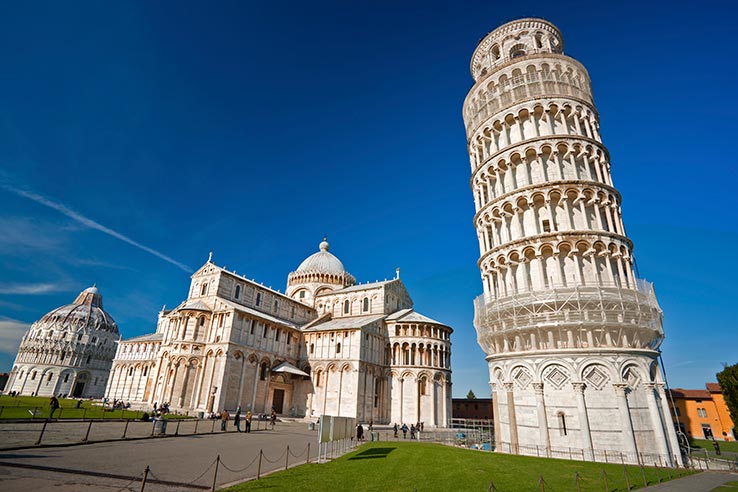
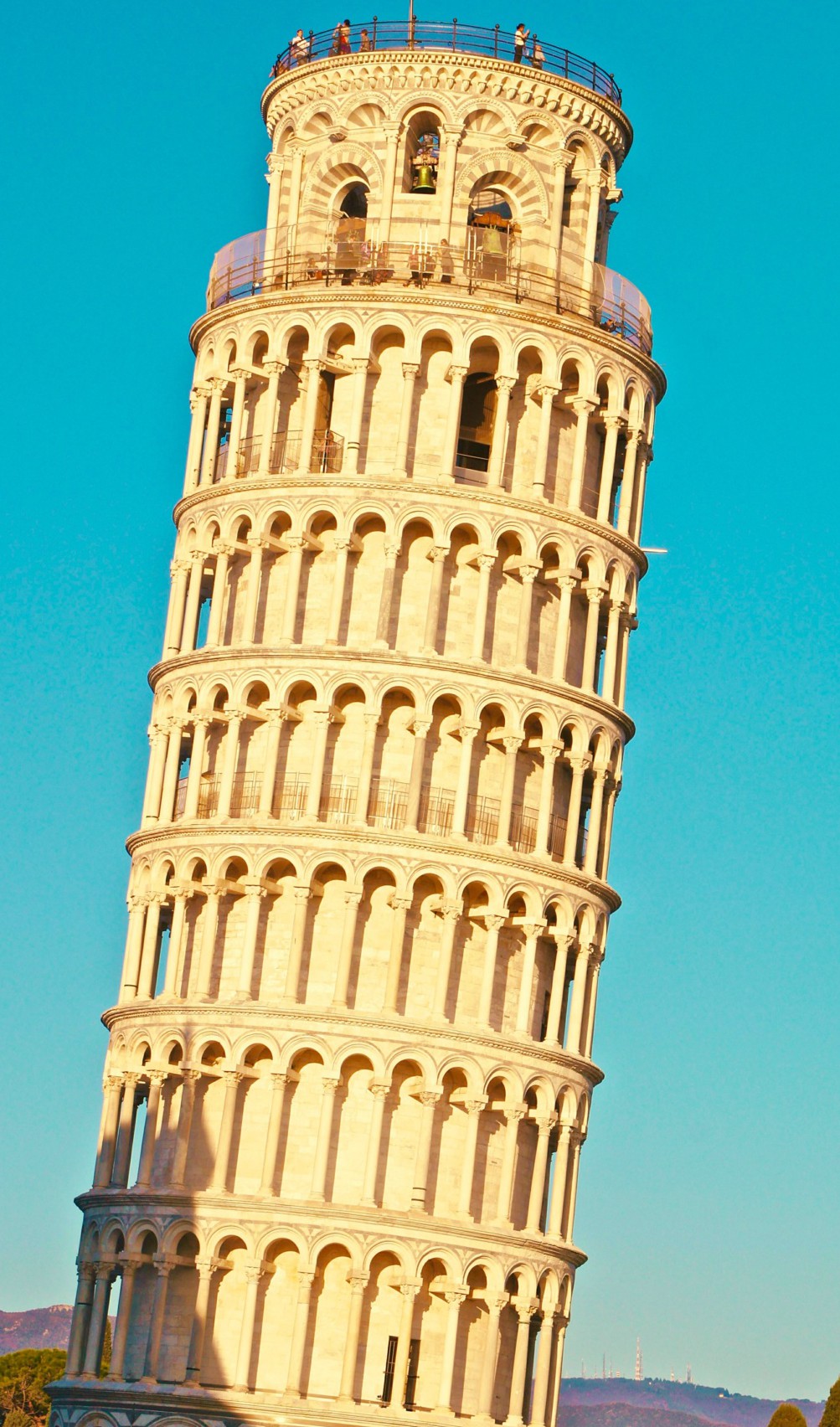
Back in the 12th century, construction began on a bell tower for a cathedral on the Arno River in western Italy, 50 miles from pisaFlorence, in a town called Pisa. With construction barely underway, the foundation of the tower began to sink into the soft, marshy ground, giving it a rakish tilt to the left (or the right, if you stood on the wrong side). The construction firm tried to compensate for the lean by making the top stories lean in the opposite direction, but that was an exercise in Italian futility. When this architectural wonder was completed in 1360, critics expected it to remain standing for a few days at most.

Six hundred years later, it was one of Italy’s most famous tourist attractions, a dramatic 190-foot high marble masterpiece that listed an amazing 15 feet off the perpendicular, predicted to fall at any second. In 1990, a million people visited the tower, climbing 293 leaning steps to the top for the somewhat unbalanced view before Italian authorities closed shop and brought in a team of archaeologists, architects and soil experts to figure out how to make the thing stand upright.

On December 15, 2001, the Leaning Tower of Pisa reopened to the public after 11 years and $27 million of fortification, and still leaning after all these years.

December 14, 1977: You Are the Dancing King

He was just another juvenile delinquent in a television sit-com, before he became a superstar playing a nobody by day who blossoms at night on the dance floor.  John Travolta strutted his stuff as Tony Manero, a paint-store clerk who dons a dashing white suit to ride the disco craze out of his dead-end existence in Saturday Night Fever. The film premiered on December 14, 1977, already guaranteed success thanks to its soundtrack, released months before the movie.

The disco songs recorded by the Bee Gees (including “Stayin’ Alive”) were all over the pop charts, sparking intense interest in the film before its release, with the film then popularizing the entire soundtrack after its release – the first (but certainly not the last) use of cross-media marketing.

Travolta plays Tony Manero, a Brooklyn paint-store clerk who’d give anything to break out of his humdrum life. The movie follows his foray, along with his partner Stephanie, into the Manhattan world of flashing lights and sweaty bodies. Disco and the culture of the disco era also star in the movie – the symphonic orchestration over a steady beat and disciplined choreography, the high style in clothing, and the sexuality of it all.

“Travolta on the dance floor is like a peacock on amphetamines,” said movie critic Gene Siskel, who bought Travolta’s famous white suit at a charity auction. “He struts like crazy.”

The film had an R-rating when it was originally released in 1978. Several years later it was edited down to PG with naughty bits removed to make it more “family-friendly” and suitable for television.

Some critics complain that the film was regressive, refashioning disco, which began as an underground social scene for gays, blacks and Latinos, as a vehicle for white masculinity and the heterosexual hunt for a willing partner. Picky, picky, picky.

December 13, 1931: Which Side Are You On?

“I do not understand why I was not broken like an eggshell or squashed like a gooseberry.”

So said the man who would become a larger than life British statesman, leading Britain through World War II and  remain a major player on the world stage into the 50s.  He very nearly didn’t make it there, thanks to the perils of New York City traffic.

It was 1931 and a low point in Churchill’s career.  At the age of 57, he had been pretty much banished by his own Conservative Party and had begun to devote himself to his writing.  He had sailed to the United States to give a series of lectures on “the Pathway of the English-Speaking Peoples.” On December 13, the night before one such lecture scheduled at the Brooklyn Academy of Music, he hailed a taxi and set out to visit a friend, financier Bernard Baruch.  He got out of the cab on Fifth Avenue between 76th and 77th Streets.  He walked a bit, then attempted to cross the street against the light (which no New Yorker would ever do).  He looked to the right, just as he would were he crossing King’s Road or Carnaby Street, saw no oncoming traffic and and kept walking.  An unemployed mechanic named Mario Cantasino was just as surprised as Churchill when the car he was driving slammed into the future Prime Minister and dragged him several yards, leaving him lying in a bruised and battered heap.  Churchill took full responsibility for the incident, and Contasino was held blameless.

After a little more than a week in the hospital and a few weeks of recuperation, Churchill finally gave his Brooklyn lecture on Jan. 28.  On one bright note: the United States being subjected to the agonies of Prohibition at this time, his American doctor wrote a note to “certify that the post-accident concussion of Hon. Winston S. Churchill necessitates the use of alcoholic spirits especially at meal times.”

Following his lecture, Churchill and his wife, seeking further rest and relaxation, traveled to Jamaica, a place where folks thankfully drove on the proper side of the street.