
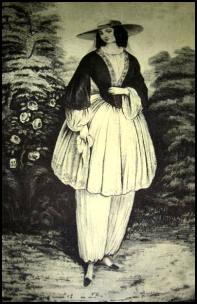
In 1840s and 50s New England, both the women’s suffrage and temperance movements were heating up. The convention held at Seneca Falls in 1848 to discuss “the social, civil, and religious condition and rights of woman” was a revolutionary beginning in the struggle by women for complete equality with men. One of the participants, Amelia Bloomer, was the editor of a magazine called the Lily, a publication with a curious mix of recipes, hints by Heloise and women’s rights manifestos. Bloomer became identified with what might be considered a sideshow of the movement.
At a ball in Lowell, Massachusetts on July 23, 1851, a certain type of apparel made its debut. It was a more practical substitute for the cumbersome, stifling, long full Victorian dresses worn at the time, and consisted of baggy pants narrowing to a cuff at the ankles (worn below a skirt), intended to preserve decency while being less of a hindrance to women’s activities.
Although Mr. Blackwell would not have approved, many women found it sensible and becoming, including Amelia Bloomer, who adopted it immediately, not only wearing it but promoting it enthusiastically in her magazine. Articles on the clothing trend were picked up in the mainstream press, and more women began to wear what was now dubbed the “Bloomer Costume” or “Bloomers”.
Bloomers remained subject to ridicule in the press and harassment on the street, and Bloomer herself dropped the fashion in 1859, saying that a new invention, the crinoline, was a sufficient reform that she could return to conventional dress. She remained a suffrage pioneer and writer throughout her life, writing for a wide array of periodicals. Although Bloomer was far less famous than some of her peers, she made many significant contributions to the women’s movement — particularly in dress reform and the temperance movement.
And fashion being what it is, bloomers will no doubt make a comeback. Until then, we’ll just refer to them as late bloomers.

 Wretched Richard's Almanac