
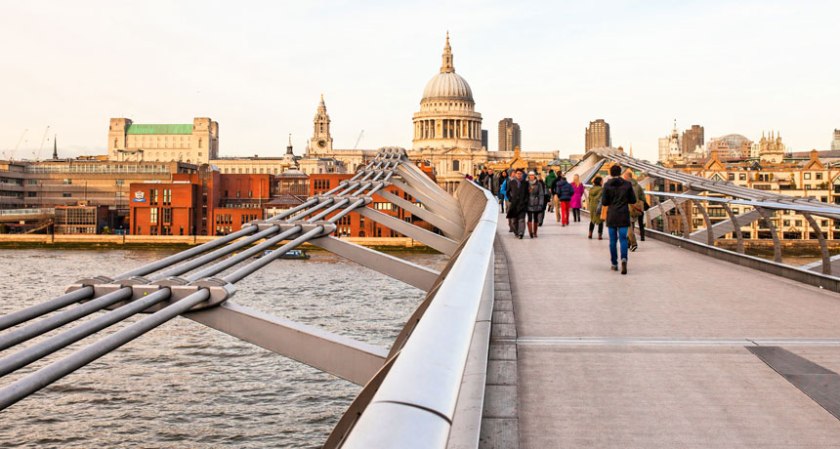
An air of excitement certainly gripped London on June 10, 2000, as 90,000 people queued up to cross the first new bridge to span the Thames River in over a hundred years, a bridge for pedestrians only, stretching from the Globe Theatre to St. Paul’s Cathedral, aptly named the London Millennium Footbridge. It didn’t take long for the bridge to become more known by its nickname, the Wobbly Bridge.
Seems the designers had not given enough attention to a phenomenon with the catchy title, synchronous lateral excitation. Even if you’ve never heard of it, it doesn’t sound like anything you’d want to be on a bridge with.
People, according to engineers, sway when they walk. People walking and swaying cause sideways oscillations in lightweight bridges. These, in turn, cause the people (some two thousand on the bridge at any given time) to sway even more to keep from falling over. And they all sway at the same time. It’s as if two thousand Londoners were doing the tango above the Thames. Result? Wobbly.
Access to the bridge was limited later in the day, and two days after it opened, the bridge closed for modifications. It reopened in 2002 (with tango forbidden). It was again closed in 2007 because of strong winds and a worry that pedestrians foolish enough to cross might be blown off the bridge.
The footbridge was not the only British millennial faux pas: a little number called the Millennium Dome elicited this derision from MP Bob Marshall-Andrews: “At worst it is a millennial metaphor for the twentieth century. An age in which all things, like the Dome itself, became disposable. A century in which forest and cities, marriages, animal species, races, religions and even the Earth itself, became ephemeral. What more cynical monument can there be for this totalitarian cocksure fragile age than a vast temporary plastic bowl, erected from the aggregate contribution of the poor through the National Lottery. Despite the spin, it remains a massive pantheon to the human ego . . .”
At the Zoo
Originally created as a royal herb garden in the 1600s, the Jardin des Plantes opened in 1793. During the following year a ménagerie was added, the world’s first and, still in existence, today the world’s oldest. The 58-acre botanical garden and zoo is located in the center of Paris, next to the Seine.
 The zoo was founded during the height of the French Revolution and the Reign of Terror. The National Assembly decreed that exotic animals in private hands – rare antelopes, tigers, Louis XIV, and the like — were to be donated to the menagerie or guillotined, stuffed and donated to the natural scientists of the Jardin des Plantes . The Jardin was free for all visitors and tourists right from its inception.
While the menagerie at first was just provisional, it grew in the first three decades of the 19th century to be the largest exotic animal collection in Europe – as they describe it in France (or somewhere): monkey honnete, girafe pas sincere, elephant plein mais stupide, orang-outang sceptical, zebre reactionaire, antilope missionaire.
A well-run place, but this being France the menagerie gardiens are usually quite fond of their aperitifs.
Someone told me it’s all happening at the zoo. — Paul Simon

 Wretched Richard's Almanac