
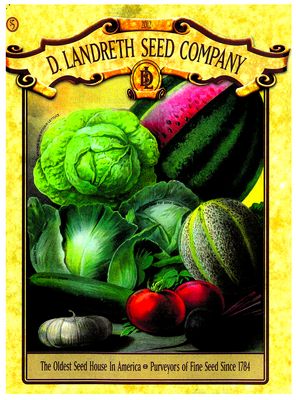
 In 1780, David Landreth and his family sailed from England to Montreal, Canada, with the intention of starting a seed company. Finding Canada a little too cold for their liking, the Landreths moved south to Philadelphia in 1783, where on January 7, 1784, they opened the first seed company in the United States. D. Landreth & Sons numbered among their clients gardening enthusiasts such as George Washington and Thomas Jefferson.
During the following years, Landreth, in addition to selling seeds, applied adventurous horticultural tinkering to such exotic new flowers and vegetables as tomatoes, zinnias and spinach. He developed a potato that was white and an extra early pea. The latter would surely have given Gregor Mendel goosebumps as he did his own pea tinkering many years later (as celebrated in yesterday’s entry).
Landreth minded his peas and cukes and became one of the most influential forces in American horticulture — a sultan of squash, a watermelon wizard, a parsley poobah. His company, now headquartered in Shelburne, Vermont, continues to be a purveyor of seeds and remains the oldest seed company in the United States.
Dorothy Parker was once asked to use the word horticulture in a sentence. “You can lead a horticulture,” she replied, “but you can’t make her think.”
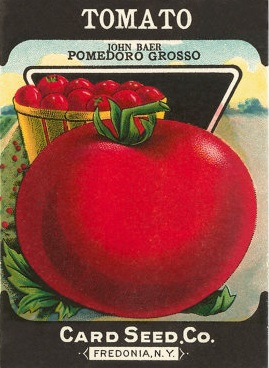
Tiny Tomato Killer Strikes Again
It is better to light a candle than curse the darkness, or so says some annoying pundit. Likewise, I suppose, it is better to do something positive than curse the mounds of snow still encircling us. I’ve always been of the curse the darkness ilk, but occasionally I do try and rise above the winter of my discontent and light a candle in the snow. One of the better remedies for my malaise is the old seed catalog – tiptoeing through the tulips, tomatoes and zinnias almost brings warmth to my icy heart.
If you ever order anything from a seed catalog, you will never have to worry about being without one again. They will arrive every January just as reliably as freezing rain. There’s Seed City, Happy Seeds, Seeds R Us and many more. Funny thing is they all come from the same little town in the Midwest. One could develop a dandy conspiracy theory about this: a single little old lady – Granny Burpee – taking seeds out of great big jars and putting them in little envelopes with all those different names so that every spring every one of us plants the same seeds in every garden everywhere. Are we really planting radishes and marigolds?
Nevertheless I jump in full seed ahead. Seven tomato varieties, a couple of cucumbers, greens, beans, okra. Snapdragons, sweet peas, exotic species I’ve never heard of. “And there’s no such thing as too many sunflowers,” I’m reminded.
There is such a thing as too many seeds, however. Granny Burpee doesn’t hold back – a hundred seeds here, two hundred there, a thousand. I’d like to order six tomato seeds, please. I really only need two cucumber seeds. The theory seems to be that you must over plant, just in case some of them don’t sprout.
But they all sprout.
I wanted a couple of tomatoes. I planted a plastic seed-starting tray, two or three seeds in each of its six cubicles. Twenty tomato plants emerge. Just thin out the extra plants, the catalogs advise, leaving one healthy tomato plant in each cubicle. That’s theory again. From over my shoulder, as I carefully pull out the runts of the seedlings: “You’re not going to murder those little plants, are you?”
Come June, I have twenty tomato plants, a dozen cucumbers, a dozen nasturtium, I don’t know how many dozen sunflowers, a sea of seedlings that I forgot to label, and six zucchini. With six zucchini plants, I’ll be able to place a giant zucchini on the back seat of every unlocked car in Vermont.
Maybe I’ll curse the darkness for a while.

 Wretched Richard's Almanac
Enjoy your seed catalogs, seeds and little plants. Just beware if one day one of the plants says, “feed me, Seymour!”
Or, I guess, “feed me, Richard!”
They have done that already, and I intend to bore you with the details in a future post.