

As every child of five knows, Karel Capek penned the play R.U.R. which premiered on January 2, 1921, and took the world by storm. Okay, maybe every Czech child of five, since Capek was a Czech writer which, of course, makes R.U.R. a Czech play. Maybe every nerdy Czech child of five who loves science fiction knows that R.U.R. stands for Rossumovi Univerzální Roboti . You’ll want to make special note of that because it’s what the following is all about.
The English translation of R.U.R. is Rossum’s Universal Robots, and it was the first ever use of the word robot, coined by Karel’s brother Josef. The play takes place in a factory that fashions faux people from bits of leftover organic matter. These are not your metallic robots that we know and love today. These are living creatures that look a lot like humans and have minds of their own. More like Frankenstein’s monster than Robby the Robot. At first they’re happy slaving away for their masters, but eventually they realize they’re doing all the work and the one percent are reaping all the benefits, so up they rise and destroy every last human.
R.U.R. was quite successful and influential in the science fiction world. Within two years, it had been translated into 30 languages. And an army of famous robots followed.
Isaac Asimov, born coincidentally on January 2, back in 1920, contributed to the robot milieu during the 1930s in his short-story collection I, Robot. Asimov created rules of etiquette for well-behaved robots, one of which is “don’t destroy your creator.”
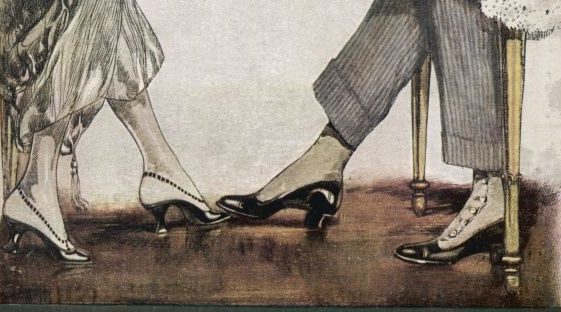
January 2, 1822: Good Robots Don’t Presseth and Treadeth on the Feet of Maidens
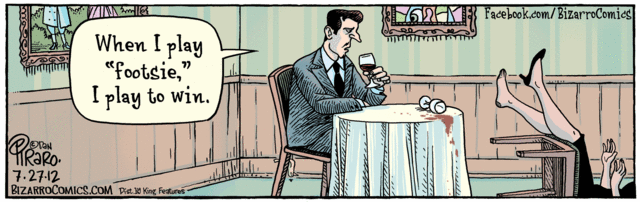
On this day, the Times of London described an unusual new method of courtship: “When a young man hath the felicity to be invited of the same party with the maiden who hath won his affections, then doth he endeavour to sit opposite her at the table, where he giveth himself up not to those unseemly oglings and gazing . . . but putting forth his foot, he presseth and treadeth on the feet and toes of the maiden; whereupon if she do not roar forth, it is a sign that his addresses are well received, and the two come in due course before the minister. This form of attack is known by the name of Footie, and the degree of pressure doth denote the warmth of the passion.”
An Italian court ruled in 2000 that footsie is not sexual harassment.
On the ninth day of Christmas True Love sent a gift of nine ladies dancing. Unfortunately, they were doing the bunny hop. And they even brought their own bunnies. This ushered in a new feature of True Love’s gifts: noise, noise, noise. Unfortunately for Scrooge, the ninth ghost of Christmas had a rather mean sense of humor. He returned Scrooge to his wedding day on which his bride-to-be, the girl of his dreams, didn’t show because her grandmother had died, she had a hangnail, or she was grounded for her unseemly interest in football players.

 Wretched Richard's Almanac