

Admission was ten cents. The movie lasted about an hour. There were no cartoons or newsreels. The first theater to show an actual movie was the Electric Theater in Los Angeles on April 2, 1902. The Capture of the Biddle Brothers was an adventure melodrama based on actual events.
A few months earlier, condemned prisoners Jack and Ed Biddle escaped from a Pennsylvania jail using tools and weapons supplied to them by the 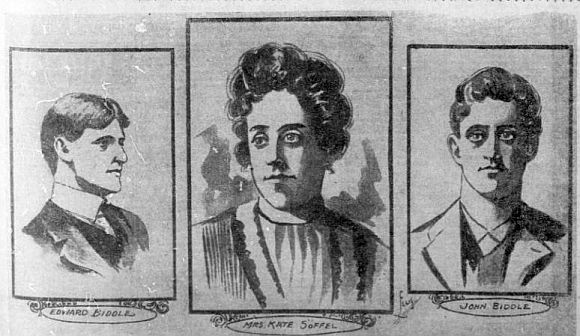 warden’s wife, Kate Soffel. “Our picture, which is a perfect reproduction of the capture, is realistic and exciting,” the producer exclaimed — breathlessly one might imagine. Two sheriff-filled sleighs pursue the Biddles and Soffel through the white and drifting snow. The dastardly trio turns to make a stand, shotguns and revolvers blazing. Ed Biddle is shot, falls to the ground in a snow bank. On one elbow, he continues to fire shot after shot until he collapses. The second Biddle continues to fire, and he too is shot. Mrs. Soffel seeing the hopelessness of their situation, if not the error of her ways, attempts to shoot herself. All three are captured. The brothers both die of their wounds. Mrs. Soffel survives, but a reconciliation with her warden husband is probably unlikely.
The movie itself did not survive, and the names of the actors are lost to history. Oddly enough a remake — well maybe not exactly a remake — was released in 1984. Mrs. Soffel starring Diane Keaton and Mel Gibson once again tells the tale of the terrible, terrible Biddle brothers. But not for a dime.
Hear Me Roar
The baseball season was just getting underway as 17-year-old Jackie Mitchell took the mound for the minor-league Chattanooga Lookouts in an exhibition game against the New York Yankees in Chattanooga, Tennessee, and on April 2, 1931, became one of the first and female pitchers in professional baseball history.

The game had gotten off to a rocky beginning for the Lookouts with their starting pitcher (male) giving up hits to the Yankees’ first two batters. The teenage Mitchell was brought in to face a couple of guys named Babe Ruth and Lou Gehrig. Mitchell’s first pitch to Ruth was a sinker that darted low for ball one. She followed with a sinker on the outside corner, which the Babe swung through and missed. Grinning, the “Sultan of Swat” swung at her next pitch and missed again for strike two. Another sinker on the corner of the plate, and Ruth watched it sail by for a strike three call. “The Babe kicked the dirt and gave his bat a wild heave as he stormed unhappily to the dugout.”
Gehrig came to bat and promptly missed three straight dipping sinkers, swinging early each time. On seven pitches, the Chattanooga teenager had struck out Ruth and Gehrig, two of the game’s greatest hitters. The hometown crowd rewarded her with a standing ovation. The next day, one newspaper cleverly suggested that “maybe her curves were too much for them.”
Unfortunately, Mitchell’s game against the Yankees was also her last. Just days after her legendary performance, (male) baseball commissioner Kenesaw Mountain Landis voided her contract because the sport of baseball was “too strenuous for women.” Although Jackie went on to tour with other prominent female athletes and play on women’s teams for a short time, Landis had pretty much wrecked her professional career, and she bowed out of sports at age 23.

 Wretched Richard's Almanac