

Paul the Oracle was somewhat of a child prodigy, demonstrating a marked intelligence right from the get-go. “There was something about the way he looked at our visitors,” said the adult in Paul’s early life. “It was so unusual, so we tried to find out what his special talents were.”
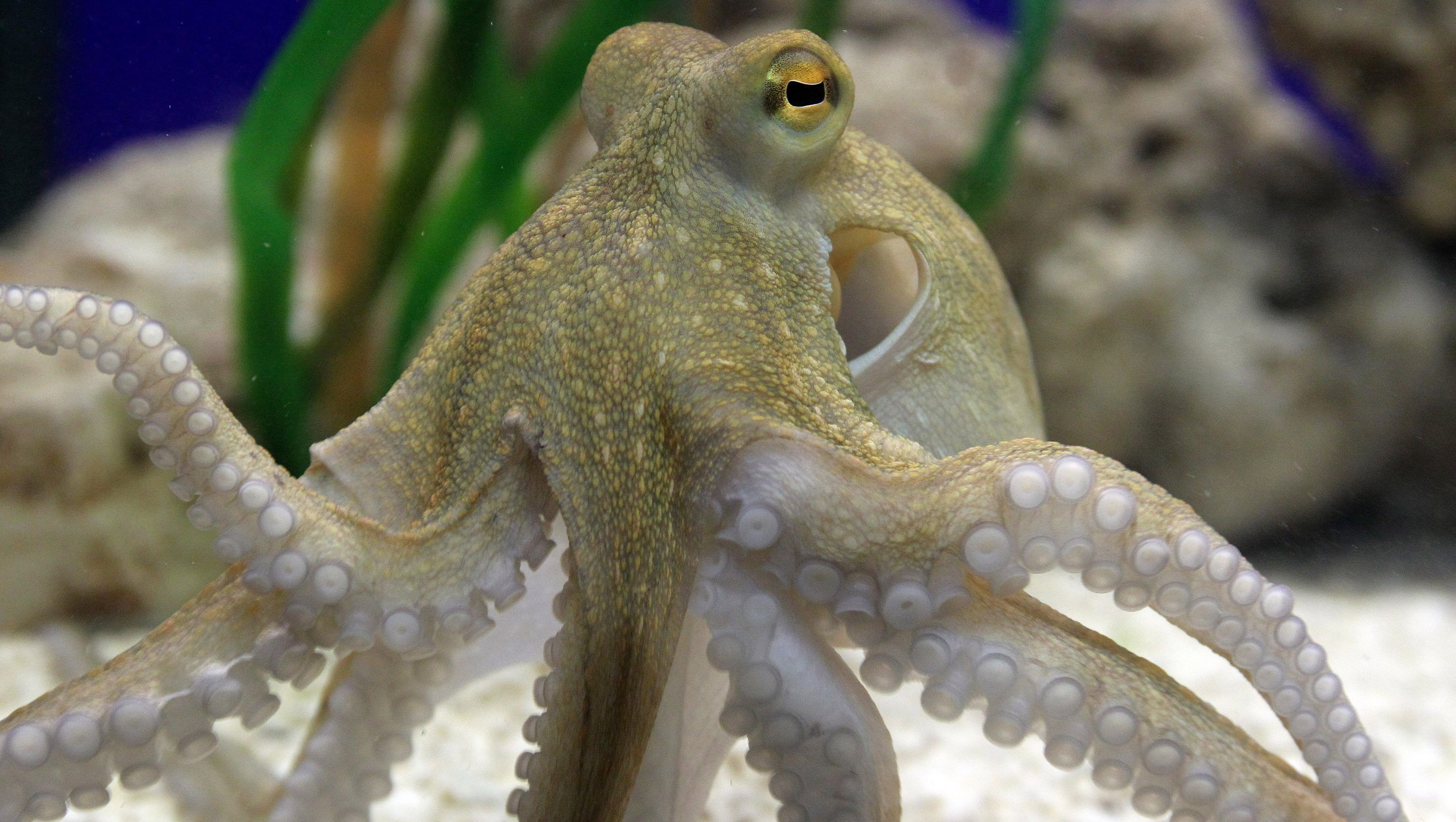 Paul was hatched from an egg at the Sea Life Centre in Weymouth, England, then moved to his permanent home, a tank at a center in Oberhausen, Germany. Paul took his name from a German children’s poem, Der Tintenfisch Paul Oktopus. He quickly became a celebrity by virtue of his divination of the outcome of international football matches, choosing the winners through a stratagem typical of German engineering in its complexity — picking boxes of oysters emblazoned with competing nations’ flags.
Octopuses are some of the most intelligent of invertebrates, with complex thought processes, memory, and different personalities (good octopus, bad octopus). They can use simple tools, learn through observation, and are particularly sensitive to pain. This according to PETA, the animal rights group. PETA argued that it was cruel to keep Paul in permanent confinement. Sea Life Centres contended that releasing him would be dangerous, because being born in captivity, he was only accustomed to sitting around a tank, popping oysters and using a remote, not fending for himself.
Paul’s accurate choices for the 2010 World Cup, broadcast live on German television, made him a star. Paul predicted the winners of each of seven matches that the German team played, against Australia, Serbia, Ghana, England, Argentina, Spain, and Uruguay. His prediction that Argentina would lose prompted Argentine chef Nicolas Bedorrou to post an octopus recipe on Facebook.
“There are always people who want to eat our octopus,” said Paul’s keeper. “He will survive.”
Paul’s correct prediction of the outcome of the semi-final, with Germany losing to Spain, led to death threats. Spain’s prime minister offered to give Paul safe haven in Spain.
Paul died on October 26, 2010, at the age of two-and-a-half, a normal lifespan for an octopus. German attempts to find other oracles have never fared well. The animals at the Chemnitz Zoo were wrong on all their predictions. Leon the porcupine incorrectly picked Australia, Petty the pygmy hippopotamus failed to be swayed by Serbia’s pile of hay topped with apples , and Anton the tamarin mistakenly ate a raisin representing Ghana.

The E-ri-e Was Arisin’
Back at the beginning of the 19th century, shipping goods from one end of New York to the other was a costly and cumbersome. There was no railroad, no trucking, no Thruway — just a two-week ordeal by stagecoach to get from New York City to Buffalo. The New York State Legislature leaped into this transportation breach. They proposed and Governor DeWitt Clinton enthusiastically endorsed a proposal to build a canal from Buffalo, at the eastern point of Lake Erie, to Albany, and the Hudson River. By 1817, they had authorized $7 million for the construction of what would laughingly be referred to as Clinton’s Ditch, 363 miles long, 40 feet wide, and four feet deep.
Work began in August 1823. Teams of oxen plowed the ground, and Irish workers did the digging, using only basic hand tools. It was a lot of work for $10 a month, but officials cleverly left barrels of whiskey alsong the route as an added inducement.
Governor Clinton opened the 425-mile Erie Canal on October 26, 1825, sailing from Buffalo in the Seneca Chief. News of his departure was relayed to New York City by cannons placed along the entire length of the canal and river, each within hearing distance of the next cannon. The firing of each signaled the next to fire. It took 81 minutes to get the word to New York— the fastest communication the world had yet known. Clinton arrived in New York on September 4, where he ceremoniously emptied a barrel of Lake Erie water into the Atlantic Ocean — the “Marriage of the Waters” of the Great Lakes and the Atlantic.
The canal put New York on the map as the Empire State, transformed New York City into the nation’s principal seaport, and opened the interior of North America to settlement. It has been in continuous operation longer than any other constructed transportation system on the North American continent.

 Wretched Richard's Almanac