

Reporters Leo Kieran of the New York Times and Herbert Ekins of the World-Telegram were out to demonstrate that air travel was shrinking the world and that it was pretty much in the reach of most people. They would do this by means of a race around the globe using 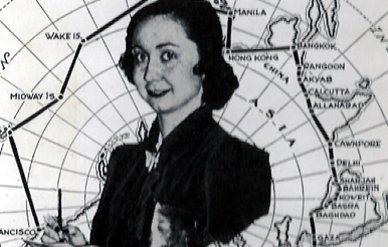 commercial transportation available to anyone with the price of a ticket. When the race started on the evening of September 30, 1936, they had been joined by a last-minute participant from the Evening Journal — a 23-year-old rookie crime reporter named Dorothy Kilgallen.
A fierce rainstorm kept the three contestants out of the air for the first leg of the race — a short hop to Lakehurst, New Jersey, to catch the airship Hindenburg. Kilgallen almost missed the flight, but the crew delayed departure until she boarded.
Ekins quickly proved to be the savviest traveler as well as the most competitive. Arriving late in Frankfurt, Germany, he quickly boarded a KLM DC-2, a plane that had finished second in an air race from London to Melbourne. Kilgallen and Kieran, on the other hand, headed to Brindisi, Italy, by train to catch a flight from there to Hong Kong on a British carrier, Imperial Airways. The train was excruciatingly slow, and the flight was delayed for seven hours because of wind.
When the two reporters arrived at a stopover in Bangkok, Siam, Kilgallen opted to hire a single-engine plane whose pilot lost his way in Indochina and made a frightening landing in the middle of a field before finding his way to Hong Kong.
Waiting to board a steamship headed from Hong Kong to Manila and the Pan Am China Clipper for the flight back to the States, Kieran and Kilgallen learned that Ekins had come and gone. He had talked his way onto a Pan Am trial flight as a crew member. Although taking the no-passenger flight was cheating, Ekins was pronounced the winner, having completed his journey on October 19.
With just the tiniest bit of grousing, the two defeated reporters acknowledged his victory in a cable from Manila while waiting for a typhoon to pass. They completed the journey in 24 days. In some ways, Kilgallen was the real winner, despite her second-place finish. Her accounts of the journey, cabled back to the Evening Journal each day, filled with descriptions of exotic lands, jungles full of dangerous beasts and shark-infested waters, made her a celebrity. It also launched her successful career which ended abruptly in 1965 with her mysterious death (a story for another day).
Bad Bad John
England’s King John, who has no number because he was the only royal John, reigned from 1199 until his death on October 19, 1216. Most historian’s agree he was a so-so monarch who had his share of disagreeable traits — belligerence, pettiness, narcissism, cruelty and strange orange hair.
Perhaps John suffered by comparison to his brother Richard I (although he was not I until Richard II came along a century or two later). Mom (Eleanor of Aquitane) always liked Richard best. Richard was tall and lionhearted; John was short and weasely.
Historians began picking on John almost immediately. And then the writers chimed in. Shakespeare gave him a bad rep, Sir Walter Scott goosed it along in Ivanhoe, and Howard Pyle really skewered him in The Merry Adventures of Robin Hood, portraying him as the unmerriest of villains who, along with his loathsome pal the Sheriff of Nottingham, doubled down on atrocity. Even A. A. Milne mostly known for warmth and fuzziness got his licks in with the poem King John’s Christmas:
King John was not a good man—
He had his little ways. And sometimes no one spoke to him
For days and days and days.
And men who came across him,
When walking in the town,
Gave him a supercilious stare,
Or passed with noses in the air—
And bad King John stood dumbly there,
Blushing beneath his crown.

 Wretched Richard's Almanac