
There’s a certain something that makes the scientific mind differ from the ordinary mind.
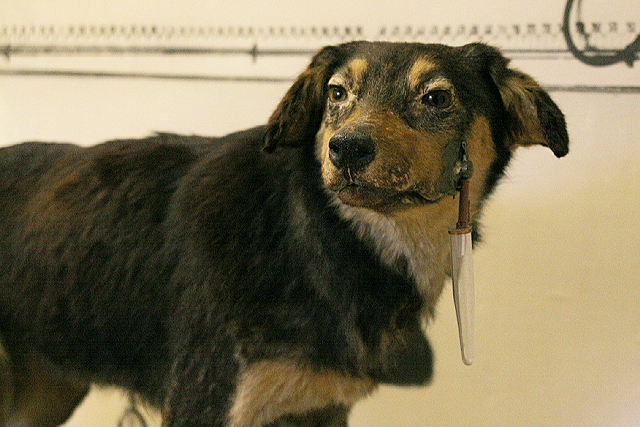
An example: We are in the habit of walking into our dog’s room (it’s a hypothetical room, okay?) at cocktail time and feeding Rover (because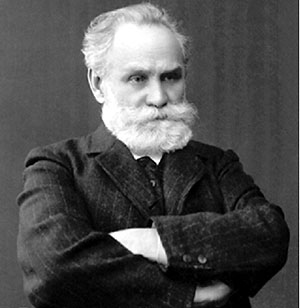 he looks like a Rover, okay?) (and he’s hypothetical too). This makes Rover quite happy. One day we walk in, drinking our cocktail but forgetting Rover’s food. No, he doesn’t bite us (an angry look, maybe). But he salivates even though there’s no food. What do we do? We beat Rover, clean up his drool, drink our cocktail, and get on with our lives.
But a scientist? He’d stare at that saliva, ponder it, apply a little scientific method and possibly come up with a bunch of new scientific ideas. Ivan Pavlov, born on September 26, 1849, did just that. He saw his Rover drool, and he developed a major branch of learning called classical (or Pavlovian) conditioning with theories and laws and all sorts of scientific accoutrements. This in turn led to concepts such as comparative psychology, behavior modification and Brave New World.
Ever the scientist, even on his death bed, Pavlov engaged a student to sit with him and take notes as he died. He did not salivate. We don’t know if the student did.
I’ll be with you in apple blossom time
The animated 1948 film Melody Time, from Walt Disney Studios features a 19-minute segment with Dennis Day as an apple farmer who sees others going west, wishing he was not tied down by his  orchard, until an angel appears, singing a happy apple song, setting him on a mission. When he treats a skunk kindly, all animals everywhere thereafter trust him. The cartoon features lively tunes, and a simplistic message of goodness, and probably helped to cement the image of Johnny Appleseed firmly in American lore.
John Chapman, the flesh and blood Johnny Appleseed, was born in Massachusetts on September 26, 1774. At the age of 18, he persuaded his 11-year-old half-brother Nathaniel to go west with him to live the lives of carefree nomadic wanderers – rolling stones gathering no moss. Eventually Nathaniel grew up and quit the rambling around to gather moss and help his father farm. Johnny didn’t.
Johnny embarked on a career as an orchardist, apprenticing to a man who had apple orchards. Eventually, he returned to roaming, and the popular accounts have him spreading apple seeds randomly, everywhere he went. He actually planted nurseries, built fences around them, left the nurseries in the care of a neighbor who sold trees on shares, and returned every year or two to tend the nursery.
And Johnny Appleseed was against grafting. Therefore his apples were of a sour variety and used primarily for hard cider and apple jack. “What Johnny Appleseed was doing and the reason he was welcome in every cabin in Ohio and Indiana was he was bringing the gift of alcohol to the frontier. He was our American Dionysus.”
Johnny also spread the Swedenborgian word of God, preaching as he traveled. The Swedenborgian movement was a popular new religion of the time promoting repentance, reformation, and regeneration of one’s life. Johnny would tell stories to children and lay the gospel on adults, receiving a floor to sleep on and supper in return. Said one of his converts: “We can hear him read now, just as he did that summer day, when we were busy quilting upstairs, and he lay near the door, his voice rising denunciatory and thrillin’—strong and loud as the roar of wind and waves, then soft and soothing as the balmy airs that quivered the morning-glory leaves about his gray beard.”
And a wee bit of apple jack didn’t hurt either.

 Wretched Richard's Almanac