

In 1287, Kublai Khan, on a bit of a tear through Asia, defeated the forces led by princes of Mongolia and Manchuria. Kublai was a grandson of 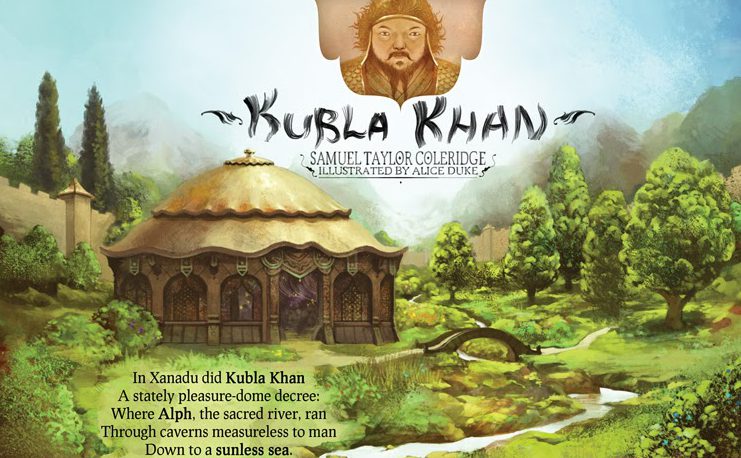 Genghis, another Khan known for being rather hard to get along with. Like his grandfather, Kublai was a holy terror right from infancy when he frequently seized power from fellow toddlers. Eventually, Kublai pushed the Mongol Empire to new heights, creating a unified, militarily powerful China and gaining international attention in the process.
Marco Polo, in the accounts of his travels, made Kublai well-known to western audiences, and Samuel Taylor Coleridge added a romantic aura in the early 19th century with his description of Kublai (Kubla to Coleridge) Khan’s summer cottage at Xanadu:
In Xanadu did Kubla Khan
A stately pleasure-dome decree:
Where Alph, the sacred river, ran
Through caverns measureless to man
Down to a sunless sea.
When the sacred river Alph plunged into that sunless sea it naturally created a great waterfall. In the rush of this waterfall, the voices of Kubla’s ancestors could be heard — that strident, discordant one being Genghis.
Face down in a cranberry bog, part 3: somebody stole my corpse
“A person ought to remain at the scene of the crime,” said the chief of police, taking me to task when he should have been commending my citizenship, as we drove back toward the bog.
 “What crime?” I complained. “I’m sure it’s just an accident. And even if I had stayed at the scene of the accident, how could I report it? I don’t have a cell phone. It might be weeks before anyone came by. I’d eventually starve. I couldn’t even eat cranberries because the sign said not to. And I’m too law-abiding to disobey a sign let alone do something criminal to a person, if someone did indeed do something criminal, which I don’t think anyone did, but I have no way of knowing.”
“You’re acting mighty guilty.” I thought I was behaving quite calmly. Upon hearing the word guilty, however, any veneer of calm was violently stripped away. And then I remembered with a jolt of nausea that the recently departed wore only red boxer shorts.
“I always act guilty,” I said, squirming to confirm my words. “Even as a kid. If someone put a baseball through a window, the owner of the house would look at me and figure I did it – just because I looked guilty. People who act guilty are almost always innocent; did you know that?”
“No, I didn’t,” said the chief, looking skeptical. “Here we are.” He stopped the car and we got out. “Now exactly where is this body?”
“Over there. On the other side of that bog.”
We approached and began to circle the bog. We circled it once, and we circled it again. We saw nothing but cranberries. “Are you sure you got the right bog?” the chief asked, giving me that look.
“Yes, I’m sure,” I said. We circled three more bogs, and a deputy who joined us began to circle the rest.
The chief of police leaned back against his car, reached into his pocket and pulled out a pen and a small tablet. “This wouldn’t be a joke, would it? If it was, it wouldn’t be very funny; I can tell you that.”
“Of course not. Do I look like a joker?” I wished I hadn’t said that.
“Had anything to drink today?” He scratched at the tablet as he spoke.
“It’s ten a.m.”
“Had anything to drink this morning?”
“Tomato juice and coffee, that’s it.”
“Do you take medication or any other kinds of drugs?”
“No, I don’t, and I resent that implication.”
“I resent spending my time searching cranberry bogs for bodies that don’t exist.” He looked at me as though he wanted nothing more out of life than to throw me into a jail cell. “You say you’re not joking, you’re not drunk or spaced out. Tell me what you think.”
“It’s obvious,” I said. “Somebody stole the corpse. Otherwise, it would be there.”
“Not that obvious to me. What’s obvious to me is that I’m going to be watching you. Now describe this alleged body to me.”
“It looked dead.”
“Nice start. Would you care to elaborate?”
“Male Caucasian.”
“Now you’re getting it. Go on.”
“Hair gray. Face sort of blue. Mustache.”
“You think this whole thing is some kind of big joke, don’t you?”
“Not at all,” I answered. “I take dead bodies quite seriously. I’m doing my best to help.”
“Okay, mustache. Gray like his hair?”
“Hmmm.” I tried to visualize the mustache but couldn’t. “I don’t know. I think it was dark. But maybe it just looked darker because it was wet. I’m just not sure. In real life, people don’t really remember all the little details. Anyone who knows all the details probably memorizes them. And maybe because that person is guilty – even though he doesn’t look it.”
“Or she.”
“What?”
“Never assume the guilty party is a man. Women kill too. Now can we dispense with the criminology and get on with it?” He continued to write in his little tablet. I wished I could have seen what he was writing; I’ll bet it wasn’t flattering.
“Okay,” I said. “The mustache was three shades darker than the hair. His forehead had six, no seven, wrinkles.”
“Okay, I’ve got enough,” he said, flipping the notebook shut and giving me a nasty look. “If we come up with a body, we’ll get back to you.”
“Don’t call us, we’ll call you?”
“Something like that.”
I watched as he and his trusty deputy returned to their respective police vehicles and pulled away, leaving me alone, angry and confused. Someone had stolen my corpse.
continued

 Wretched Richard's Almanac
the best title I’ve seen in a long time
Thank you, and Kubla(i) thanks you.